
An evidence-based ranking of software testing services companies in Texas, compiled from Clutch, G2, GoodFirms, and official company data. All scores reflect publicly verifiable information as of Q1 2026.
Market overview
Texas has become one of the fastest-growing technology markets in the United States — and the landscape of software testing services companies in Texas reflects that growth. With strong activity across Austin, Dallas, Houston, and emerging regional hubs, companies are scaling digital products across SaaS, fintech, healthcare, and logistics, driving a significant increase in demand for reliable software quality.
However, the QA services landscape in Texas is structurally uneven.
While the state hosts a mix of local testing firms and global providers, the landscape of QA services companies in Texas is not limited to Texas-based delivery. Instead, the market operates as a hybrid ecosystem, where local vendors coexist with globally distributed QA specialists serving US clients remotely.
This creates a key challenge for buyers evaluating software and QA testing services companies in Texas: most vendors can execute testing tasks, but far fewer can establish scalable QA processes, integrate into engineering teams, and deliver measurable improvements in release quality.
What this ranking is based on
This report evaluates software testing services companies in Texas using verifiable, evidence-based criteria, including:
client feedback from Clutch (primary source)
additional validation from G2 (where available)
service depth, tooling, and case studies from official company sources
The focus is not on brand recognition or company size, but on proven delivery capability:
ability to scale QA operations
maturity of automation and testing processes
measurable outcomes such as reduced regression time, cost efficiency, and improved release reliability
How to read this ranking
Not all QA vendors are built the same.
Some companies in this list specialize in deep QA execution and automation, others focus on enterprise-scale quality engineering, while a smaller group combines strong client validation with measurable delivery outcomes.
The ranking of software testing services companies in Texas reflects how well each company performs across these dimensions, not just what they claim, but what they can demonstrate through real client evidence.
Top 10 software testing services companies in Texas
1. DeviQA
Founded: 2010
Employees: 250–999
Avg. hourly rate: $25–$49 / hr
Min. project size: $5,000+
Company website: https://www.deviqa.com/
DeviQA stands out as a pure-play QA provider with a strong combination of review validation and measurable delivery outcomes. On Clutch, the company holds a 5.0/5 rating based on 33 reviews, making it one of the most consistently reviewed and highly rated vendors in this ranking.
The most consistent signal across client feedback is seamless team integration. Multiple reviews emphasize that DeviQA operates less as an external vendor and more as an extension of the internal team. Clients note that the company “integrates smoothly into existing workflows” and collaborates closely with development teams, which reduces coordination overhead and improves delivery speed.
Another recurring theme is structured QA process improvement. Beyond executing test cases, DeviQA is frequently described as bringing clarity and discipline to QA operations. Feedback highlights a “structured approach to testing” and the ability to build scalable automation frameworks that improve both efficiency and reliability. This positions the company as a partner that contributes to QA maturity, not just execution capacity.
A third consistent pattern is strong communication and delivery reliability. Clutch reviews repeatedly describe the team as “communicative, professional, and responsive,” with work delivered on time and aligned with expectations. This level of consistency is particularly important in long-term engagements where predictability is critical.
Where DeviQA differentiates more clearly is in public, measurable proof of impact. Case studies and client feedback point to tangible outcomes such as:
regression testing reduced from 20 hours to 2 hours
80–90%+ test automation coverage
large-scale automation suites with thousands of test cases
significant reduction in manual QA effort and faster release cycles
These results indicate a consistent focus on automation-driven efficiency and QA scalability, rather than isolated testing tasks.
Compared to many competitors, DeviQA combines high review density with detailed case-study evidence, which strengthens the credibility of its positioning. The company’s service scope is also broad, covering functional, automation, performance, API, and end-to-end testing across multiple industries.
2. Cigniti
Founded: 1998
Employees: 1,000-5,000
Avg. hourly rate: $50-$99 / hr
Min. project size: $10,000+
Company website: https://www.cigniti.com/
Cigniti stands out primarily as a large-scale enterprise QA and digital assurance provider with direct Texas credibility. Unlike many global testing vendors that serve Texas remotely, Cigniti has an official presence in Irving, Texas, which materially strengthens its relevance for buyers in the state. Public company materials position it as an AI- and IP-led quality engineering provider with 4,200+ professionals and a broad end-to-end testing portfolio.
From a client-validation perspective, the publicly visible signal is more limited than for the top review-heavy vendors. On Clutch, Cigniti shows an overall 4.9/5 rating based on 6 reviews, with sub-scores of 4.8 for quality, 4.9 for schedule, 5.0 for cost, and 4.8 for willingness to refer. That suggests clients who do review the company are generally very satisfied, especially with delivery discipline and value. At the same time, the sample size is small, so the review story is credible but not as statistically strong as vendors with 20–30+ reviews.
The strongest interpretation of Cigniti’s market position is not “best-reviewed specialist,” but enterprise-scale quality engineering provider with strong delivery governance. Clutch’s public summary describes the company as specializing in independent quality engineering and testing services and says clients were impressed by its “technical capabilities” and “adherence to project timelines.” Those are important signals because they point less to boutique flexibility and more to execution maturity in larger programs.
Where Cigniti becomes more compelling is in the breadth of its QA model. Official service pages show coverage across test automation, agile testing, DevOps testing, security testing, mobile testing, and broader quality engineering services. The company also emphasizes a Testing Center of Excellence model and enterprise-grade testing labs, which supports the idea that it is strongest in structured, large-scale engagements rather than narrow task-based QA execution.
Its proof of expertise is also reinforced by productized QA assets. Public pages describe iNSta as an AI-powered, scriptless, self-healing automation platform designed to generate reusable test scripts and scale automation faster. That does not replace client reviews, but it does strengthen the case that Cigniti operates with a more mature IP-led model than many service-only QA firms.
The main limitation is transparency of public review sentiment outside Clutch. On G2, Cigniti’s seller page shows 0 verified reviews, so there is no meaningful G2-based buyer sentiment to analyze. Because of that, any profile of Cigniti should stay careful: the company has clear Texas presence, broad service maturity, and strong enterprise positioning, but the publicly visible third-party review layer is still thinner than that of the strongest review-backed competitors.
3. QASource
Founded: 2010
Employees: 250–999
Avg. hourly rate: $25–$49 / hr
Min. project size: $5,000+
Company website: https://www.qasource.com/
QASource positions itself as a long-standing outsourced QA provider with a hybrid delivery model, and that model clearly shows up in client feedback. On Clutch, the company holds a 4.8/5 rating based on 17 reviews, with consistent themes around communication, flexibility, and the ability to scale QA teams without compromising quality.
The most repeated signal across reviews is operational reliability combined with flexibility. Clients frequently mention that QASource adapts quickly to changing requirements and integrates into existing workflows without friction. One reviewer noted that the team was “very flexible and responsive to our needs,” while another emphasized their ability to “quickly ramp up resources and deliver on time.” This positions QASource as a vendor that is particularly strong in ongoing, evolving QA engagements rather than one-off projects.
Another key pattern is strong day-to-day execution. Clutch reviews consistently highlight timely delivery, clear communication, and dependable output quality. Clients describe the team as “communicative and easy to work with” and note that deliverables are completed “on time with high quality.” These are not standout differentiators on their own, but the consistency across reviews suggests a stable and predictable delivery model — which is critical for long-term QA partnerships.
Where QASource differentiates more clearly is in its hybrid onsite–offshore model with US-based management. According to both Clutch and the company’s positioning, QA engineers work offshore while project management and communication are handled from the US. This structure is reflected in reviews that mention smooth collaboration and minimal communication overhead despite distributed teams. It effectively balances cost efficiency with accessibility, which is a recurring reason clients choose the company.
From a capability perspective, QASource offers a broad QA services portfolio, including manual testing, automation, performance testing, API testing, and mobile QA. However, compared to the very top vendors, public case studies with detailed, quantified outcomes are less visible. The strength here is less about standout transformation metrics and more about consistent execution at scale over time.
G2 adds a supporting but lighter signal. The company has a small number of reviews (around a dozen), with feedback pointing to a customized approach, strong QA expertise, and effective collaboration. However, the dataset is too limited to materially change the overall assessment.
4. QualityLogic
Founded: 1986
Employees: 50–249
Avg. hourly rate: $25–$49 / hr
Min. project size: $5,000+
Company website: https://www.qualitylogic.com/
QualityLogic stands out as a QA provider that goes beyond test execution and focuses on building structured, reliable quality processes. On Clutch, the company holds a 4.9/5 rating based on 30 reviews, with highly consistent feedback across communication, quality of work, flexibility, and attention to detail.
One of the strongest patterns in client feedback is process maturity and structured delivery. Clients frequently highlight that QualityLogic does not simply execute test cases but approaches QA systematically. Reviews describe the team as “detail-oriented” and emphasize their strong understanding of quality processes. This positions QualityLogic as a partner that improves how QA is done, not just how much testing is delivered.
Another recurring theme is clear communication and dependable project management. Clutch feedback consistently describes the team as “communicative and responsive,” with deliverables completed on time and expectations managed transparently. This level of operational consistency is particularly valuable in long-term QA engagements where predictability matters more than short-term speed.
Where QualityLogic differentiates further is in its ability to handle complex and specialized QA domains. The company demonstrates strong expertise in areas such as:
accessibility testing (WCAG compliance)
smart energy systems
media and streaming platforms
This is reinforced by case-based evidence where QualityLogic:
optimizes large regression suites (thousands of test cases)
helps organizations transition to CI/CD-driven QA models
builds internal QA capabilities (e.g., accessibility centers of excellence)
One notable example includes using an AI-driven approach to analyze 5,000 regression test cases, reducing redundancy while maintaining full coverage. Another case shows a multi-year QA transformation where a client moved from ad hoc testing to a fully structured, modern QA infrastructure.
5. TestingXperts
Founded: 2014
Employees: 1,000-5,000
Avg. hourly rate: $50-$99 / hr
Min. project size: $5,000+
Company website: https://www.testingxperts.com/software-testing-services/
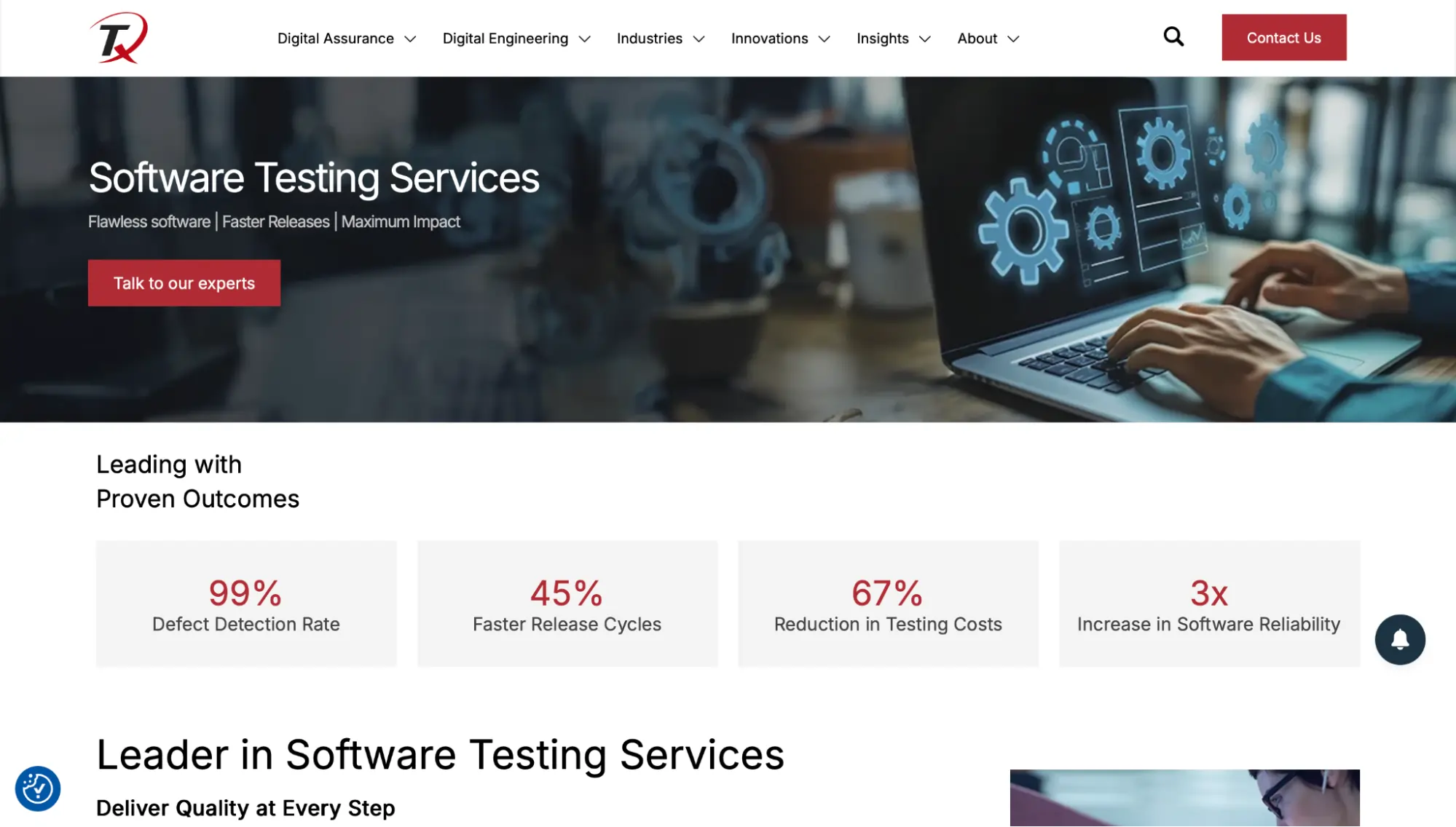
TestingXperts positions itself as a large-scale quality engineering provider, and that positioning is clearly reflected in how its value is communicated, through quantified outcomes rather than review density.
Compared to vendors like QualityLogic or QASource, publicly available client reviews are less prominent. However, the company compensates for this with a strong portfolio of case studies that consistently highlight measurable business impact, especially around cost reduction, speed, and QA efficiency.
The most consistent pattern across TestingXperts’ public proof is operational optimization at scale. Case studies repeatedly show:
40%–55% QA cost reduction
50% faster time-to-market
90%+ reduction in regression testing time
Significant decreases in defect leakage and manual testing effort
For example, in one insurance-sector case, TestingXperts helped reduce QA costs by over 40% while accelerating release cycles by 50%. In another engagement with an energy logistics company, the team achieved 55% cost savings across 32 applications, while maintaining zero post-production defects. These are not isolated claims — they reflect a consistent pattern of efficiency-driven QA transformation.
Another key differentiator is enterprise-grade delivery structure. TestingXperts emphasizes:
QA advisory and transformation services
DevOps and Agile testing integration
automation-first strategies supported by proprietary accelerators
The company also highlights its Texas presence, including a dedicated office and inclusion in Texas government vendor listings (DIR), which strengthens its credibility for organizations that require local or US-based engagement models.
From a capability perspective, TestingXperts offers a broad portfolio, including:
functional and non-functional testing
automation and performance engineering
AI/ML, IoT, and RPA testing
DevOps and continuous testing
This breadth supports the idea that TestingXperts is not a niche QA vendor, but a full-scale quality engineering partner designed for complex environments.
6. a1qa
Founded: 2002
Employees: 250–999
Avg. hourly rate: $25–$49 / hr
Min. project size: $10,000+
Company website: https://www.a1qa.com/
a1qa stands out as a QA-first company with a strong focus on process optimization and automation-driven efficiency. On Clutch, it holds a 4.9/5 rating based on 19 reviews, with consistent feedback around communication, organization, and technical expertise.
The most visible pattern in client feedback is process discipline and structured delivery. Clients frequently describe a1qa as “well-organized” and “methodical,” highlighting the company’s ability to bring clarity and structure into QA workflows. This is especially important in environments where testing is fragmented or poorly defined — a1qa tends to standardize and formalize QA practices rather than simply execute tasks.
Another recurring theme is proactive collaboration. Reviews emphasize that the team does not wait for instructions but actively suggests improvements and identifies risks early. Clients note that a1qa is “proactive in communication” and contributes ideas that improve both testing efficiency and product quality. This positions the company as a partner rather than a task-based vendor.
Where a1qa becomes particularly strong is in automation and DevOps-aligned QA transformation. Public case studies consistently show significant improvements in speed and efficiency:
testing time reduced from 40 hours to 2 hours
environment setup reduced from 36 hours to 30 minutes
release cycles accelerated significantly through automation
In another case, a1qa helped streamline regression testing for a B2B platform, reducing manual effort and enabling faster, more predictable releases through a combination of automation frameworks and process optimization.
The company also reinforces its credibility through scale: it reports 1,500+ completed projects and 800+ clients across 39 countries, which supports the idea of a mature and repeatable QA delivery model.
From a service perspective, a1qa offers a full spectrum of QA services, including:
functional testing
test automation
mobile and web testing
DevOps and continuous testing
industry-specific QA solutions
7. ImpactQA
Founded: 2011
Employees: 50–249
Avg. hourly rate: $25–$49 / hr
Min. project size: $10,000+
Company website: https://www.impactqa.com/
ImpactQA positions itself as a full-cycle QA provider with a strong local footprint in Texas, headquartered in Plano. That alone makes it more directly relevant for Texas-based buyers compared to many global QA vendors operating remotely.
On Clutch, ImpactQA holds a 4.6/5 rating based on 6 reviews. While the sample size is relatively small, the feedback is consistently positive, with recurring themes around efficiency, professionalism, and collaboration.
The most visible pattern in client feedback is execution efficiency. Clients highlight that ImpactQA delivers work quickly and effectively, with minimal friction. Reviews describe the team as “efficient and professional,” capable of handling QA tasks reliably without requiring heavy oversight. This positions the company as a practical, execution-focused partner rather than a strategy-heavy QA consultant.
Another recurring theme is breadth of capabilities. Clients note that ImpactQA demonstrates “proficiency across various QA and testing services,” which aligns with the company’s broad service portfolio:
functional testing
automation testing
performance testing
accessibility testing
security and SAP testing
This breadth makes the company flexible, especially for organizations that need multiple QA services under one vendor.
Where ImpactQA strengthens its position is through case-study-driven results, particularly around cost efficiency. Public examples show:
up to 70% reduction in QA costs
significant reduction in manual testing effort
improved user experience and compliance (e.g., WCAG in accessibility projects)
For example, in an IoT-based wellness platform case, ImpactQA reduced QA costs by 70% while ensuring full end-to-end validation. In another project, the company improved accessibility compliance while reducing manual workload — showing its ability to balance efficiency with quality requirements.
However, compared to top-ranked vendors, the difference is clear: ImpactQA is stronger on execution and cost efficiency than on public proof density or large-scale QA transformation narratives.
8. TestFort
Founded: 2011 Employees: 50–249 Avg. hourly rate: $25–$49 / hr Min. project size: $10,000+
Company website: https://testfort.com/
TestFort stands out as a highly review-validated QA provider, with a strong focus on execution quality and attention to detail. On Clutch, the company holds a 4.9/5 rating based on 17 reviews, with consistently positive feedback across communication, flexibility, and technical capability.
The most consistent signal across reviews is quality of execution. Clients frequently highlight TestFort’s ability to identify issues that internal teams miss and to deliver thorough, well-structured testing. Feedback often emphasizes the team’s “attention to detail” and strong analytical thinking, which positions TestFort as a vendor that improves product quality at a granular level.
Another recurring theme is adaptability and responsiveness. Clients note that the team is “flexible and quick to adjust” to changing requirements, which is particularly valuable in fast-moving product environments. This suggests a delivery model that can keep pace with evolving development cycles rather than rigidly following predefined scopes.
Communication is also a strong point. Clutch feedback repeatedly describes the team as “communicative and easy to work with,” with clear reporting and transparent workflows. This contributes to smooth collaboration, especially in distributed setups where alignment can often become a bottleneck.
Where TestFort differentiates further is in its growing focus on modern testing domains, including AI-related testing. Public case studies highlight outcomes such as:
70% reduction in production defects in AI-driven systems
60% reduction in hallucinations in AI-based applications
improved model accuracy and user satisfaction
These cases indicate that TestFort is not limited to traditional QA but is actively expanding into more complex, emerging testing areas.
At the same time, compared to higher-ranked vendors, TestFort’s positioning is more centered on execution excellence than on large-scale QA transformation or enterprise-level process ownership.
9. Qualitest
Founded: 1997
Employees: 1,000–9,999
Avg. hourly rate: Undisclosed
Min. project size: Undisclosed
Company website: https://www.qualitestgroup.com/
Qualitest stands out primarily for its global scale and enterprise-grade delivery model, rather than review-driven validation. It is one of the largest quality engineering providers in the market, with 8,000+ engineers across multiple regions, and a clearly established presence in Texas, including expansion in Austin and long-term work with companies like Texas Instruments.
Unlike vendors such as TestFort or a1qa, where client feedback is a primary signal, Qualitest’s positioning is built more on enterprise engagements and operational scale. The available Clutch data shows no meaningful review base in the retrieved profile, which makes third-party validation limited compared to most companies in this ranking.
However, the company compensates for this with strong case-study-driven evidence and a broad service offering. Public materials show consistent outcomes across enterprise engagements, including:
40% cost efficiency improvements through managed testing services
significant reduction in defect leakage (in some cases close to 60%)
zero-defect go-live scenarios in large migration projects
For example, in a Salesforce migration case for a major energy provider, Qualitest helped reduce system integration testing cycles and enabled a zero-defect production release. In another engagement with a financial services organization, the company delivered substantial cost savings through managed QA services, demonstrating its strength in long-term, large-scale engagements.
From a capability perspective, Qualitest offers one of the broadest QA portfolios in the market, including:
managed testing services
test automation and performance engineering
AI-led quality engineering
crowd testing and UX validation
domain-specific QA across industries such as finance, telecom, healthcare, and gaming
This breadth reinforces its positioning as a full-scale quality engineering partner, particularly suited for complex enterprise ecosystems.
10. QA Mentor
Founded: 2010
Employees: 250-999
Avg. hourly rate: <$25/ hr
Min. project size: $1,000+
Company website: https://www.qamentor.com/
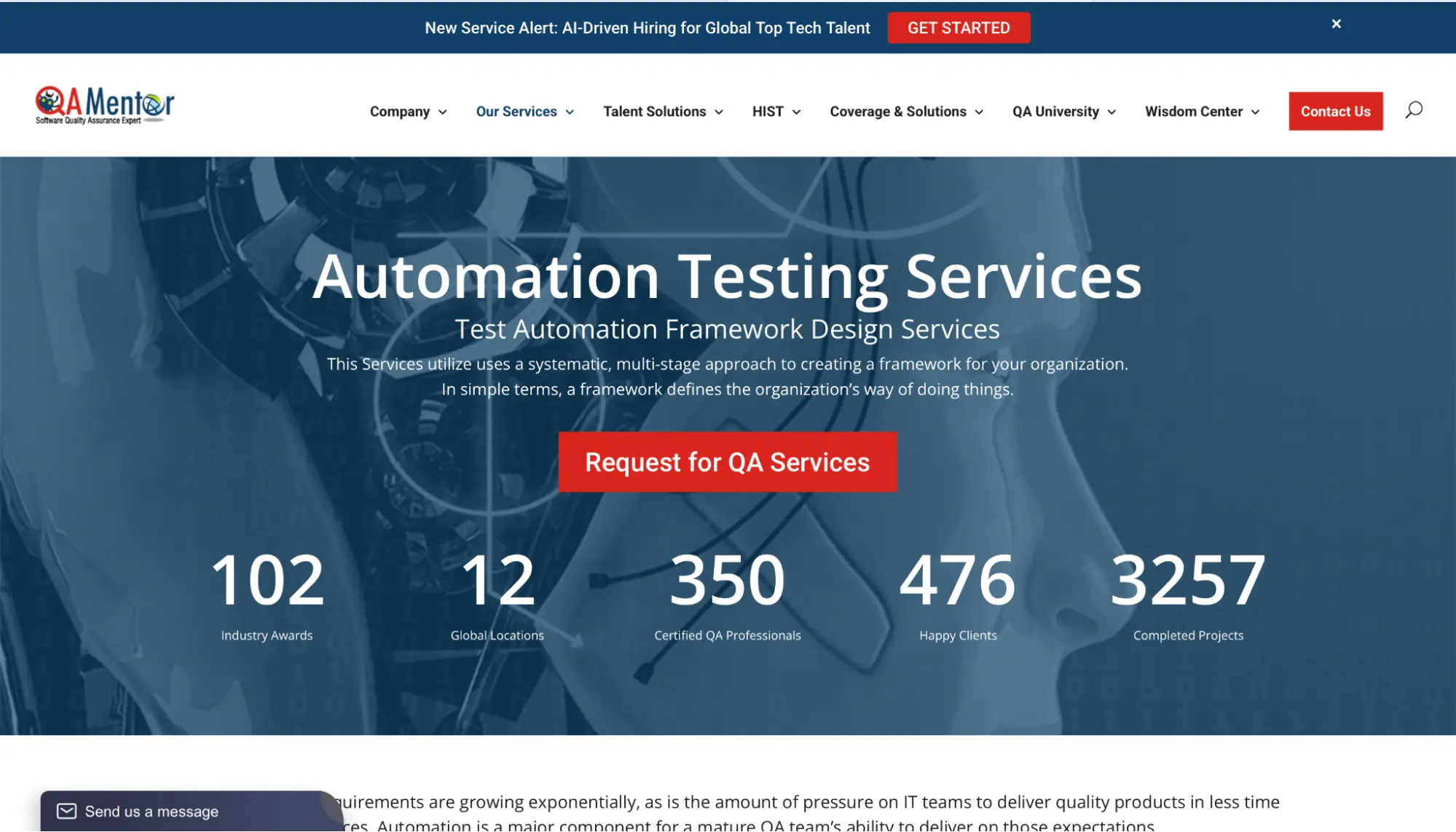
QA Mentor positions itself as a highly diversified QA provider, offering one of the widest ranges of testing services in the market, over 30+ QA service types. On Clutch, the company holds a 4.9/5 rating based on 7 reviews, indicating strong satisfaction among clients, but with a relatively small sample size.
The most consistent signal in available feedback is breadth and flexibility. QA Mentor is often described as a company that can cover many different QA needs under one umbrella — from basic functional testing to more structured services like regression strategy, environment management, and test coverage analysis. This makes it particularly appealing for companies that prefer a single vendor for multiple QA functions.
Another notable theme is process orientation supported by certifications. QA Mentor highlights multiple industry certifications, including:
ISO 27001 (information security)
ISO 9001 (quality management)
ISO 20000-1 (IT service management)
CMMI Level 3
While these are not direct indicators of delivery quality, they reinforce the company’s positioning as a process-driven QA provider with standardized methodologies.
From a delivery perspective, QA Mentor emphasizes global availability and cost flexibility, with support across multiple time zones and relatively low entry pricing compared to many competitors. This aligns with Clutch data, which shows a lower minimum project size and hourly rate, making the company more accessible for smaller engagements.
However, the key limitation becomes clear when comparing QA Mentor to other vendors in the ranking: limited public proof of impact. Unlike higher-ranked companies, there are fewer publicly available case studies with measurable outcomes, and the review base is smaller. As a result, the company’s positioning relies more on service breadth and certifications than on demonstrated large-scale QA transformation or quantified results.
Methodology
This ranking is based on a structured evaluation of software testing providers using publicly verifiable data from Clutch, G2, and official company sources. Each company was assessed across four core dimensions that reflect real delivery capability, not marketing positioning.
Scoring model
How the ranking was determined
Each company among software testing services companies in Texas received a composite score from 0 to 100, calculated using the weighted model above.
In practice, higher-ranked companies consistently demonstrated:
strong and recent client validation (especially on Clutch)
clear, measurable QA outcomes (not generic claims)
structured QA processes and automation maturity
the ability to operate effectively in US-based delivery environments
Companies among QA services companies in Texas with weaker public proof (e.g., limited reviews or lack of case-study metrics) scored lower, even if their service breadth or scale was significant.
Data sources used
Important notes
Only publicly verifiable data was used
Missing data points are marked as “Not found”
Preference was given to 2024–2026 evidence
This is not a sponsored ranking and reflects an evidence-based evaluation
Conclusion
The Texas software testing market in 2026 is not defined by a lack of providers, it is defined by a gap in delivery maturity.
Across Austin, Dallas, Houston, and beyond, buyers evaluating software testing services companies in Texas have access to a wide range of QA vendors. However, this analysis shows a clear divide between those that can execute testing tasks and those that can build, scale, and own quality as a system.
The companies at the top of this ranking consistently demonstrate three characteristics:
Strong client validation — not just high ratings, but consistent feedback across multiple engagements
Measurable outcomes — clear evidence of reduced regression time, increased automation coverage, and improved release reliability
Structured QA delivery — the ability to integrate into development workflows and operate as part of the engineering process
At the same time, different vendor types emerge across the market:
QA specialists with strong proof and process maturity (e.g., DeviQA, a1qa)
Enterprise-scale quality engineering providers (e.g., TestingXperts, Qualitest, Cigniti)
Execution-focused partners with strong delivery consistency (e.g., QASource, TestFort, QualityLogic)
Local or cost-efficient providers with broader service coverage (e.g., ImpactQA, QA Mentor)
What becomes clear across software testing services companies in Texas is that scale alone is not a differentiator, and neither is service breadth. Many vendors offer similar testing services on paper. The difference lies in how those services are delivered, measured, and integrated into real engineering environments.
For Texas-based buyers, the implication is straightforward:
For buyers evaluating QA companies in Texas, the most important decision is not whether a vendor can perform testing – most can. The real question is whether they can improve your release process, reduce risk, and scale with your product over time.
The companies that can answer that with evidence, not claims, are the ones that lead this market.