An independent analytical report identifying the strongest QA services providers with a New York presence, backed by Clutch, G2, and case study evidence.
New York QA market overview (2026)
New York's software testing market, and the broader landscape of software testing services companies in New York, sits at the intersection of two converging pressures: the city's concentration of high-stakes industries (fintech, healthcare, media, and enterprise SaaS), and a broader industry shift toward continuous delivery. That combination creates both demand and high expectations. QA failures here are not abstract; they translate directly into regulatory exposure, revenue loss, and reputational damage at scale.
Key Market Characteristics
Automation maturity is bifurcated. Larger New York-based engineering teams have invested heavily in CI/CD pipelines and expect testing partners to operate natively within them. Smaller and mid-market firms often still run manual-heavy processes and require vendors who can both build automation from scratch and manage it long-term.
AI in QA is transitioning from hype to execution. The 2024 State of Testing Report found that 25% of respondents use AI tools for test case creation and 23% for optimization. Leading vendors in 2026 are not just using AI as a sales narrative, they are embedding it into test generation, self-healing automation, and defect prediction workflows.
Outsourcing vs. in-house dynamics have shifted across software testing services companies in New York. Post-2023, many New York technology organizations reduced internal QA headcount and moved toward hybrid models: a lean in-house QA lead supported by an external delivery team. This makes the quality of vendor integration, specifically, how fast external teams ramp up and how transparently they operate, a top selection criterion.
Regulated industries dominate the client base. Healthcare, fintech, and financial services remain the dominant verticals for New York QA procurement. These sectors require certifications (ISO 27001, SOC 2), documented traceability, and audit-ready test evidence, which immediately filters out generic development shops.
What differentiates strong QA vendors from weak ones
The New York market exposes the gap between vendors who provide 'testing as a service' and those who provide genuine quality engineering. The distinction matters:
Weak vendors execute test cases from a predefined list, report bugs, and wait for the next sprint. They add throughput, not insight.
Strong vendors design testing strategy, select and maintain automation tooling, integrate with CI/CD pipelines, measure defect leakage, and continuously improve coverage and speed. They reduce release risk, not just bug counts.
The practical signals of a strong vendor among software testing services companies in New York: onboarding time under two weeks, automation framework ownership rather than handover, named KPIs (defect leakage rate, test coverage percentage, release velocity), and verifiable client outcomes, not just satisfaction scores.
The market leader
DeviQA — The Benchmark for QA Delivery in New York
Founded 2010 | New York, USA + Global Presence | Clutch Rating: 5.0/5.0 (33 verified reviews) | Clutch 1000 List 2025 | ISO 9001, ISO 20000, ISO 27001 Certified
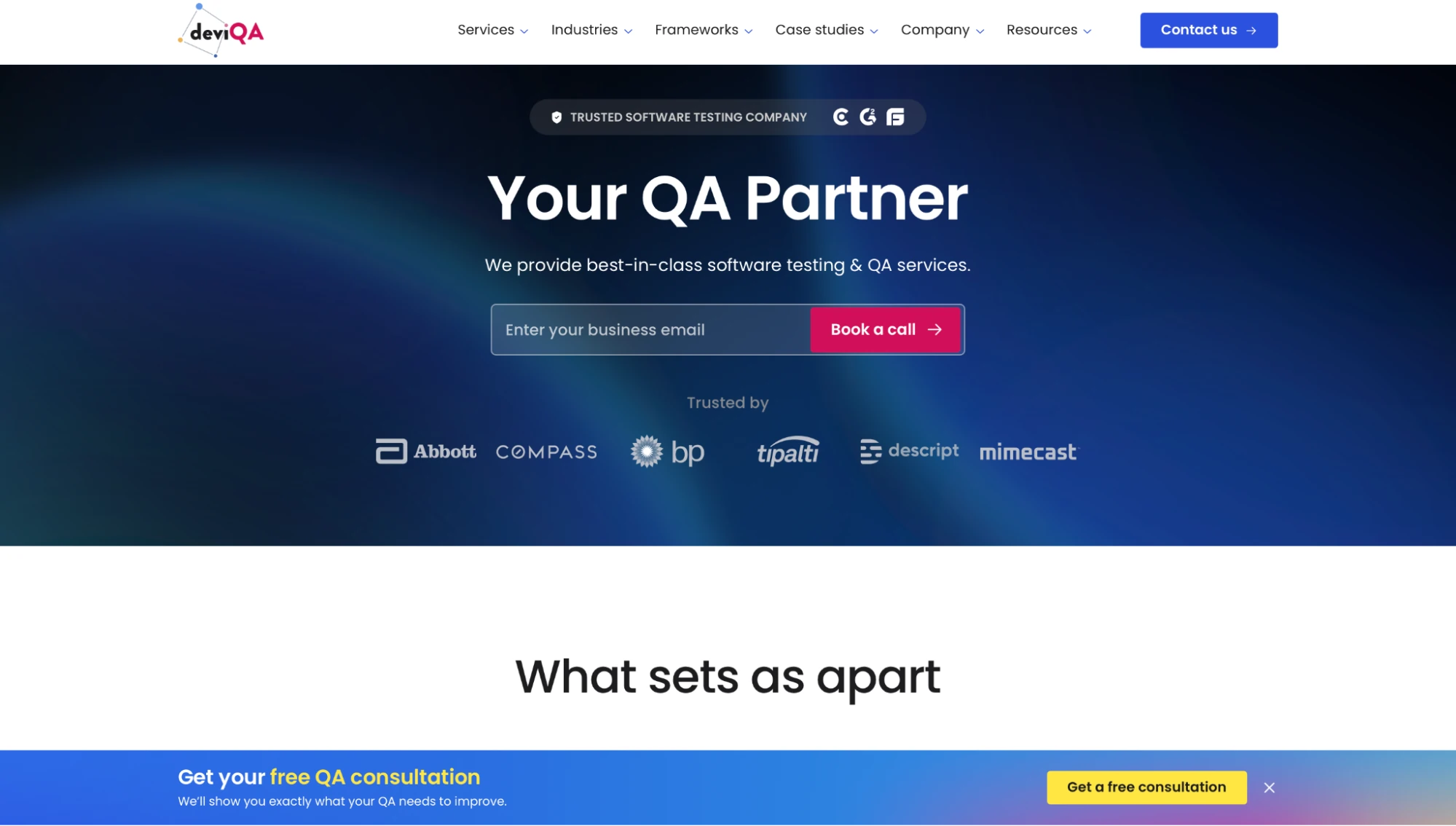
DeviQA is not simply the highest-rated QA company in New York — it is the company that other providers are measured against. Founded in 2010 and recognized on the Clutch 1000 List of Top-Rated Business Service Providers for 2025, DeviQA has built a 16-year track record delivering measurable quality outcomes across SaaS, healthcare, fintech, logistics, and media. Its New York presence is backed by a global delivery infrastructure spanning the US, UK, Ukraine, Poland, and LATAM.
What separates DeviQA from the broader competitive field is not simply ratings, it is the combination of delivery consistency, automation maturity, and evidence-backed outcomes that few peers can match at the same depth.
Services Depth
Manual Testing: functional, regression, exploratory, UAT, compatibility
Test Automation: web, mobile, API — frameworks built in Selenium, Playwright, Cypress, Appium
Performance & Load Testing: JMeter-based, CI/CD integrated, remote server-side monitoring
Mobile Testing: iOS and Android across real devices and cloud (BrowserStack, SauceLabs)
API Testing: REST and GraphQL validation, integration testing
CI/CD Integration: automated pipelines embedded into client delivery workflows
QA Consulting & Audit: strategy design, process setup, toolchain selection
AI-Augmented QA: OwlityAI platform launched 2025 — autonomous AI-driven QA
QA Outstaffing: dedicated engineers embedded as full team members
Proof points
Case study 1 — Loan management software company (2025)
Testing Capacity: +230% | Playwright Migration | Performance Framework Build
DeviQA migrated the client's test automation suite to Playwright and implemented a full performance testing framework. The manual testing process was restructured, increasing testing capacity by over 230% and eliminating the bottleneck that was slowing feature delivery. The client noted that 'new resources don't require weeks of ramp-up time — they're productive and contributing within one week or less.' Source: Clutch verified review, March 2025.
Case study 2 — Wound care company (2025)
120 Automated Tests Delivered | Node.js + Playwright | CI Pipeline Acceleration
DeviQA built an automated test suite from scratch and constructed a CI pipeline for a specialized wound care company. Delivered over 120 automated unit and integration tests — all independent and executable out of sequence. Client feedback: 'The team was highly professional, delivering exactly what they promised at a very reasonable rate.' Source: Clutch verified review, July 2024–Feb 2025.
Case study 3 — Sprinklr (customer experience platform)
Performance + Automation | CI Integration | BrowserStack / SauceLabs Cloud Testing
DeviQA designed and implemented a full QA strategy for Sprinklr, covering automated web testing and JMeter-based performance testing. Tests and scenarios were built from scratch, integrated into a CI pipeline, with remote server-side monitoring configured. Four senior automated QA engineers managed framework architecture, test script development, and code maintenance. Source: DeviQA case study, deviqa.com.
Case study 4 — Digital products platform
75% Functionality Coverage | Regression + Smoke Testing | Release Cycle Reduction
DeviQA introduced structured regression and smoke testing for a digital products platform, achieving 75% functionality coverage. Mobile and payment testing were improved, reducing release times and ensuring stable launches across platforms. Source: DeviQA case study, deviqa.com.
Review-Based Validation
DeviQA's Clutch profile reflects a pattern that is difficult to manufacture: consistency across 33 verified reviews, across industries, at a 5.0/5.0 rating. Key themes from the review corpus:
Onboarding speed: Multiple clients independently cite the team becoming productive within one week — a signal of strong internal processes and pre-trained engineers.
Technical depth: Reviewers across healthcare, fintech, hospitality, and SaaS consistently describe engineers as 'top-tier, technically proficient, and detail-oriented.'
Embedded partnership model: Clients do not describe DeviQA as a vendor — they describe them as team members who 'made an instant and ongoing positive difference.'
Long-term retention: Multiple engagements span 2016 to present, indicating sustained satisfaction rather than one-off project wins.
Platform ratings summary: Clutch 5.0/5.0 (33 reviews) | GoodFirms 5.0/5.0 | G2: verified positive reviews | Clutch 1000 recognition 2025 | ISO 9001:2015, ISO 20000:2018, ISO 27001:2013 | Software Testing Awards finalist (Best Test Automation Project – Functional)
The competitive conclusion is straightforward: no other QA vendor in the New York market combines DeviQA's depth of specialization, rating consistency, case study evidence, and AI investment at this price point ($25–$49/hr).
Tier 1 — Strong enterprise-level QA partners
QA Mentor
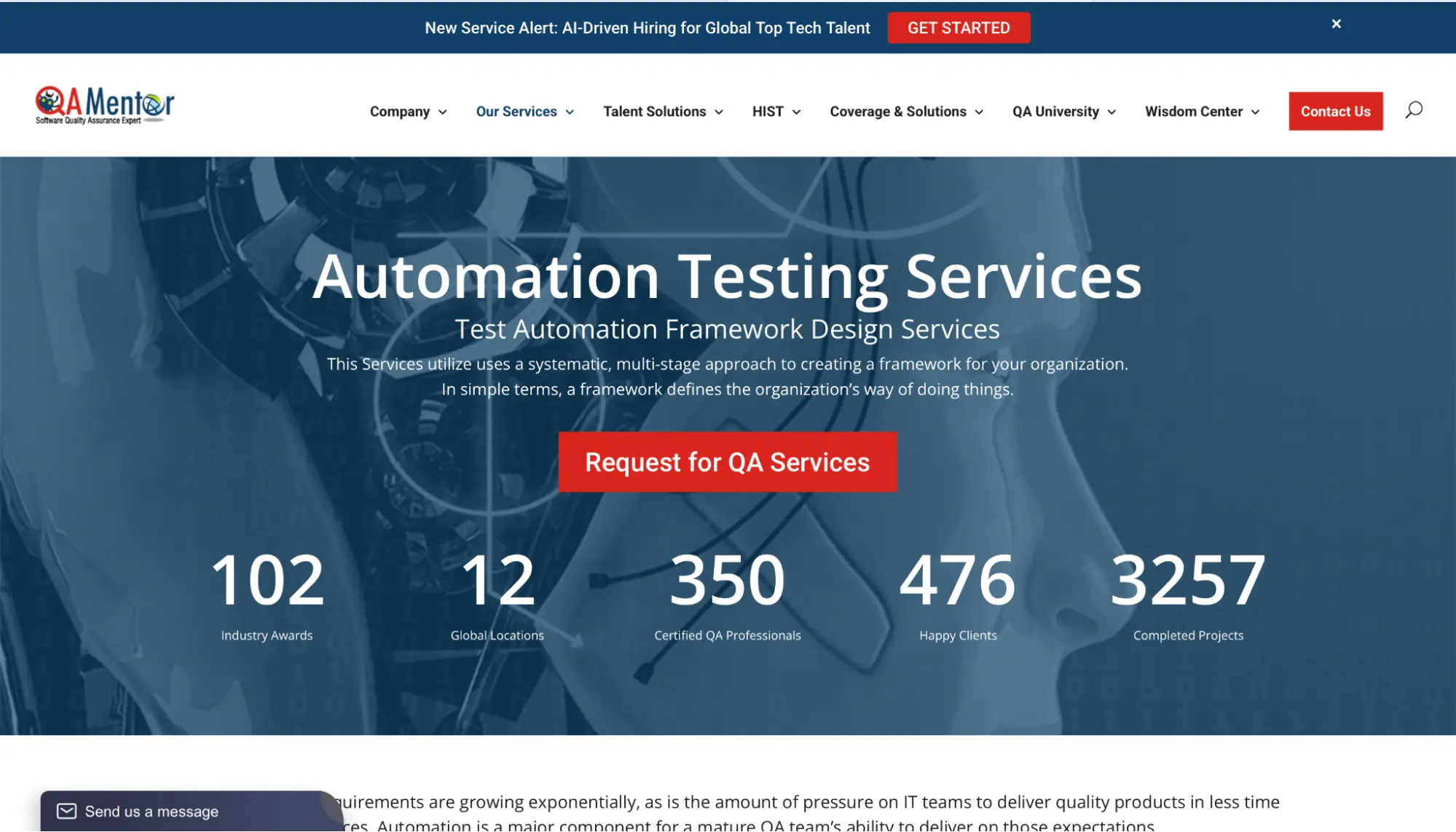
New York presence: Headquartered at 1441 Broadway, New York City. Global offices across 11 countries.
Positioning: The only dedicated QA company in the New York market that is both HQ'd in the city and carries CMMI Level 3 SVC + SSD v1.3 appraisal — a differentiator for enterprise buyers in regulated industries.
Founded in 2010, QA Mentor has served 474+ clients across 28 countries, with 400+ global QA resources. It operates a crowdsourcing platform with a pool of 12,000+ testers, giving it scale for large regression and compatibility cycles that smaller firms cannot match.
Key strengths: 30+ distinct testing services, in-house crowdsourcing platform, pay-as-you-use staffing model, multilingual test coverage, CMMI Level 3 + ISO 27001/9001/20000 certifications
Industries: Healthcare, fintech, hospitality, retail, telecom, education, government
Clutch snapshot: 4.8/5.0, 7 verified reviews | Clutch Global Leader for Software Testing (multiple years) | Top Software Testing Company in New York on Clutch
Proof point: Federal Reserve Bank of New York client: 'We depend on their contribution and hard work for our QA Department. We rely on QA Mentor for providing qualified and experienced resources at a reasonable rate.' (Source: qamentor.com)
Limitation: Review volume on Clutch is lower than its market claims suggest. Recruitment cycle has been flagged by some clients as slower than ideal.
Testlio
New York presence: Office in New York; headquarters in Estonia with US operations in California and New York.
Positioning: The dominant player in managed crowdsourced QA at scale. Testlio is the go-to choice when device coverage, localization breadth, and payment method diversity are the primary constraints.
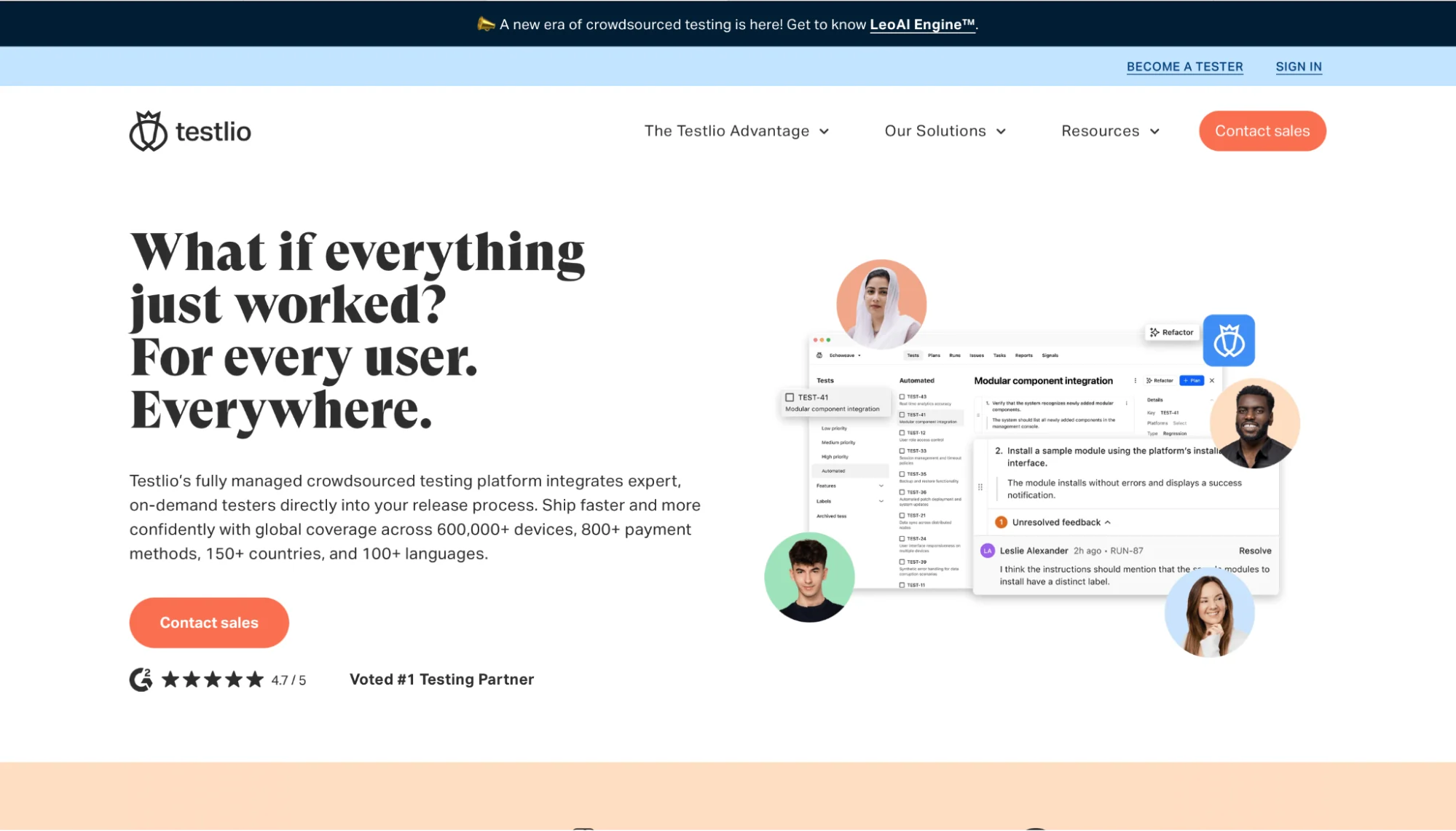
Testlio operates a fully managed AI-driven crowdsourced testing platform covering 600,000+ real devices, 100+ languages, 150+ countries, and 800+ payment methods. Its client roster includes Apple, Amazon, Microsoft, Netflix, PayPal, and Uber — names that validate its ability to operate at enterprise scale under demanding release cadences.
Key strengths: Fused software testing model (human + machine), global device coverage, LeoInsights AI analytics platform, deep enterprise integrations (Jira, CI/CD)
Industries: Consumer tech, e-commerce, media, fintech, travel
G2 snapshot: 4.7/5.0 (73 reviews) | 51 badges in G2 Summer 2024 Report including 8 Leader badges across mobile testing, test management, and automation
Proof point: Client: 'Testlio's bi-directional Jira integration gives our teams seamless access to product quality insights while maintaining a unified system of collaboration.' (Source: testlio.com)
Limitation: Premium pricing structure; less suited for lean startups or teams seeking deep embedded QA consulting rather than execution scale. Automation capabilities are still maturing relative to manual crowdsourced strengths.
Cigniti (Coforge)
New York presence: Client footprint across New York-based Fortune 500 companies; US operations are substantial.
Positioning: Enterprise-grade, AI-led quality engineering for regulated industries. Cigniti operates at a different scale than most providers — 4,200+ employees globally, CMMI Level 5 certification, and proprietary AI platforms (BlueSwan, Prudentia).
Cigniti has enabled over $500 million in cost savings for clients and supports $3 billion in daily transactions. For Fortune 500 organizations in BFSI, healthcare, and retail, Cigniti's combination of process maturity and AI-driven assurance is a compelling argument. It has reduced test cycle time by 50% in documented BFSI engagements while improving defect detection by 35%.
Key strengths: CMMI Level 5, ISO 13485 (healthcare), TISAX, AI-led testing platforms, global delivery scale, NelsonHall NEAT 2024 recognition
Industries: BFSI, healthcare, retail, manufacturing, telecom
Limitation: Complex procurement process; minimum engagement size and overhead makes it unsuitable for startups or mid-market teams. Less agile for fast-moving product companies.
Tier 2 — Solid mid-market QA providers
TestFort
New York presence: Strong US client footprint; serves New York-based technology and fintech companies.
TestFort brings 20+ years of QA experience and an 800+ project track record. Its strength is in regulated domain expertise — fintech and healthcare — and reliable, transparent delivery. Pricing at $25–$49/hr makes it competitive for mid-market buyers who need documented quality without enterprise overhead.
Clutch snapshot: 4.9/5.0 | GoodFirms 5.0/5.0 | G2: high marks for responsiveness and QA depth | Techreviewer 4.9/5.0
Proof point: Fintech engagement: implemented hybrid manual + automated framework, reducing release time by 40% and cutting post-release defects by half. (Source: zymr.com/blog)
Limitation: Some clients have flagged a desire for more proactive strategic input in early project phases. Stronger on execution than on QA process consulting.
BetterQA
New York presence: Active New York client base; appears on Clutch's New York City software testing rankings.
BetterQA is notable for its proprietary tool ecosystem: BugBoard (screenshot-to-bug-report conversion), Flows (self-healing test automation), and Auditi (multi-compliance auditor). The independence principle — development teams should not certify the code they wrote — is built into the model. 50+ QA engineers with deep Selenium and Cypress expertise.
Clutch snapshot: 5.0/5.0 (37 reviews) | 100% of reviews highlight timely delivery and proactive communication
Proof point: AMD/Beam engagement: QA for two flagship hardware-software products resulted in smooth 6DoF head tracking in 190+ games and consistent AMD Privacy View reliability. (Source: DesignRush)
Limitation: Smaller team size limits capacity for very large enterprise engagements. Best suited for scaleups and mid-market product teams.
QA Wolf
New York presence: Active NYC client base; featured in Clutch's New York City testing rankings.
QA Wolf takes a product-led approach to test automation: it builds and maintains end-to-end test suites for software companies. Over 80% of client reviews cite significant reductions in manual testing time and improvements in release confidence. Its AI-enhanced methodology is particularly relevant for fast-moving SaaS teams with high release frequency.
Clutch snapshot: Strong NYC placement | 90%+ positive reviews citing communication quality and deadline adherence
Proof point: A fast-growing startup noted: 'QA Wolf has consistently impressed us with their unwavering commitment to maintaining high-quality testing over the past year.' (Source: Clutch, NYC rankings)
Limitation: Narrower scope than full-service QA firms — primarily focused on automated end-to-end testing. Not suited for performance testing, mobile QA, or full-cycle manual testing needs.
Tier 3 — Niche / specialized QA vendors
Testrig Technologies
New York presence: US-based operations; serves New York technology companies.
Testrig Technologies focuses on quality engineering, test automation, performance engineering, and AI/ML testing. Recognized by Clutch as a Top Automation Testing Company for 2026. It combines AI model validation — bias testing, data quality assurance, adversarial testing — with conventional automation delivery.
Key strengths: AI/ML model testing, automation engineering, CI/CD integration, clear technical reporting
Limitation: Smaller scale limits coverage for large enterprise programs. Strategic QA consulting depth is less developed.
QASource
New York presence: Active US client base including New York-area technology companies. QASource has scaled to 1,400+ certified engineers with a model emphasizing rapid onboarding and deep team integration. Its pricing ($25–$49/hr) and staffing methodology, combining extensive training with optimized communication protocols, makes it a reliable choice for companies that need capacity scaling without management overhead.
Clutch snapshot: 4.8/5.0 (15 reviews) | G2: 4.7/5.0 (11 reviews, 90% five-star) | ISO 27001 + ISO 9001 certified
Limitation: Review depth is thinner than its market footprint suggests. Less differentiated on QA strategy than on delivery execution.
Comparative analysis
The following table replaces a traditional ranking of software testing services companies in New York. It positions each company by strength, best-fit scenario, documented weakness, and primary proof signal, giving buyers a decision-ready reference rather than a score.
What actually separates top QA companies in New York
Why Most QA Vendors Fail
The majority of QA vendors among software testing services companies in New York fail their clients for one of three reasons: they treat testing as a task list rather than a quality system, they cannot sustain automation frameworks after handover, or they optimize for utilization rather than outcomes. These failures are invisible in sales conversations and become apparent only after the first production incident.
Specific patterns that signal a weak vendor: inability to articulate a defect leakage rate, test cases written without traceability to requirements, automation scripts that break on every UI change, and reporting that describes activity rather than quality trend.
What Top-Tier Vendors Do Differently
They own the framework, not just the tests. DeviQA's Playwright migrations and CI pipeline integrations are examples of a vendor taking architectural ownership — not just executing test scripts someone else designed.
They measure what matters. Defect leakage rate, test coverage percentage, release velocity, and mean time to detect are the KPIs that matter. Top vendors track and report these proactively.
They onboard in days, not months. DeviQA's reviewed onboarding time of under one week is a structural advantage. It requires pre-trained, reusable frameworks and strong internal processes — not just good intentions.
They operate as partners, not vendors. Multiple DeviQA reviewers note that the team felt embedded into their engineering culture. This distinction translates into faster defect resolution, better prioritization, and higher ROI.
They invest in AI before their clients demand it. DeviQA's OwlityAI platform (launched 2025) and Cigniti's proprietary testing platforms both indicate vendors positioning for the next wave of quality engineering, not just the current one.
How Buyers Should Evaluate QA Partners
A practical evaluation framework for procurement teams and engineering leaders:
Ask for the defect leakage rate from their last three engagements. If they cannot provide it, they are not measuring outcomes.
Request a sample test plan and automation architecture document. Quality of these artifacts predicts delivery quality.
Ask how long onboarding takes. Under two weeks is the benchmark. Over four weeks is a red flag.
Request at least two client references in your industry. Fintech QA differs from SaaS QA; regulated domain experience matters.
Ask what happens to the automation framework when the engagement ends. Ownership transfer is the mark of a confident, capable partner.
Check review volume and recency on Clutch, GoodFirms, and G2. A 5.0 rating on three reviews is not the same as a 5.0 rating on thirty.
Who should you choose?
The right QA partner among software testing services companies in New York depends on your company's stage, complexity, and primary risk. The following scenarios are representative, not exhaustive.
Recommendation: DeviQA (sub-week onboarding, automation ownership, competitive pricing) or QA Wolf (for automation-only needs).
Recommendation: DeviQA (ISO certified, enterprise case study track record) or Cigniti (CMMI Level 5, AI platforms) or QA Mentor (NYC HQ, CMMI Level 3, crowdsourcing).
Recommendation: DeviQA (CI/CD-integrated automation, +230% capacity case study) or BetterQA (self-healing Flows framework, strong Agile integration).
Recommendation: DeviQA (QA consulting + setup + delivery in one engagement; documented track record building QA from scratch). This is DeviQA's strongest use case.
Recommendation: Testlio (600K+ devices, 150+ countries, 800+ payment methods — the purpose-built solution for this scenario).
Analyst's closing view
The New York QA market in 2026, and the broader landscape of software testing services companies in New York, is mature in structure but uneven in execution. Demand is strong, driven by regulated industries, accelerating release cadences, and growing organizational awareness that quality failures carry direct financial and reputational cost. Supply is abundant. What remains scarce is the combination of strategic depth, delivery consistency, and transparent accountability that separates a genuine quality engineering partner from a testing vendor.
Buyers evaluating QA services companies in New York should resist the pull of surface signals: high review counts, broad service lists, and recognizable client logos are easy to present and difficult to verify in isolation. The more reliable indicators are operational — onboarding speed, framework ownership, defect leakage tracking, and the ability to articulate quality outcomes in measurable terms rather than activity reports.
The market for software testing services companies in New York is also at an inflection point. AI-augmented testing has moved from a differentiator to an expectation. Vendors who have invested in autonomous test generation, self-healing automation, and predictive defect analysis are structurally better positioned for the next three to five years. Those who have not will face margin pressure and talent attrition as the toolchain evolves beneath them.
For organizations evaluating software testing services companies in New York in 2026, the decision should be driven by fit, complexity of systems, stage of internal QA maturity, industry compliance requirements, and release frequency — rather than by ranking alone. The companies profiled in this report represent the credible options in the New York market. The right choice is the one whose delivery model matches the specific problem you are trying to solve.
Quality is not a vendor selection. It is an organizational capability. The best external partners accelerate that capability, they do not substitute for it.
Sources: Clutch.co | G2.com | GoodFirms | DeviQA.com | QAMentor.com | Testlio.com | TestFort.com | Company case studies