A market that has outgrown its original structure. Utah’s technology sector has undergone a fundamental transformation over the past decade. What started as a cluster of mid-sized software firms along the Wasatch Front has evolved into one of the most active technology corridors in the United States.
The Silicon Slopes ecosystem, anchored by Lehi, Salt Lake City, and Provo, now supports thousands of software companies, ranging from venture-backed SaaS startups to publicly traded enterprise platforms. Consistently ranking among the top states for tech employment growth, Utah is no longer an emerging market, it is an established product-driven ecosystem where software quality directly impacts competitiveness.
Despite the growing demand, the software testing companies in Utah landscape presents a real challenge for buyers.
Most vendors claim automation expertise
The same tools (Selenium, Cypress, Appium) appear across nearly all service pages
Client logos are often presented without context or measurable outcomes
Differentiation at the surface level is minimal
For engineering leaders making time-sensitive decisions, this creates a high noise-to-signal environment when evaluating QA companies in Utah, making it difficult to distinguish real execution capability from marketing claims.
This analysis is intentionally selective. It focuses exclusively on vendors that demonstrate verifiable delivery capability through:
Independently validated client reviews (Clutch, G2)
Case studies with quantifiable outcomes
Clearly defined and structured QA methodologies
Service depth extending beyond a single testing discipline
Companies lacking substantiated evidence, relying primarily on generic positioning, or demonstrating limited third-party validation were ranked lower or excluded from consideration among software testing companies in Utah.
The objective of this report is not to provide exhaustive coverage of the market, but to deliver a defensible, evidence-based shortlist that enables confident decision-making.
Methodology
Scope and Data Collection
This ranking covers software testing and QA service providers in Utah actively delivering to US-based clients, with particular attention to vendors with demonstrated experience serving Utah's SaaS, product, and technology company base. Companies were identified through a combination of sourcing methods: B2B platform listings (primarily Clutch.co and G2), direct research into case study libraries, industry directories, and inbound vendor profiles submitted for consideration. The initial candidate pool included over 60 firms; the final ranked list reflects only those with sufficient public evidence to support a credible assessment.
Data was collected between Q3 2025 and Q1 2026, focusing specifically on software testing companies in Utah. All ratings, review counts, and case study claims were verified against primary sources at the time of evaluation. No company paid for inclusion, and no vendor was given advance access to scoring criteria or preliminary results.
Evaluation Criteria
QA companies in Utah were assessed across five weighted criteria. Each criterion was scored on a scale of 0–20, producing a composite score out of 100.
1. Client Reputation, 20 points. This criterion evaluated the volume, recency, and consistency of independent client reviews, with Clutch.co as the primary source given its verification standards. Volume alone was insufficient, a vendor with 80 reviews averaging 4.6 stars was assessed differently than one with 12 reviews averaging 5.0, because review concentration over time indicates sustained delivery quality rather than a single strong engagement period. Reviewers' descriptions of communication, issue resolution, and whether they would re-engage the vendor were weighted more heavily than overall star ratings.
2. Proof of Impact, 25 points. This was the highest-weighted criterion, and deliberately so. The QA industry has a well-documented tendency to describe process inputs (tools used, test cases written, team size) rather than business outputs. Vendors were evaluated on whether their published case studies contained specific, attributable metrics: reductions in defect escape rate, improvements in test coverage percentage, decreases in release cycle duration, automation implementation rates, or cost-per-defect improvements. Case studies describing outcomes in vague qualitative terms ("improved quality," "accelerated delivery") without supporting data were scored conservatively. Vendors with no public case study library received minimal credit on this dimension regardless of review scores.
3. Service Depth and Technical Capability, 20 points. For software testing companies in Utah, this criterion evaluates whether the vendor delivers a coherent, integrated QA capability rather than a fragmented set of services. Core areas assessed include manual and exploratory testing, test automation engineering, API and integration testing, performance and load testing, mobile QA, and security testing. Additional credit is given to vendors demonstrating capabilities in AI-assisted test generation or intelligent test maintenance, reflecting the direction of the market. Vendors offering only one or two service lines are scored lower, as limited capability increases dependency risk for buyers with complex or evolving testing needs.
4. Delivery Maturity, 20 points. This criterion assessed structural indicators of a vendor's ability to deliver reliably at scale and over extended engagements. Inputs included: evidence of defined onboarding and knowledge transfer processes, references to QA documentation standards, team structure transparency (dedicated vs. shared resources), and client retention signals, specifically, whether review narratives described multi-year or multi-project relationships. Vendors whose client references were predominantly short-term or project-bound received lower scores, as Utah's SaaS companies generally require ongoing QA partnerships rather than one-time engagements.
5. US and Utah Market Relevance, 15 points. Given the specific focus of this report, vendors were assessed on their demonstrated familiarity with the US client context: timezone-aligned communication, experience with US-based product companies, and, where applicable, physical presence or team members operating in North American time zones. This criterion did not require a Utah office; several strong performers operate remotely but have structured their delivery models explicitly around US client workflows. Vendors with exclusively offshore-hours delivery and no documented accommodation for US business schedules were marked down.
Scoring and Ranking
Each software testing company in Utah received an independent score across all five criteria, producing a composite out of 100. Where evidence was ambiguous or incomplete, scores defaulted to the conservative end of the range, the burden of proof rested with public documentation, not with assumed capability. Vendors scoring below 55 composite were excluded from the final ranked list on the grounds that insufficient public evidence exists to make a responsible recommendation to buyers.
The final ranking represents QA service companies in Utah ordered by composite score. Ties within three points were resolved by weighting Proof of Impact and Delivery Maturity more heavily, as these factors are the most predictive of real-world engagement success. The top-ranked vendor outperformed the closest competitor consistently across multiple criteria, not just a single dimension, a pattern that indicates genuine delivery capability rather than narrow specialization or strong marketing alone.
Top QA companies in Utah
1. DeviQA
Composite Score: 91/100
Website: https://www.deviqa.com/
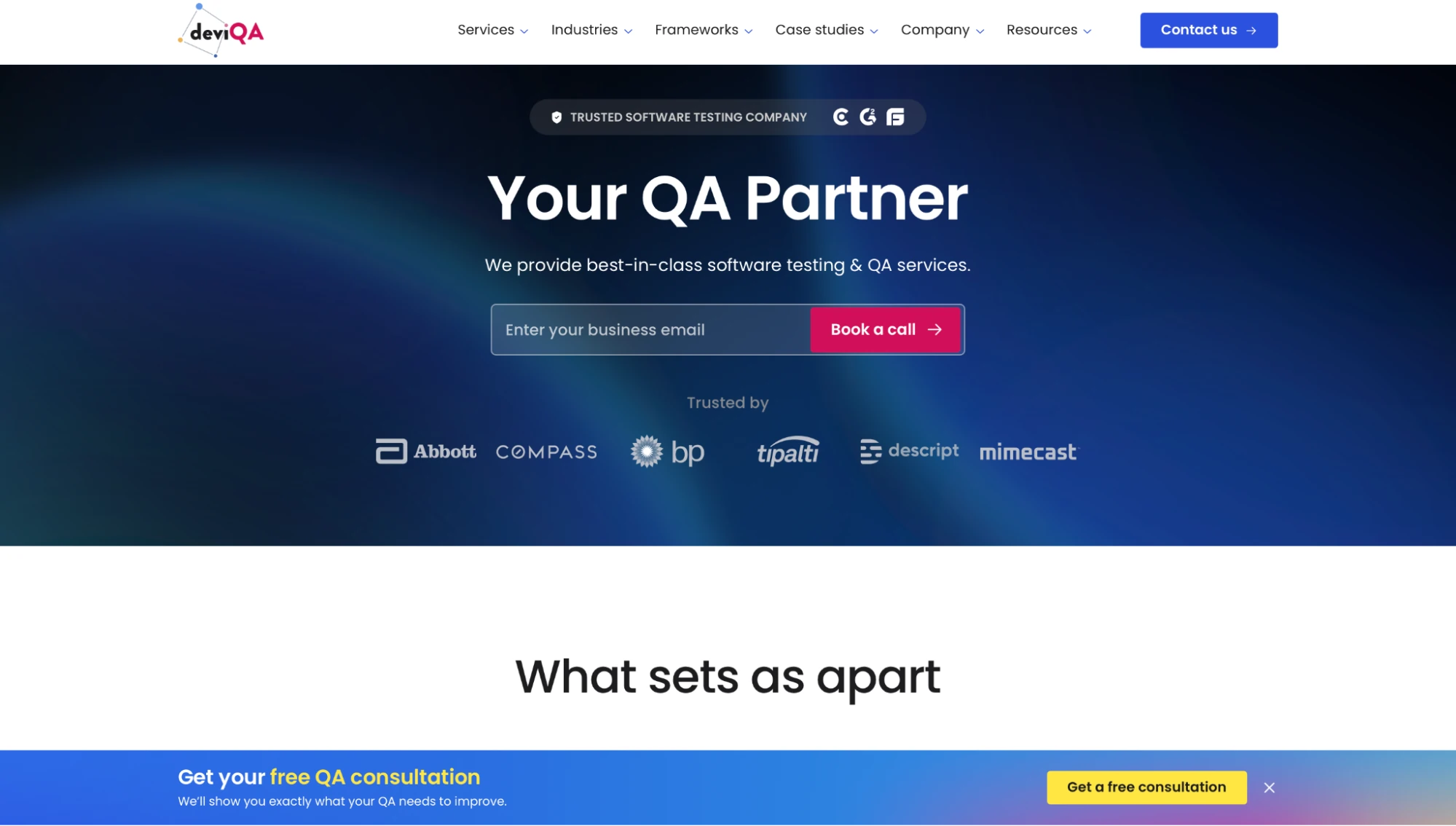
DeviQA is the strongest overall performer in this analysis, and the gap between it and the next-ranked vendor is not marginal. Founded in 2010, the company has grown to over 300 QA engineers with delivery operations spanning the US, UK, Ukraine, and Poland, a structure that directly supports North American client workflows without the timezone friction that undermines many offshore-only providers.
What separates DeviQA from the field is the density and specificity of its public evidence. Published client feedback documents outcomes such as automating nearly 80% of a regression suite in under three months, resulting in significant savings, the kind of metric that reflects genuine delivery, not project completion. On Clutch, DeviQA holds a 5.0/5.0 overall rating, with perfect scores across Quality, Schedule, and Willingness to Refer, and holds ISO 9001:2015, ISO 20000:2018, and ISO 27001:2013 certifications. That combination of review consistency, certification depth, and documented outcomes is rare at this volume.
For Utah's SaaS and product companies, which need partners capable of building automation infrastructure from scratch, not just executing test scripts, DeviQA's track record of over 300 projects delivered from inception is directly relevant.
Key Strengths: Verified client outcomes with quantified metrics; 5.0 Clutch rating at scale; US-aligned delivery model; ISO-certified processes; strong automation engineering depth; free proof-of-concept engagement model reduces onboarding risk.
Services Offered: Test automation engineering, functional and regression testing, performance and load testing, mobile application testing, API and web services testing, security testing, QA consulting, DevOps QA integration.
2. Testlio
Composite Score: 83/100
Website: https://testlio.com/
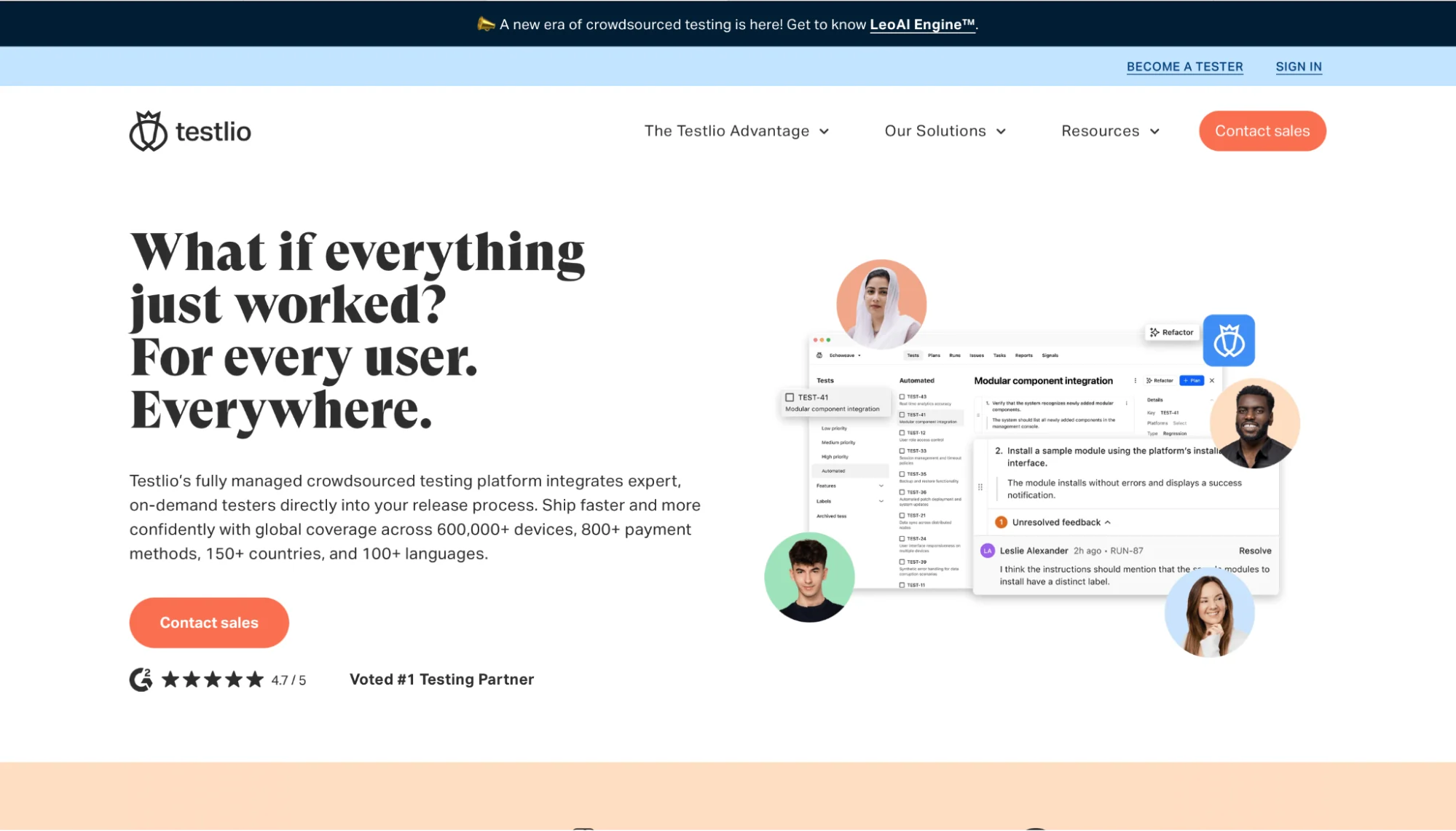
Testlio's differentiation in this market is structural rather than just technical. The company's "Fused Software Testing" approach combines automated and manual testing through a proprietary platform integrating AI and DevOps practices, supported by a network of over 10,000 global testers and distributed real-device networks. For Utah companies building consumer-facing mobile or multi-platform products, this real-device coverage is a meaningful capability that most vendors cannot replicate.
The primary limitation for smaller Utah companies is fit: Testlio's model is optimized for enterprise-scale programs, and its pricing reflects that. Startups or early-stage product teams may find the engagement structure heavier than needed. That said, for mid-sized Utah SaaS companies in fintech, healthcare, or legaltech with complex release cycles, Testlio represents a credible and well-documented option.
Key Strengths: Proprietary managed testing platform; real-device and real-transaction testing at global scale; strong enterprise client base; AI-integrated DevOps workflow; verified multi-year client relationships.
Services Offered: Functional testing, exploratory testing, regression testing, localization testing, automation testing, usability testing, API validation, payments testing, mobile app testing.
3. QASource
Composite Score: 79/100
Website: https://www.qasource.com/
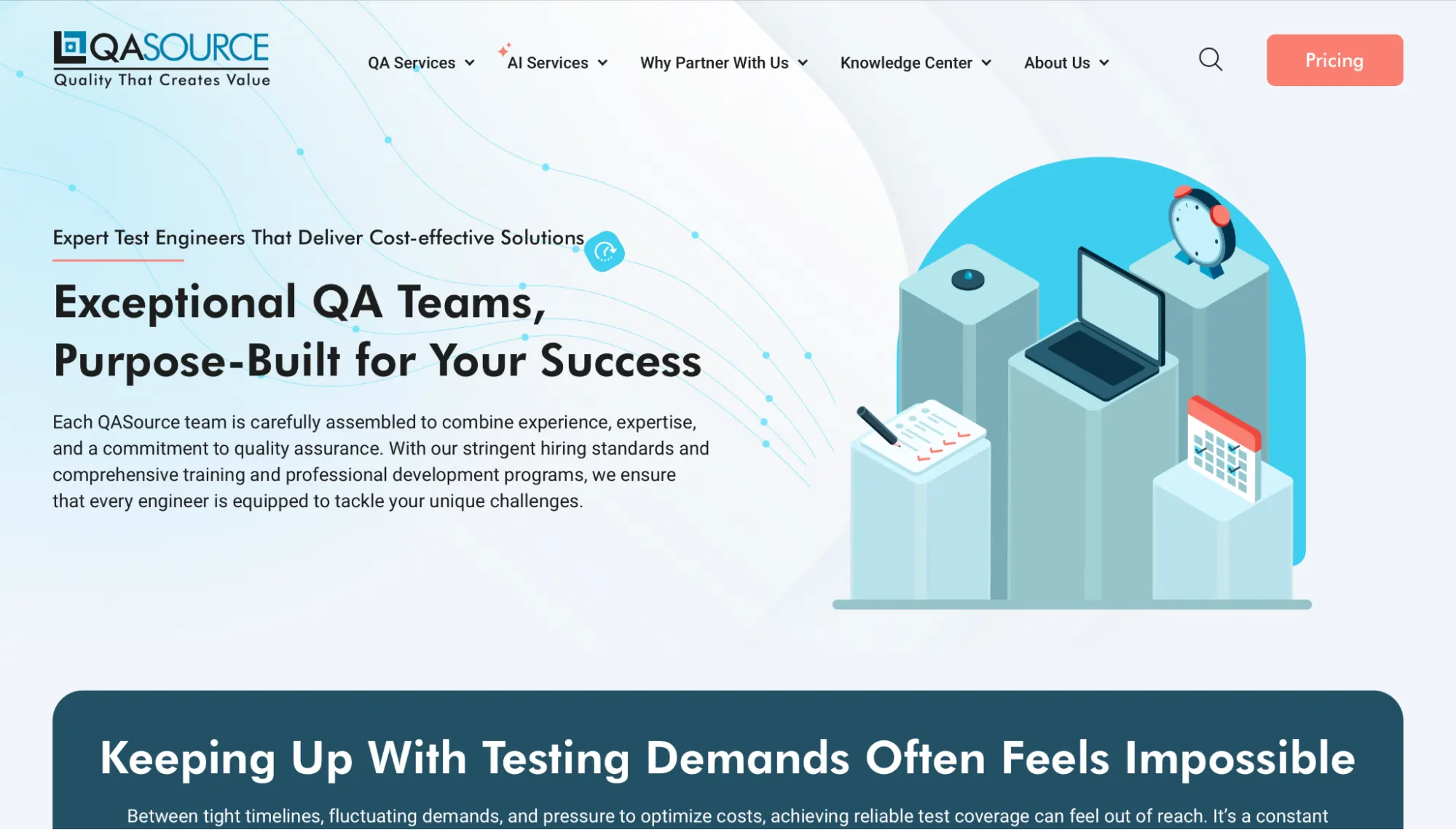
QASource is the most compelling option for Utah companies that need a long-term, embedded QA team rather than a project-based engagement. Client reviews consistently highlight QASource's reliability, communication quality, and ability to stabilize QA processes, with specific references to teams integrating seamlessly with internal developers and bringing immediate consistency and structure to QA operations.
QASource holds 4.8–4.9 client ratings across review platforms, with reviews praising daily communication, predictable delivery, and automation suites that have reduced manual testing effort by more than half. With over 700 QA engineers and 18+ years of operation, it has the scale to support Utah companies through aggressive growth phases without requiring a vendor change.
Key Strengths: Long-term managed QA team model; strong automation track record; deep bench at scale; consistent 4.8+ ratings across platforms; proven integration with client engineering organizations.
Services Offered: Functional testing, automation testing, mobile testing, performance testing, API testing, security testing, AI testing, DevOps QA, accessibility testing.
4. a1qa
Composite Score: 76/100
Website: https://www.a1qa.com/
a1qa is a pure-play QA provider, it does not offer software development services, which is a meaningful structural advantage for buyers who want independent testing without the conflict of interest that can arise when the same vendor builds and tests the same product. The company holds 4.8–4.9 ratings on Clutch, with clients consistently emphasizing professionalism, a structured approach, and proactive defect identification, including reviewers noting that a1qa finds issues the internal team never considered.
With over 1,000 QA experts and 1,500+ completed projects, a1qa brings more than 20 years of experience to end-to-end testing, security, and QA consulting. For Utah companies in regulated industries, healthcare, fintech, insurtech, where audit trails, documentation standards, and independent verification matter, a1qa's model is particularly well-suited.
Key Strengths: Pure-play QA independence; 20+ years delivery history; strong in regulated industry verticals; proactive defect culture; stable long-term engagement model.
Services Offered: Full-cycle QA and testing, test automation, performance testing, security testing, QA consulting, documentation services, mobile and web app testing.
5. QualityLogic
Composite Score: 73/100
Website: https://www.qualitylogic.com/
QualityLogic is one of the few vendors in this ranking with genuine domestic roots, having operated since 1986. Named a Global Leader by Clutch and included in the top 10 software application testing providers, the company has completed over 6,000 programs with 200+ QA engineers and test technicians, with major clients including Adobe and AT&T. Its US-based delivery model commands a price premium, but for Utah companies where data handling, IP protection, or communication bandwidth are concerns, that premium may be justified.
QualityLogic also holds a differentiated position in accessibility testing and smart energy/IoT testing, capabilities that are not widely available from other vendors in this ranking. For Utah's growing hardware-adjacent and connected-device companies, that specialization adds relevant value.
Key Strengths: US-based onshore delivery; 37+ years of operating history; accessibility and IoT testing specialization; Clutch Global Leader recognition; strong client retention signals.
Services Offered: Functional testing, automated testing, performance and load testing, accessibility testing, usability testing, IoT and smart energy testing, mobile and web app testing.
6. QA Wolf
Composite Score: 69/100
Website: https://www.qawolf.com/
QA Wolf occupies a specific and well-defined niche: getting engineering teams to high automation coverage quickly. The company claims that 92% of customers release faster, 90% eliminate post-release hotfixes, and 85% increase revenue, and leads ratings on G2, Clutch, and TrustRadius. The model is built around delivering 80%+ end-to-end automated test coverage within four months, a proposition that directly addresses one of the most common pain points for Utah's fast-scaling SaaS teams: accumulated manual testing debt.
The limitation is scope. QA Wolf is an automation-first service and is not designed for organizations that need broad-spectrum QA coverage including manual exploratory, security, or performance disciplines. It is best evaluated as a specialist engagement, not a full QA outsourcing partner.
Key Strengths: Rapid automation ramp-up (80% coverage in 4 months); strong G2 and Clutch ratings; flake-free test engineering; unlimited parallel test runs; modern tooling stack.
Services Offered: End-to-end automated testing, test plan development, bug reporting, QA automation engineering, CI/CD integration.
7. TestFort
Composite Score: 65/100
Website: https://testfort.com
TestFort has been operating since 2001, giving it one of the longer operational histories in this field. Its positioning is squarely in the mid-market: structured, competent, and reliable rather than innovative. Review profiles indicate consistent execution quality and client retention, particularly for web application and e-commerce testing engagements. For Utah companies that need dependable QA coverage without the overhead of a larger vendor relationship, TestFort represents a workable option.
The company scores lower on proof of impact, its published case study library, while present, does not consistently surface the kind of quantified outcome data that higher-ranked vendors provide. Buyers should conduct direct reference checks before engaging.
Key Strengths: 20+ years of operating history; consistent review scores; reliable mid-market delivery model; established automation and manual testing practices.
Services Offered: Manual testing, automated testing, functional testing, regression testing, performance testing, API testing, security testing, mobile testing, web application testing.
8. ScienceSoft
Composite Score: 62/100
Website: https://www.scnsoft.com/
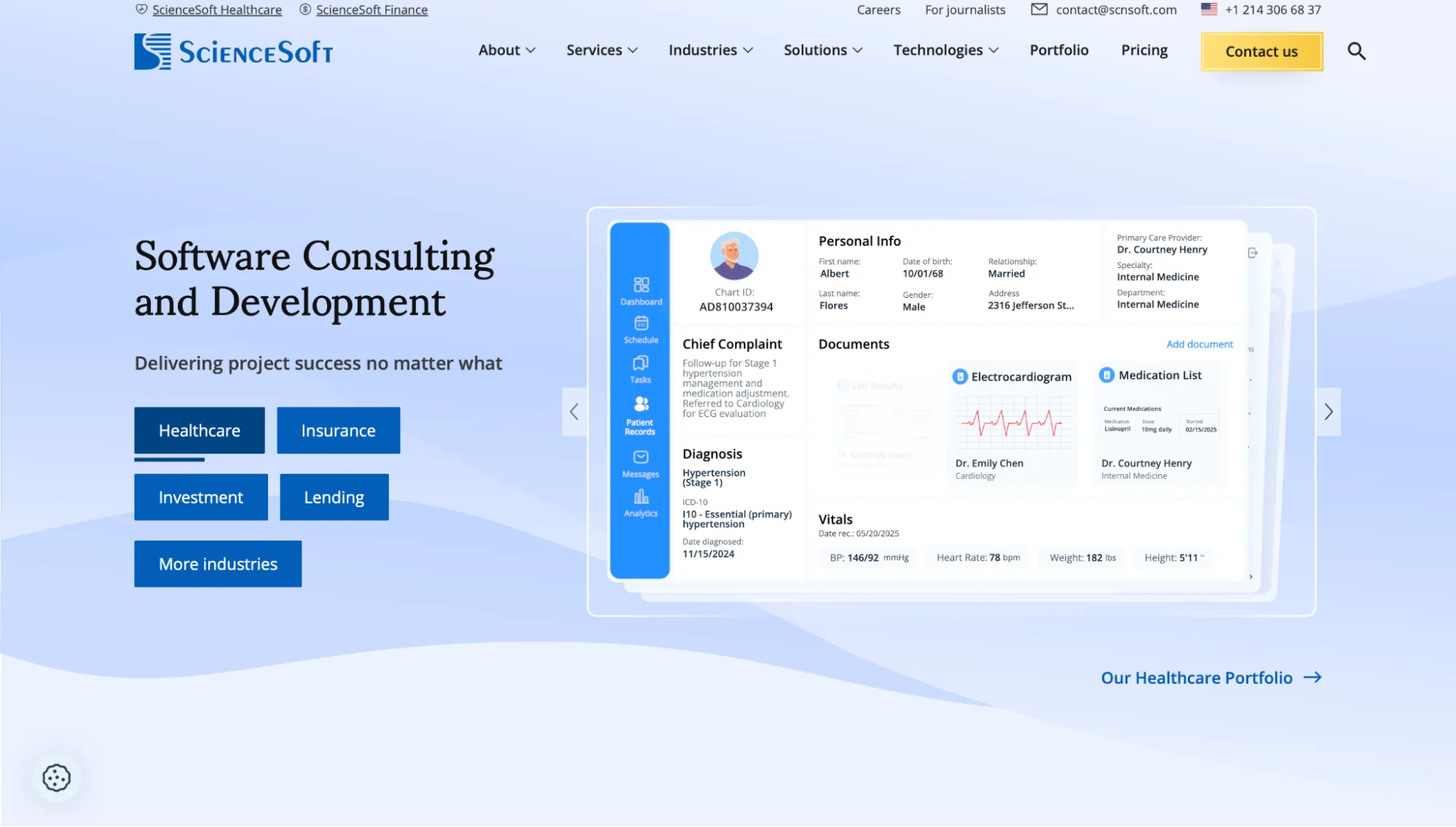
ScienceSoft is a broad IT services company, and QA is one of several service lines rather than its primary focus. That distinction matters: buyers should expect solid execution but not the specialist depth or exclusive QA culture that pure-play vendors deliver. Where ScienceSoft earns its place on this list is in digital transformation testing, specifically, legacy system migration, ERP validation, and complex enterprise integration testing. For Utah companies in industries undergoing platform consolidation, its breadth can be an advantage. The company is well-established and recognized for expertise in digital transformation, helping businesses enhance software quality, security, and performance with advanced testing and IT solutions. QA Source
Key Strengths: Strong in legacy migration and enterprise integration testing; broad technology stack coverage; established global presence; good fit for complex IT transformation programs.
Services Offered: Functional testing, automated testing, performance testing, security testing, ERP and integration testing, digital transformation QA, web and mobile testing.
9. Testmatick
Composite Score: 58/100
Website: https://testmatick.com/
Testmatick offers a focused service model built around multi-device in-lab testing, compatibility testing across device matrices, and structured manual QA. Founded in 2009, the company has identified over one million bugs across mobile, web, and API engagements, and delivers QA audit services alongside its core testing portfolio. Its review volume on independent platforms is lower than higher-ranked vendors, which limits confidence in the consistency of its delivery, but the reviews that exist are positive, and its multi-device testing infrastructure is a genuine differentiator for Utah companies building cross-platform consumer products.
Key Strengths: Multi-device in-lab testing capability; long operational history; QA audit services; solid compatibility testing practice.
Services Offered: Manual testing, automated testing, mobile and web testing, compatibility testing, performance testing, API testing, QA audit.
10. BetterQA
Composite Score: 54/100
Website: https://betterqa.co/
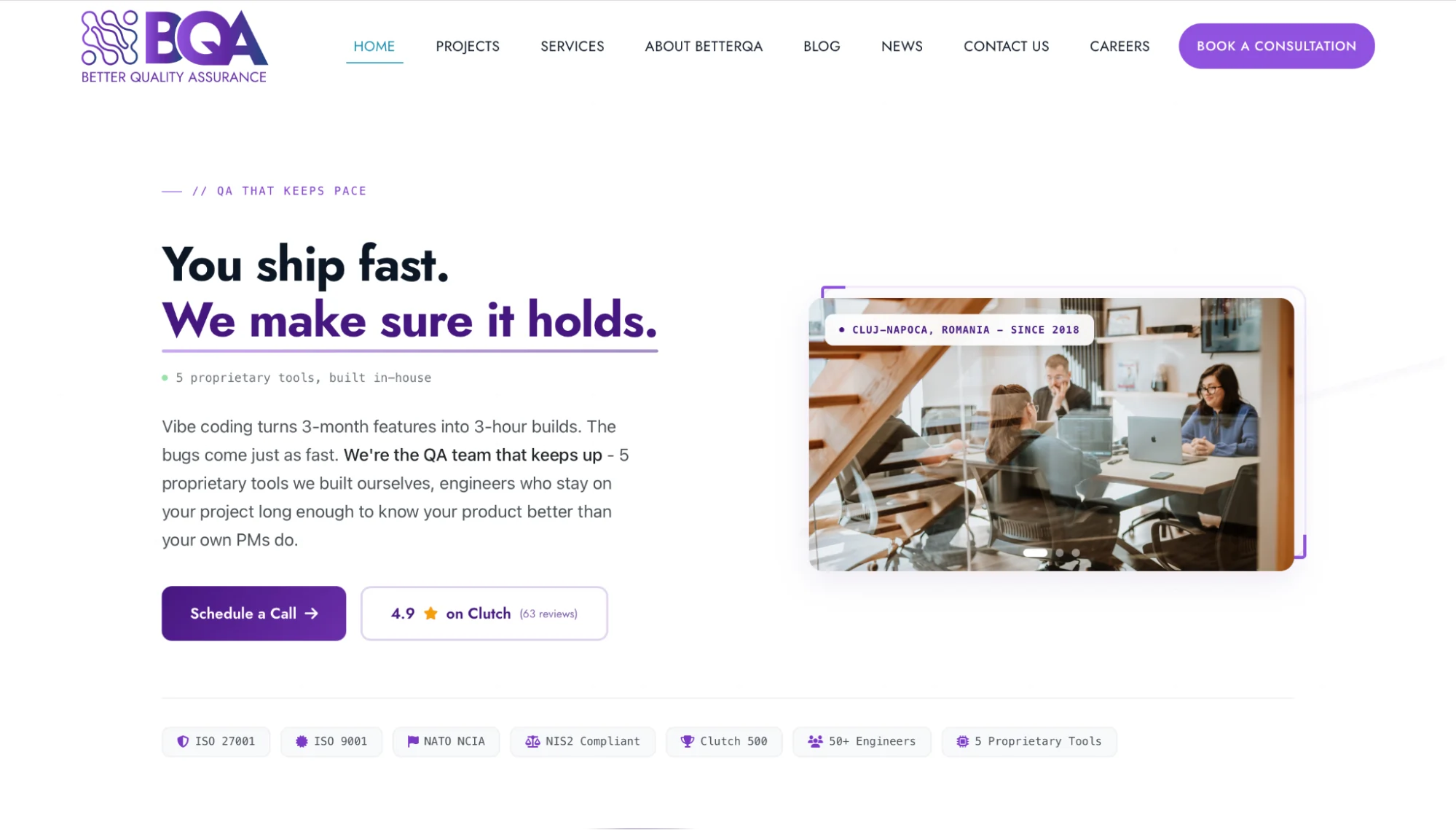
BetterQA rounds out the list as a lean, independent QA specialist with a clear positioning around objectivity; the company explicitly does not write production code, which preserves the independence of its testing function. With 50+ engineers across manual testing, automation, security audits, and performance testing, BetterQA offers over 30 QA services and supports clients with AI-powered testing tools. BetterQA Its review base is smaller than most vendors ranked above it, and its case study library is less developed, which caps its score on proof of impact. For Utah startups seeking a cost-effective, independent QA partner for early-stage product validation, it is worth evaluating, but with appropriate due diligence given the thinner public evidence trail.
Key Strengths: Strong independence model (no code development conflict); AI-powered testing tooling including BugBoard; broad service range for a boutique firm; explicit commitment to test objectivity.
Services Offered: Manual testing, test automation, security testing, performance testing, accessibility testing, API testing, QA consulting.
Composite scores for software testing companies in Utah are based on the five-criteria weighted methodology described in the Methodology section. All vendor data was sourced from publicly available Clutch profiles, GoodFirms listings, company websites, and published case studies as of Q1 2026. Scores reflect available public evidence only.