Independent Market Research Report. A Buyer's Guide & Vendor Analysis for Engineering, Product, and QA Leaders
Why QA Is Business-Critical in Michigan
Michigan’s technology landscape is simultaneously one of the most demanding and underappreciated QA markets in North America. Detroit has long been the backbone of the American automotive industry, but it has also evolved into an increasingly sophisticated hub for embedded software, connected vehicle platforms, logistics systems, and industrial digital transformation.
Alongside Detroit, Ann Arbor and Grand Rapids have developed into credible SaaS and startup corridors, supporting a growing ecosystem of healthcare technology, fintech, and enterprise software firms. As a result, the market for software testing services companies in Michigan has become far more important, driven by businesses that need reliable QA partners capable of supporting complex, high-risk, and fast-evolving software environments.
This concentration of legacy-meets-modern engineering creates a testing environment that is structurally more complex than standard SaaS markets. Michigan-based software teams routinely face the challenge of integrating cloud-native applications with decades-old enterprise systems, a combination where defect leakage is not merely an inconvenience but a potential safety, compliance, or operational risk.
The QA Challenges Facing Michigan Businesses
QA bottlenecks in scaling teams: As Michigan’s SaaS ecosystem matures, internal QA teams struggle to keep pace with accelerating release cycles. Many organizations face a version of the same problem: developer productivity increases through CI/CD adoption, but QA remains a manual bottleneck that delays deployment. This growing gap is one of the key reasons why demand for software testing companies in Michigan continues to rise, as businesses look for external partners who can introduce scalable automation, stabilize pipelines, and remove testing constraints from the release process.
Unstable test automation: A significant share of Michigan engineering teams have invested in automation tooling, Selenium, Playwright, Cypress, but struggle to maintain stable, meaningful test suites. Flaky tests, brittle selectors, and frameworks that few engineers can maintain reliably are endemic to the Midwest enterprise space.
Late-stage testing: In automotive and manufacturing-adjacent software, where the cost of production defects is exceptionally high, teams still tend to push testing toward the end of the development cycle. This compresses release timelines, elevates risk exposure, and creates technical debt at precisely the stage where quality is most critical. As a result, many companies increasingly turn to QA and testing services companies in Michigan to introduce earlier QA involvement, reduce defect leakage, and ensure production-grade reliability without slowing down delivery.
Integration complexity: Michigan enterprises operate mixed-technology stacks, legacy ERP systems, SAP environments, custom middleware, and modern microservice APIs often running in parallel. Testing integrations between these layers demands both domain knowledge and technical depth that generic QA providers cannot reliably deliver.
Against this backdrop, the decision of which software testing services companies in Michigan to engage is consequential. A vendor that performs well in pure SaaS environments may be entirely unsuitable for complex, industrial, or regulated Michigan use cases. The strongest vendors in this report have been evaluated precisely on their ability to serve the nuanced, integration-heavy, and compliance-aware contexts that Michigan buyers typically encounter.
What Differentiates Strong Vendors in This Market
The Michigan QA market rewards vendors who combine technical depth with practical delivery capability. The distinguishing characteristics of top-tier providers are not primarily about team size or marketing positioning, they are about demonstrated outcomes. The highest-ranked vendors in this report share four defining traits:
Real automation maturity: Not claims of automation, but verifiable frameworks that are stable, maintainable, and integrated into CI/CD pipelines. Clients report specific outcomes, regression cycles cut from days to hours, coverage expanded to 80% or beyond, rather than vague references to 'automation capability.'
Domain-relevant experience: Capacity to operate in regulated, high-stakes, or technically complex environments, including healthcare HIPAA compliance, financial system validation, or the unique challenges of automotive-adjacent software platforms.
Embedded QA mindset: The best software testing services companies in Michigan become an extension of the client's engineering team. They attend standups, flag architectural quality risks, and contribute to test strategy rather than simply executing test cases handed to them.
Measurable, transparent outcomes: Top-tier providers report on defect density, regression coverage, escaped defect rates, and release velocity, not just test execution activity.
The following ranking of top QA services companies in Michigan applies a structured, evidence-based evaluation framework to identify the ten vendors best positioned to serve Michigan-based buyers in 2026.
Top 10 Software Testing Services Companies, Michigan (2026)
1. DeviQA
Overview: DeviQA is a global software testing and quality assurance company founded in 2010, with delivery operations spanning the US, UK, Eastern Europe, and Latin America. The company provides end-to-end QA services through outsourcing and dedicated team models, serving SaaS, healthcare, fintech, logistics, and e-commerce clients. Named to Clutch's Top 1,000 Business Service Providers list in 2025, DeviQA has built a reputation for measurable, outcome-driven quality engineering rather than activity-based testing execution.
Key Strength: Full-cycle QA ownership with production-grade automation frameworks. DeviQA consistently delivers CI/CD-embedded automation that clients describe as production-ready from day one. Their engineers are fluent in Playwright, Selenium, k6, JMeter, and custom pipeline configurations. Case study outcomes include a 230% increase in testing capacity for a loan management platform following a Playwright migration, and 99.95% uptime achieved for Abbott's healthcare systems during traffic surges with approximately 35% backend response time improvement. The company holds ISO 9001:2015, ISO 20000:2018, and ISO 27001:2013 certifications.
Best Fit: Mid-market to enterprise SaaS, healthcare platforms, fintech, and logistics companies that need QA to operate as a true engineering function rather than a downstream testing checkpoint. Particularly well-suited to organizations that have attempted automation but face stability or coverage gaps.
Proof Signal: 5.0★ on Clutch (33 verified reviews) with sub-scores of 5.0 across Quality, Schedule, and Willingness to Refer. Named to Clutch 1000 Top-Rated Business Service Providers for 2025. Documented case studies include 230% testing capacity increase (loan management), 120+ automated integration tests delivered for a wound care platform (Node.js/Playwright), and a 95% reduction in regression cycle times for a multi-industry SaaS client.
Why They Rank Here: DeviQA earns the top position through the combination of consistent, perfect review scores at meaningful review volume, independently verified measurable outcomes, full-spectrum automation capability, and ISO-certified delivery maturity. In a Michigan market where QA buyers must navigate both startup SaaS and complex enterprise integration contexts, DeviQA's demonstrated capacity to operate across both, with proactive quality ownership and CI/CD integration, makes them the most reliably effective partner evaluated in this report.
2. QA Wolf
Overview: QA Wolf is a US-based managed testing company that raised $36 million in 2024, reflecting investor confidence in its model of delivering end-to-end automated test coverage as a fully managed service. Founded by former software developers, QA Wolf takes full ownership of test creation, maintenance, and execution for web and mobile applications, promising 80% automated E2E coverage within four months. The company operates a fixed-fee, Slack-integrated collaboration model that appeals strongly to engineering teams wanting to remove QA burden without building internal automation infrastructure.
Key Strength: Speed and simplicity of automated coverage at scale. QA Wolf's core differentiator is its ability to take QA entirely off the engineering team's plate, clients describe onboarding as fast, test suites as stable, and bug reporting as actionable. Over 80% of reviewers on Clutch cite reduced production bugs and improved deployment confidence. Their Playwright-based infrastructure is well-maintained and the team handles flakiness proactively, which is the exact failure mode that most in-house automation teams struggle with.
Best Fit: Startups and scale-ups with web-centric products that need fast, reliable automated regression coverage and minimal internal QA overhead. Particularly strong for Michigan SaaS companies in Ann Arbor and Grand Rapids looking to move from manual QA to automated testing without hiring a dedicated team.
Notable Limitation: QA Wolf's model is optimized for end-to-end web automation. Teams that require deep manual exploratory testing, complex API-layer QA, security testing, or extensive mobile device coverage may need to supplement QA Wolf with additional specialist capacity.
Proof Signal: 5.0★ on Clutch (57 verified reviews). 100% of reviews report positive outcomes. Specific client outcomes include 99% test coverage achieved within months, significant reductions in manual testing hours, and measurable improvement in release confidence across financial services, insurance, telecommunications, and education clients. Backed by $36M in Series A funding (2024).
Why They Rank Here: QA Wolf earns the #2 position for its exceptional review consistency at the largest verified volume among pure automation providers, its distinctive and effective managed-service model, and its proven track record of rapidly deploying stable automated coverage. For Michigan's growing SaaS ecosystem, it represents one of the fastest paths from ad-hoc testing to structured, continuous quality assurance.
3. Qualitest
Overview: Qualitest is the world's largest independent quality engineering and testing company, founded in 1997. With over 1,000 QA professionals globally and a client roster that includes Johnson & Johnson, Philips, Intel, Microsoft, and Google, Qualitest operates at enterprise scale across technology, insurance, banking, healthcare, manufacturing, and telecommunications verticals. The company has developed a proprietary AI-led testing approach and has been recognized as a leader in Forrester's Continuous Automation and Testing Services Wave Q2 2024.
Key Strength: AI-powered quality engineering at enterprise scale. Qualitest combines risk-based testing methodologies with AI-assisted defect prediction and proprietary digital assurance tooling. Their manufacturing, automotive-adjacent, and insurance vertical expertise makes them a natural fit for Michigan's industrial technology base. Published case studies include 30% automation coverage delivered in 12 weeks for a healthcare system, 90% reduction in analysis effort through AI/ML-powered testing, and 92% faster test data creation for a US bank.
Best Fit: Large Michigan enterprises in manufacturing, insurance, finance, and regulated sectors requiring a partner with deep vertical specialization, proven governance frameworks, and the scale to support multi-workstream, multi-year QA programs. Organizations undertaking digital transformation of industrial or legacy platforms.
Notable Limitation: Qualitest's enterprise focus means engagement models can be complex and commercial terms may not be well-calibrated for mid-market buyers. Onboarding for larger programs tends to be structured and time-intensive rather than agile.
Proof Signal: Gartner Peer Insights 4.9★ (54 reviews). Forrester Wave Leader, Continuous Automation and Testing Services Q2 2024 (highest possible scores in GenAI and AI-infused application testing). PEAK Matrix Leader for Quality Engineering Services for AI Applications 2024.
Why They Rank Here: Qualitest ranks third by virtue of its dominant market position, category-leading analyst recognition, and depth of verifiable enterprise outcomes. For Michigan's largest technology buyers, particularly in automotive-adjacent systems, insurance, and manufacturing, Qualitest represents the most institutionally mature option in this report.
4. a1qa
Overview: a1qa is a pure-play software testing company established in 2003, headquartered in the US with delivery centers in Eastern Europe and operations spanning the UK, Netherlands, and Central Asia. With over 700 QA engineers and more than 1,500 completed projects, a1qa has built one of the most extensive track records among independent testing providers. Named by Gartner as a Top-10 Pure-Play Testing Service Provider in the Multidomain Skills category, a1qa serves clients across telecom, finance, logistics, healthcare, e-commerce, and embedded systems.
Key Strength: Long-cycle enterprise QA partnerships with deep process rigor. a1qa is known for its structured test documentation standards, transparent KPI reporting, and ability to sustain quality programs over multi-year engagements. Their telecom and embedded systems experience is particularly relevant to Michigan's communications and manufacturing technology base. Published outcomes include accelerated release timelines for telecom platforms through regression optimization and reduced production defects in enterprise financial systems through CI/CD-embedded QA coverage.
Best Fit: Enterprises and large mid-market companies that require a long-term QA partner with process maturity, strong documentation discipline, and experience managing the QA function at program scale across multiple simultaneous workstreams. Well-suited to Michigan organizations integrating legacy systems with modern cloud platforms.
Notable Limitation: a1qa's thoroughness and process discipline mean onboarding timelines can be longer than more agile alternatives. Pricing is positioned at the premium tier relative to offshore-only providers.
Proof Signal: 4.9★ on Clutch with consistent client praise for communication quality, engineering depth, and delivery reliability. Gartner recognition as a Top-10 Pure-Play Testing Provider. Serving Fortune 500 clients including Adidas, Pearson, Acronis, Kaspersky, and Telekom Austria Group across 20+ countries.
Why They Rank Here: a1qa's two-decade delivery track record, analyst recognition, and domain-specific strength in the telecom, logistics, and embedded systems verticals that are directly relevant to Michigan's industrial technology market earn it the fourth position. Buyers seeking structured, governance-driven QA programs with measurable maturity should evaluate a1qa alongside Qualitest.
5. QASource
Overview: QASource was founded in 2002 and is one of the largest pure-play QA outsourcing companies globally, with over 1,400 engineers across US, India, Canada, and Mexico operations. The company's hybrid delivery model, combining US-based management and QA leadership with cost-efficient offshore execution, has made it a preferred partner for healthcare, fintech, and enterprise SaaS companies requiring compliance-aware testing. QASource has served clients including eBay, IBM, Oracle, and Facebook across more than 60 service types.
Key Strength: Cost-efficient, compliance-oriented QA delivery with strong healthcare and fintech vertical depth. QASource offers proprietary automation accelerators that reduce ramp time on regression testing. Their US-management model addresses the communication and timezone challenges common with purely offshore providers while preserving cost efficiency. Documented outcomes include a 75% reduction in release cycle times for a publishing platform and a 76% reduction in manual QA effort through structured automation.
Best Fit: Healthcare organizations, financial services companies, and enterprise SaaS teams that require compliance documentation (HIPAA, SOX, GDPR), scalable offshore capacity, and a US-based QA management layer. Michigan health systems, insurance companies, and automotive software teams with compliance mandates.
Notable Limitation: Some clients have noted that highly complex enterprise products require a more structured onboarding phase before teams reach full productivity. QASource's model is optimized for scale rather than deep bespoke QA strategy.
Proof Signal: 4.8★ on Clutch (15 reviews). 4.7★ on G2 (11 reviews, 90% 5-star). 75% faster release cycles and 76% reduction in manual QA effort across published case studies. 20+ years of delivery; 1,400+ engineers.
Why They Rank Here: QASource ranks fifth for its combination of verified delivery outcomes, compliance expertise directly relevant to Michigan's healthcare and finance sectors, and a proven hybrid delivery model that addresses the cost-vs-quality tension most buyers face. The company's scale provides confidence for buyers managing large, ongoing testing programs.
6. TestingXperts (Tx)
Overview: TestingXperts is a global quality engineering company founded in 2013, positioning itself as one of the world's three largest pure-play QA companies. Operating with 1,000+ engineers across the US, UK, India, Australia, Netherlands, and Canada, Tx has developed a strong AI-first approach to quality assurance, including its proprietary QXcel AI-powered QE platform. A division of the Damco Group, TestingXperts has delivered QA programs for automotive enterprises, SAP environments, retail, healthcare, and telecommunications clients.
Key Strength: AI-native testing integrated deeply into DevOps pipelines. Tx's standout capability is its ability to embed quality engineering into CI/CD workflows with automation that scales intelligently across sprint cycles. A published automotive case study describes a structured SAP automation strategy that delivered 40-50% faster test cycles, 60% less manual regression effort, and 30% better quality scores. Tx invests 5-10% of annual revenue in TxLabs, its innovation hub, keeping its automation tooling current.
Best Fit: Large Michigan enterprises undertaking digital transformation of complex platforms, particularly those operating SAP environments, automotive software stacks, or large-scale retail and healthcare platforms. Organizations that want QA to be a strategic DevOps enabler rather than an operational function.
Notable Limitation: TestingXperts' model is optimized for large enterprises. Mid-market teams or early-stage companies may find the engagement structure over-engineered for their needs, and commercial terms typically require higher minimum commitments.
Proof Signal: Forrester NEAT Chart Leader (2019). NelsonHall recognition. Automotive case study: 40-50% faster test cycles, 60% reduction in manual regression, 30% quality improvement using UiPath/QXcel. Served clients including AMD, HP, Thomson Reuters, BrowserStack, and Domino's Pizza.
Why They Rank Here: TestingXperts earns the sixth position through its AI-embedded delivery model, demonstrated automotive sector competency, and the combination of enterprise scale with genuine tooling innovation. For Michigan's automotive-adjacent technology buyers, Tx represents one of the few vendors with domain-specific case study evidence at the automotive enterprise level.
7. BetterQA
Overview: BetterQA is a specialized software testing company that has built a strong reputation for functional QA, test automation, and API testing delivery for e-commerce, financial services, HR technology, and media clients. Consistently listed on Clutch's rankings for Detroit and Michigan, BetterQA delivers through dedicated QA teams that embed seamlessly into client Agile workflows. The company has developed particular depth in usability testing, performance stability assessments, and security audits across web and mobile platforms.
Key Strength: Agile-embedded functional QA with exceptionally high communication quality and proactive delivery. Clients consistently describe BetterQA as being 'always available,' 'seamlessly integrated,' and capable of catching quality issues proactively before they become escalations. A documented pre-launch engagement identified over 50 bugs that would have reached production, directly reducing post-release support costs. BetterQA holds 100% positive Clutch reviews for timely delivery and client integration.
Best Fit: E-commerce platforms, fintech startups, media companies, and HR technology providers, particularly Michigan-based businesses in the $5M-$50M ARR range that need embedded QA capacity without the complexity of managing an offshore delivery relationship. Particularly effective for companies with Agile or two-week sprint cadences.
Notable Limitation: BetterQA's team size makes it less suited to very large, multi-workstream QA programs requiring simultaneous coverage of five or more testing tracks. Buyers with enterprise-scale volumes may need to supplement with additional capacity.
Proof Signal: 4.9★ on Clutch (60 reviews). 5.0★ on G2 (212 reviews, the largest review volume of any QA company evaluated in this report). 5.0★ on GoodFirms (64 reviews). Listed on Clutch's Top Software Testing Companies in Michigan and Detroit rankings.
Why They Rank Here: BetterQA's extraordinary review volume and consistency across three independent platforms place it among the best-validated mid-market QA providers serving Michigan-relevant clients. For buyers in the mid-market segment who prioritize reliable communication, Agile compatibility, and functional coverage quality, BetterQA is among the most defensible choices in this ranking.
8. Testlio
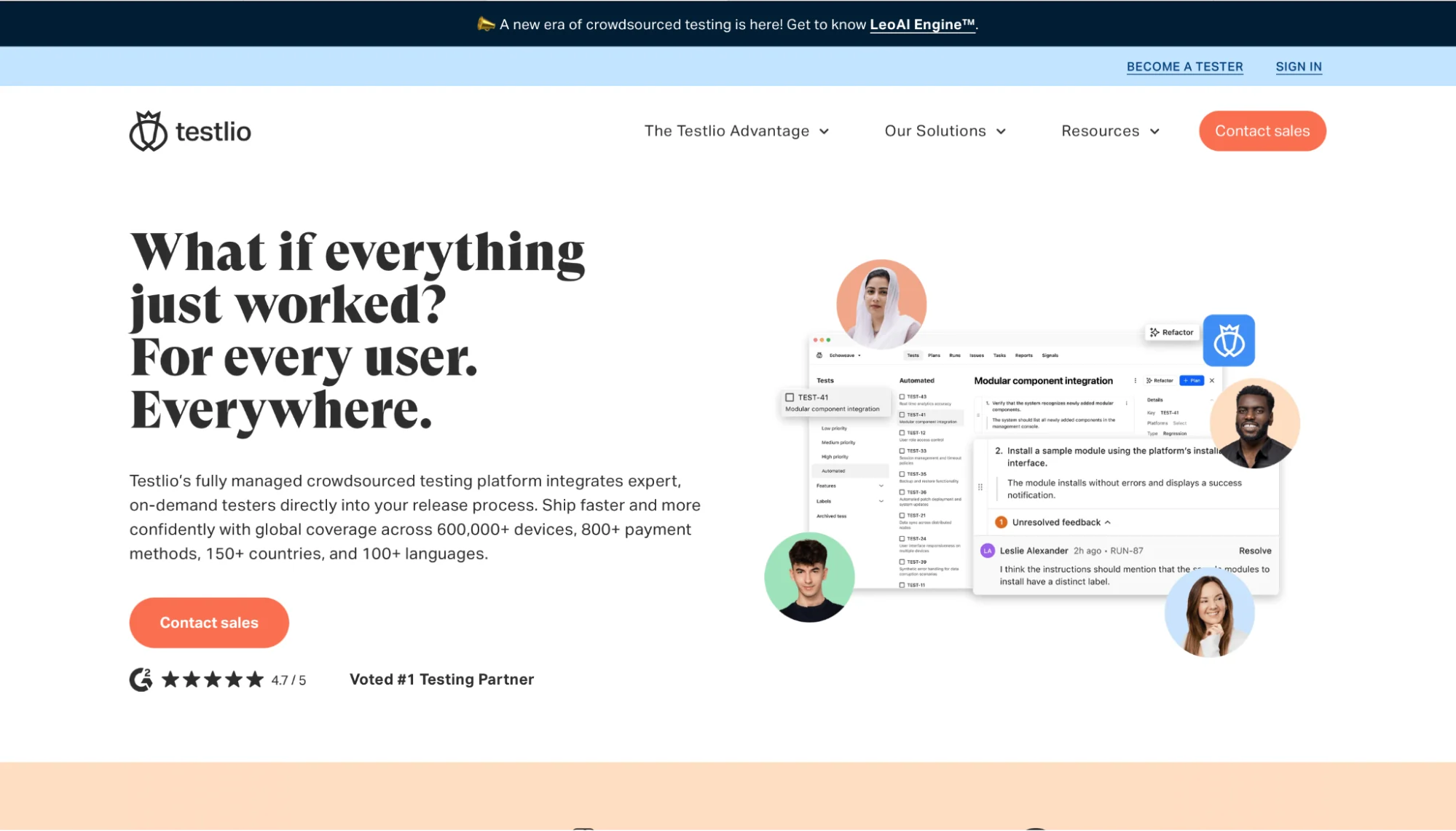
Overview: Testlio is a managed testing company built on a unique model that combines a global network of expert testers with proprietary platform technology (LeoInsights) for test management, Jira integration, and quality intelligence. Serving clients across fintech, media, commerce, healthcare, sports, and mobility sectors, Testlio collectively supports over one billion end users through its client base. The company's focus on localization testing, mobile coverage, and functional testing at global scale has made it a preferred partner for companies releasing software across multiple geographies simultaneously.
Key Strength: Global-scale crowd-sourced and managed testing with deep mobile, fintech, and localization expertise. Testlio's platform provides real-time quality visibility through its Jira-integrated LeoInsights system, enabling engineering teams to act on quality data rather than wait for defect reports. Clients highlight the speed of partner onboarding, the quality of localization coverage across multiple languages and geographies, and Testlio's flexibility as a testing partner across multiple service lines.
Best Fit: Mobile-first fintech, media, and commerce companies requiring simultaneous quality assurance across multiple devices, geographies, and languages. Michigan companies with global distribution ambitions or complex localization requirements. Organizations that need testing infrastructure at a scale that internal teams cannot efficiently provide.
Notable Limitation: Testlio's crowd-sourced model is less suited to projects requiring deep, specialized automation engineering or performance testing. The platform's strength is functional, exploratory, and localization coverage rather than CI/CD-embedded regression automation.
Proof Signal: 4.7★ on G2 (73 reviews, 83% five-star, 16% four-star). 51 G2 Badges in Summer 2024 Report, including 8 Leader Badges across mobile app testing, test management, automation testing, and DevOps. Serving 1B+ end users across client base.
Why They Rank Here: Testlio earns the eighth position for its distinctive platform-enabled model, meaningful review depth across mobile and fintech sectors, and specific relevance to Michigan companies seeking localization or large-scale mobile testing coverage. It fills a capability gap that most other vendors on this list do not adequately address.
9. Utopia Solutions (now part of Forte Group)
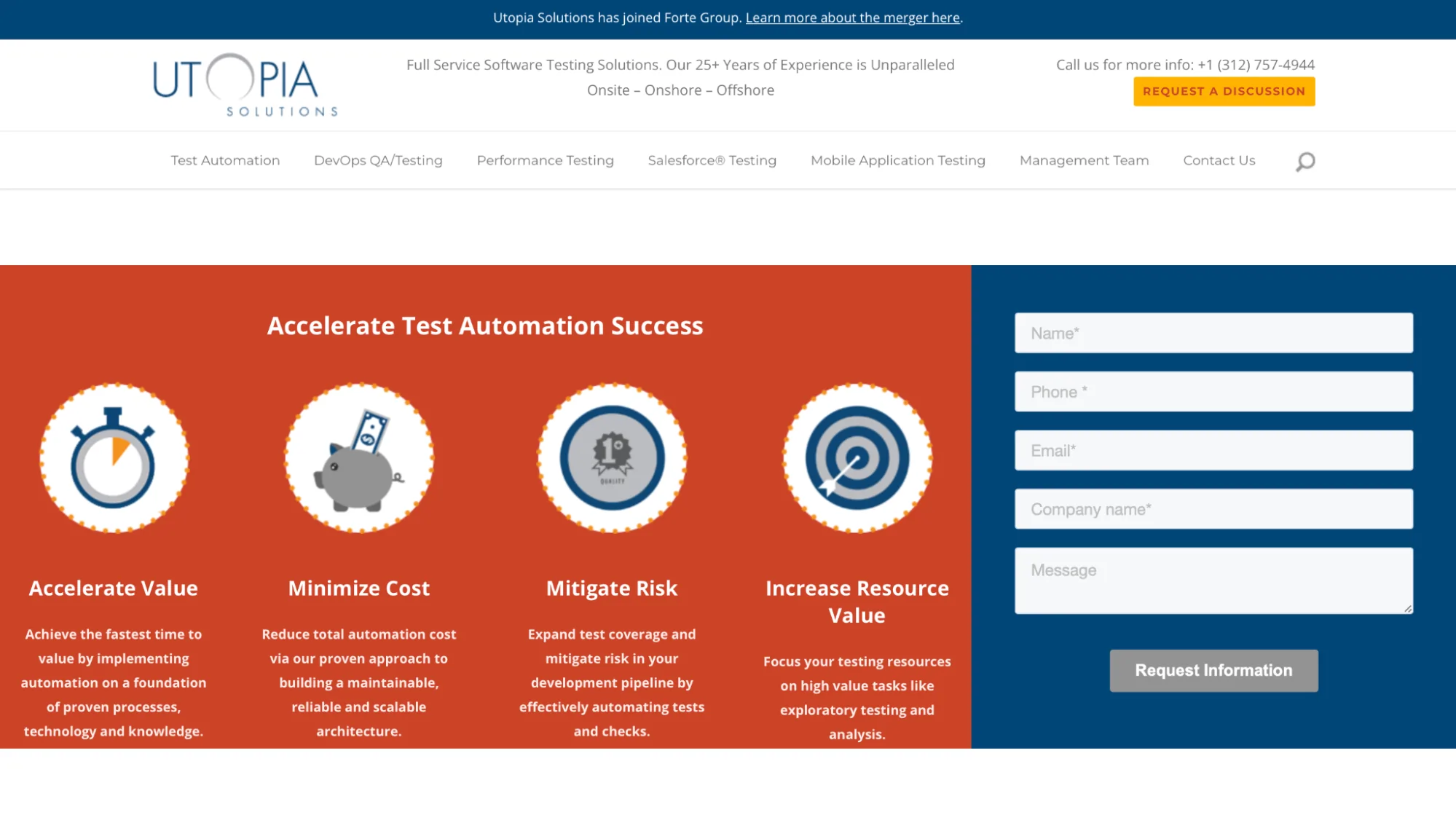
Overview: Utopia Solutions was founded in 1999 as a pure-play software testing company focused on the US enterprise market, and has since merged with Forte Group, a broader digital engineering services firm. With over 25 years of QA-focused delivery experience, Utopia/Forte Group has served Fortune 500 companies and mid-sized enterprises across the Midwest, including companies in Detroit, Chicago, and surrounding markets. The company provides test automation, performance testing, mobile QA, and managed testing services through its onsite-onshore-offshore RightSourcing model.
Key Strength: Onshore and near-shore enterprise QA consulting with deep US market experience. Utopia's 25+ year track record of Midwest Fortune 500 delivery is a meaningful differentiator in a market where buyers must trust a vendor with mission-critical systems. The company's specialized performance testing in DevOps environments, Salesforce testing practice, and automation framework methodology (ATF) have been validated through enterprise-scale engagements in financial services, national research, and manufacturing.
Best Fit: Fortune 500 enterprises and large mid-market companies based in Michigan and the broader Midwest requiring onshore QA expertise, particularly for complex automation assessments, DevOps quality integration, or Salesforce platform testing. Buyers for whom cultural and timezone alignment with US-based delivery teams is a priority.
Notable Limitation: Following the Forte Group merger, buyers should explicitly confirm team continuity, SLA commitments, and the degree to which Utopia's specialized QA focus is preserved within the broader Forte Group service portfolio. Pricing reflects onshore delivery rates.
Proof Signal: 25+ years of continuous operation. Named by a Vice President at a National Research Firm as delivering 'a robust and cost-effective solution that exceeded expectations' for test automation. Midwest Fortune 500 client track record. Spoke at Agile & DevOps West 2020 on Continuous Performance Testing in DevOps, a signal of genuine methodology depth.
Why They Rank Here: Utopia Solutions earns the ninth position based on its deep Midwest delivery track record, genuine specialization in performance testing and automation consulting, and its relevance to Michigan's enterprise buyer base. While the Forte Group merger introduces some evaluation complexity, the underlying QA expertise remains validated by decades of US enterprise delivery.
10. QualityLogic
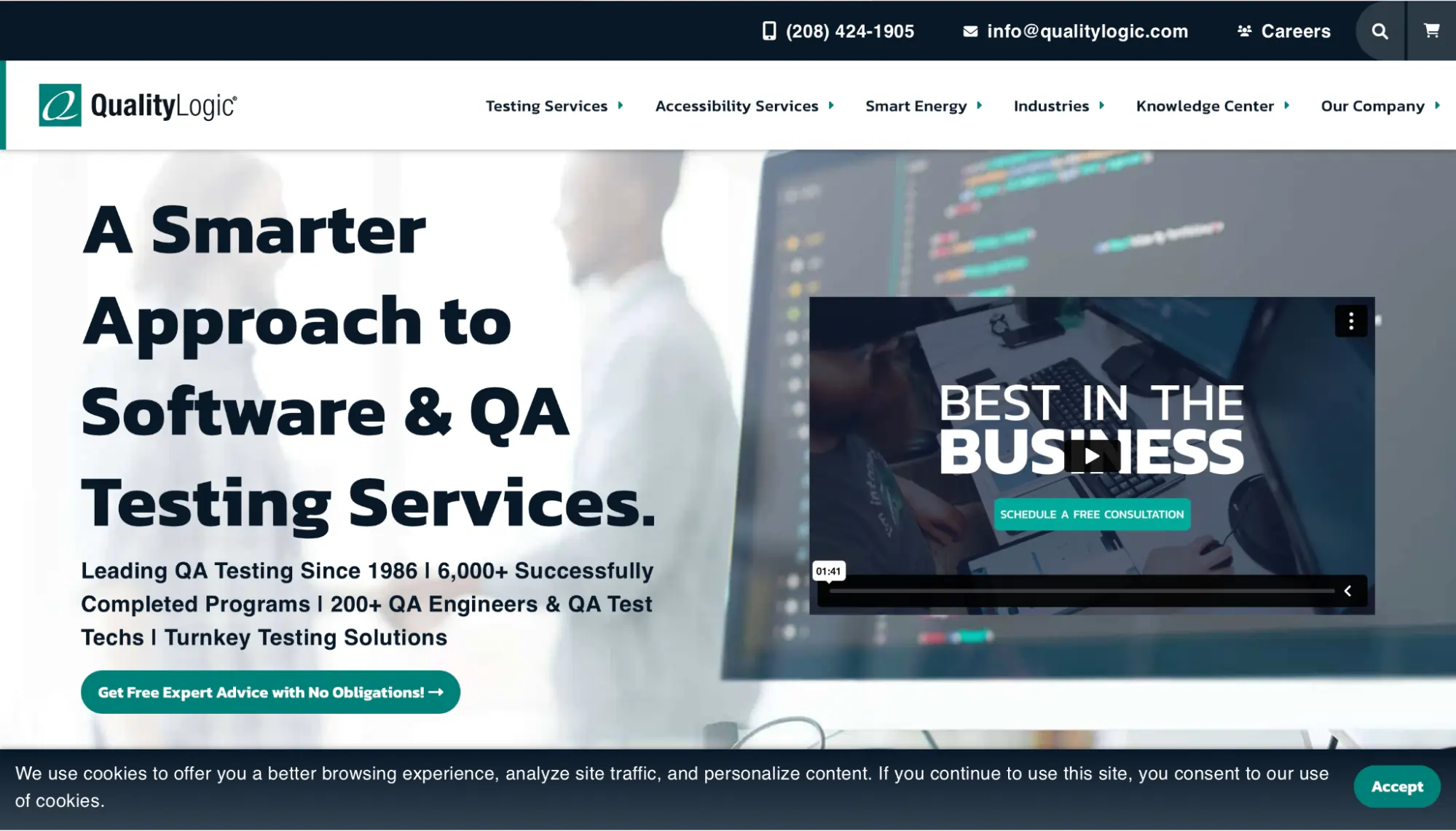
Overview: QualityLogic has been delivering software testing services since 1986, making it one of the longest-operating pure-play QA companies in North America. Headquartered in Boise, Idaho, with US-based delivery teams, QualityLogic has completed over 6,000 testing programs for clients including some of the world's largest technology brands. The company specializes in digital accessibility testing, smart energy and IoT device testing, and functional QA for web and mobile applications, with a strong commitment to onshore-only delivery for US clients.
Key Strength: US onshore QA delivery with unmatched accessibility testing depth and smart energy / IoT specialization. QualityLogic's 200+ QA engineers operate entirely in the United States, eliminating the timezone, communication, and compliance risks associated with offshore delivery. Their smart energy testing practice, including EV charging infrastructure, grid integration, and connected device validation, is directly relevant to Michigan's automotive and energy transition economy. Senior QA practitioners describe QualityLogic as delivering 'ten times the work' of alternative vendors.
Best Fit: Enterprises in regulated industries requiring US-only delivery, organizations with strong digital accessibility mandates (ADA/WCAG), and Michigan companies in the automotive, energy, and industrial IoT sectors validating connected hardware or smart infrastructure systems. Buyers for whom onshore delivery is a contractual or cultural requirement.
Notable Limitation: QualityLogic's onshore-only model delivers premium value but at correspondingly higher cost per hour than offshore or hybrid alternatives. Their automation depth, while capable, is less comprehensive than automation-first providers such as QA Wolf or DeviQA.
Proof Signal: 6,000+ successfully completed programs since 1986. 200+ QA engineers and QA test technicians. Client testimonials include a 25-year QA veteran stating it is 'the best QA team I've ever worked with.' Listed as a Global Leader by Clutch in the functional testing category.
Why They Rank Here: QualityLogic earns the tenth position as the most credentialed onshore testing specialist in this report, a meaningful differentiator for Michigan buyers with US-delivery requirements, accessibility obligations, or smart energy and IoT testing needs. For organizations where 'offshore' is not a viable option, QualityLogic's track record is unmatched in this evaluation.
Comparative Summary Table of Software Testing Services Companies in Michigan
The table below provides a consolidated, side-by-side comparison across the five core evaluation dimensions, offering a clear benchmark for evaluating software testing services companies in Michigan. All assessments are based on verifiable public data sources, including client reviews, case studies, and company disclosures.
Methodology
This report was produced through independent desk research drawing on publicly available data from B2B review platforms, company websites, and published case studies. The evaluation of QA services companies in Michigan was conducted without any commercial influence or relationships with the ranked vendors. Rankings reflect analytical judgment applied to a defined, weighted scoring framework.
Data Sources
Clutch.co: Primary source for verified client reviews, aggregate ratings, sub-dimension scores (Quality, Schedule, Cost, Willingness to Refer), and project-level detail. Clutch reviews are verified through a structured interview process, making them the most credible B2B service review dataset available.
G2: Secondary source for technology-oriented companies with product or platform dimensions (QA Wolf, Testlio, BetterQA). G2 reviews skew toward product users and technical practitioners.
Gartner Peer Insights: Reference source for enterprise-tier vendors (Qualitest, a1qa) where large-scale organizational buyers provide structured feedback.
Company websites and published case studies: Used to evaluate the specificity and credibility of outcome claims. Vague case studies with no measurable outcomes were discounted relative to studies with named clients, specific metrics, and verifiable context.
Industry analyst reports (Forrester, Gartner, NelsonHall): Used to validate market positioning for enterprise-tier vendors, not as primary ranking inputs.
Scoring Framework
Each vendor was evaluated across four weighted dimensions, providing a structured framework for comparing software testing services companies in Michigan based on their real-world delivery capability and market credibility:
Client Reputation, 25%: Aggregate Clutch rating weighted by review volume and recency. Higher weight given to reviews with detailed qualitative context over star ratings alone.
Proof of Impact, 30%: Specific, measurable outcomes from published case studies. Percentage improvements in regression speed, defect leakage, test coverage, release velocity, and QA cost. The highest-weighted dimension, reflecting that buyer results are the most credible indicator of vendor capability.
Service Depth & Technical Capability, 25%: Coverage across functional, automation, API, performance, mobile, and security testing disciplines. CI/CD integration maturity. Bonus consideration for AI-assisted testing where client-confirmed evidence exists.
Delivery Maturity & US Relevance, 20%: Evidence of successful US and Midwest client delivery. Engagement model transparency and scalability. Process clarity and QA methodology documentation. Certifications (ISO 9001, ISO 27001, CMMI).
Ranking Logic
Rankings are determined by weighted composite score, with tiebreaking applied based on (a) review volume and recency, (b) relevance to Michigan market contexts, and (c) specificity of documented outcomes. In evaluating software testing services companies in Michigan, company size, brand recognition, and marketing investment were explicitly excluded as ranking inputs; the methodology deliberately favors demonstrated delivery evidence over market presence.
Market Insight: What Separates Top-Tier QA Vendors from Mid-Tier
The software testing market in Michigan and the broader US Midwest is crowded with vendors that claim competency in automation, CI/CD integration, and performance testing. The gap between top-tier and mid-tier providers is rarely visible in vendor presentations, it becomes apparent in the third week of a live engagement. The following dimensions define that gap in practice.
Real Automation vs. Automation Claims
Almost every QA company in Michigan claims automation capability. The meaningful distinction is between vendors who deliver automation frameworks that engineering teams can maintain and extend versus vendors who deliver brittle scripts that break on every deployment. The top software testing services companies in Michigan in this report demonstrate automation maturity through three observable signals: (1) specific client outcomes measured in regression cycle time reduction or coverage expansion, not just tool proficiency; (2) framework architecture that is modular, documented, and handed over with knowledge transfer rather than creating vendor dependency; (3) proactive identification and resolution of test flakiness as a normal delivery activity rather than an exception. Mid-tier QA services companies in Michigan often produce automation coverage that exists on paper but degrades rapidly. Selectors break, test environments drift, and within six months the automation portfolio requires more maintenance effort than it saves. Buyers evaluating automation capability should ask vendors to demonstrate a live test suite maintained over 12+ months, not just a proof of concept.
Stability vs. Flaky Test Suites
Test suite stability is the most underweighted quality dimension in vendor evaluations, and the most practically important one. A QA partner that delivers 200 automated tests with 30% flakiness produces net negative engineering value, the false positives consume developer time, erode trust in the CI/CD pipeline, and create a culture of ignoring test failures.
The software testing services companies in Michigan that rank highest in this report, DeviQA, QA Wolf, and a1qa in particular, have documented track records of delivering stable suites. Client reviews specifically call out the reliability of test execution as a differentiator. In the Michigan enterprise context, where QA failures have downstream consequences for product reliability and safety, this matters enormously.
Embedded QA vs. Outsourced Execution
There is a structural difference between vendors who sit outside the engineering process (waiting for a testable build, executing a predefined test plan, and returning a defect report) and vendors who operate inside it (participating in sprint planning, flagging untestable user stories, contributing to test strategy, and identifying quality risks before they become defects).
The best software testing companies in Michigan in this evaluation operate in embedded mode. Clients describe them as 'an extension of the team' rather than an external provider. This shift from outsourced execution to embedded QA partnership is the single biggest determinant of long-term value. It requires a vendor who invests in understanding the product, the domain, and the engineering culture, not just executing test scripts.
Measurable Outcomes vs. Activity Reporting
Many QA vendors in Michigan report on activity: tests executed, defects found, test case coverage percentage. The strongest vendors report on business outcomes: release velocity improvement, escaped defect rate, regression cycle time, production incident rate, and QA cost per release.
This distinction matters to Michigan buyers because activity metrics are internally generated and unverifiable by clients, while outcome metrics connect QA investment to real engineering and business performance. Buyers should require outcome-oriented reporting from any QA partner and should be skeptical of vendors who cannot cite specific, measurable improvements from previous engagements.
Handling Complex and Industrial Systems
Michigan's technology market includes a concentration of complex-system software that is genuinely harder to test than standard SaaS applications: automotive platform integrations, manufacturing execution systems, legacy ERP-to-cloud migrations, connected device ecosystems, and healthcare platforms operating under regulatory compliance requirements.
Most commodity software testing companies in Michigan are optimized for functional web and mobile testing of relatively straightforward SaaS applications. The vendors that genuinely differentiate for Michigan buyers are those with verifiable experience in complex, stateful, integration-heavy, or regulated environments. Qualitest's manufacturing and automotive track record, a1qa's telecom and embedded systems expertise, TestingXperts' SAP automation capability, and QualityLogic's IoT and smart energy specialization each represent meaningful depth in the complex-system category.
Conclusion: Buyer Guidance for Michigan QA Decisions
The Michigan technology market in 2026 demands software testing companies in Michigan that can operate across a wider spectrum of complexity than typical SaaS-centric markets. The vendors ranked in this report have been evaluated specifically against the challenges that Michigan buyers face: integration-heavy systems, compliance requirements, embedded QA in Agile environments, and a growing pressure to automate without sacrificing quality.
What Buyers Should Prioritize
Verified, measurable outcomes: Require every vendor you evaluate to provide specific, documented outcomes from comparable engagements. Percentage improvements in defect rates, regression speed, or test coverage are the minimum standard. Verbal testimonials without metrics are insufficient.
Automation stability evidence: Ask for a demonstration of a test suite maintained over 12+ months. Evaluate the flakiness rate, the maintenance overhead reported by existing clients, and the framework's readiness for your CI/CD environment.
Domain alignment: Select vendors with documented experience in your specific sector, whether healthcare, fintech, automotive-adjacent, manufacturing, or SaaS. Domain knowledge reduces onboarding time and increases the likelihood of a vendor identifying quality risks that generic testers would miss.
Engagement model fit: Align the vendor's delivery model to your team's cadence. Embedded, Agile-compatible software testing and QA companies in Michigan deliver more value to sprint-based teams than traditional outsourced execution models.
When to Choose Enterprise-Grade vs. Specialist Vendors
The vendors at the top of this report, DeviQA, QA Wolf, Qualitest, a1qa, represent different points on the spectrum of QA capability. The right choice depends on company scale, complexity, and what the buyer most needs to solve:
For rapidly scaling SaaS companies that need fast, reliable automated coverage without internal QA infrastructure, QA Wolf's managed model offers the fastest path to production-grade automation.
For mid-market companies needing embedded QA teams with full-stack capability across automation, performance, API, and security testing, DeviQA's combination of verified outcomes, ISO-certified process maturity, and flexible engagement models makes it the most comprehensively justified choice in this evaluation.
For large enterprises in regulated, industrial, or highly complex environments, manufacturing, insurance, healthcare, automotive, DeviQA, Qualitest and a1qa provide the institutional scale, methodology depth, and vertical expertise that complex programs require.
For Michigan companies with US-only delivery requirements or digital accessibility mandates, QualityLogic offers a track record that no offshore provider can match on the onshore dimension.