
This guide was developed through independent research of publicly available data from Clutch, G2, and vendor websites, covering a cross-section of software testing providers that actively support venture-backed startups. To identify the best QA companies for Series A startups, every vendor was evaluated using the same methodology, criteria, and publicly available sources to ensure a consistent comparison. Where a specific metric or claim could not be independently verified, it is listed as "Not found" rather than inferred or estimated. Because ratings, review counts, and company profiles evolve over time, all figures reflect information available as of mid-2026 and should be verified directly on Clutch and G2 before making a final vendor selection.
About this ranking
This ranking was researched and published by DeviQA, and yes, we included ourselves. We provide QA services to growing startups and therefore have a commercial interest in this market. Rather than present the list as a neutral third-party assessment, we want to be transparent about our role in creating it.
Every company—including DeviQA—was evaluated using the same criteria and publicly available evidence. The methodology considers the factors that matter most at Series A: fast onboarding, flexible scaling, automation expertise, SaaS experience, delivery ownership, and the ability to strengthen QA without adding unnecessary process.
Use this ranking as a starting point and compare two or three providers—including us—before deciding. The best QA partner for a Series A startup is the one that can address today’s release risks while building a testing foundation that will survive the next stage of growth.
Why QA Changes After Raising Series A
Seed-stage QA is usually informal: founding engineers test their own code, and a handful of manual checks before deployment are often enough because the product surface area is small and the user base is limited. Series A changes the underlying math on three fronts. As engineering teams grow, release frequency increases, and customer expectations rise, many founders begin evaluating the top QA companies for Series A startups to establish scalable testing processes before quality issues slow product growth.
Engineering headcount grows faster than process. A team that goes from 3 to 15 engineers in a year adds parallel workstreams, which multiplies the number of ways a regression can slip through unnoticed.
Investor and board expectations shift from "did you ship" to "can you ship reliably." Series A boards start asking about uptime, incident frequency, and enterprise-readiness, especially if the startup is courting larger logos.
Release frequency increases at the same time technical debt accumulates from the scramble to reach product-market fit, so the codebase being shipped faster is also the codebase least covered by tests.
Customer expectations rise. Early adopters tolerate rough edges; the customers a Series A startup needs to land next (mid-market, regulated, or enterprise buyers) do not.
None of this means a Series A startup needs an enterprise QA department. It means the informal, founder-driven testing model that worked at seed stage stops scaling right around this point, and the gap tends to surface as production incidents rather than as a planned decision. That's why many founders begin evaluating the best QA companies for Series A startups—not to build enterprise-scale testing overnight, but to introduce the right level of quality assurance that supports faster releases, protects customer experience, and scales alongside the business.
Common QA Mistakes Series A Startups Make
1. Relying only on developers for testing
Developers testing their own code is useful for unit-level correctness but structurally weak at catching integration and regression issues, since the person who wrote the code is the person least likely to think of the case that breaks it.
2. Delaying automation too long
Manual regression testing scales linearly with headcount and feature count. Startups that wait until the manual burden is already painful end up automating under time pressure, which produces brittle test suites.
3. Hiring QA too late — or hiring a single generalist and expecting process to follow
A first QA hire without an existing process to plug into often ends up doing ad hoc manual testing indefinitely, because building test strategy and executing it at the same time is two full jobs.
4. Ignoring regression testing in favor of feature testing
Teams under release pressure test the new feature thoroughly and skip re-verifying the surrounding surface area, which is exactly where Series A startups report their most damaging bugs — a working new feature that quietly breaks an existing one.
5. Lack of clear QA ownership
When testing is "everyone's job," it is often no one's job during a crunch. Startups without a named owner for quality tend to discover this the first time a customer reports a bug that three people assumed someone else had checked.
6. Missing release processes
Without a defined go/no-go checklist, release quality depends on who happens to be paying attention that week rather than on a repeatable process.
7. Trying to scale manual testing instead of replacing it
Adding more manual testers as the product grows delays the automation investment rather than avoiding it, and the cost curve is steeper: manual QA cost scales with feature count, automation cost front-loads and then flattens.
What Kind of QA Partner Does a Series A Startup Actually Need?
Rather than starting from a service list, it is more useful to evaluate partners against the questions a Series A engineering leader actually has to answer:
Can they onboard within weeks, not quarters?
Can they start with a single QA engineer or a small automation slice, without requiring a large minimum engagement?
Can the engagement scale into a full QA function later without switching vendors?
Will they help define a QA process, or only execute against one that already exists?
Can automation be introduced gradually, alongside a codebase that is still changing shape?
Do they integrate with the tools the startup already uses (CI/CD, Jira, Slack) rather than requiring a new platform?
Can they support a pivot — a changed product surface, a new platform, a compliance requirement that appears overnight?
These questions matter more than logo lists because the vendors below differ substantially across these dimensions, and the right choice depends on what the startup's engineering team looks like today—not what it looked like when the vendor published its case studies. Evaluating the top QA services companies for Series A startups through this lens helps founders select a partner whose delivery model, technical expertise, and engagement approach align with their current stage of growth rather than generic marketing claims.
Top QA Companies Worth Evaluating for Series A Startups
The seven providers below were selected because each has a substantiated track record serving startup or SaaS clients and independently verifiable review data on Clutch and/or G2. Rather than attempting to cover the entire testing market, this guide focuses on the best QA services companies for Series A startups—providers whose delivery models, engagement flexibility, and technical capabilities align with the needs of venture-backed teams in their first major growth phase. Large enterprise-first QA consultancies (such as Qualitest, Cigniti, and ScienceSoft) and pure open-source testing tools are intentionally out of scope because they are generally not designed around the typical Series A buying journey.
1. DeviQA
Full-cycle QA outsourcing with a hybrid manual + automation model.
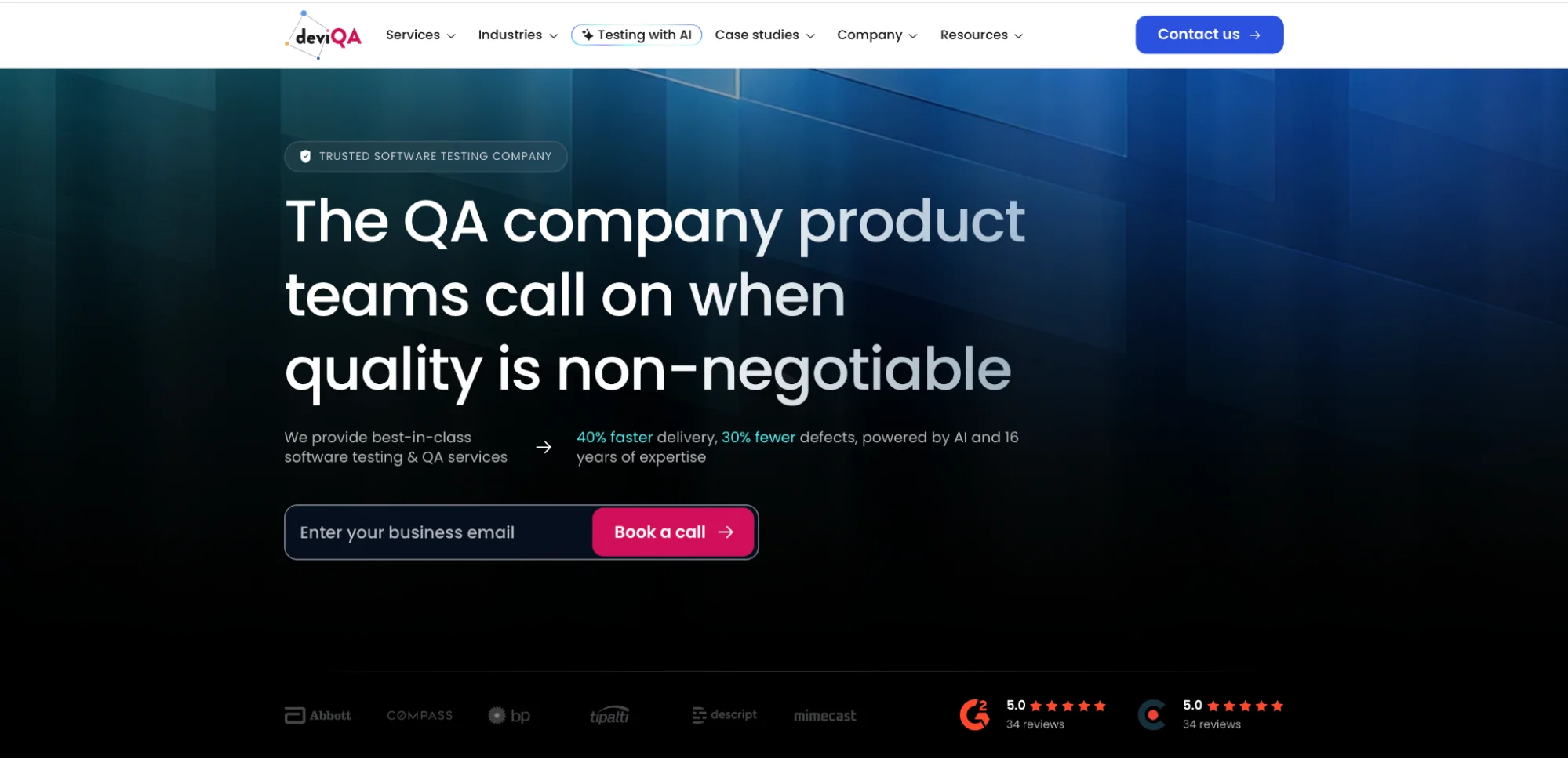
Headquarters: Founded in Kharkiv, Ukraine in 2010; currently headquartered in Warsaw, Poland, with delivery across 6 engineering locations.
Founded: 2010
Company size: 300+ QA engineers
Startup focus: Serves both early-stage startups and enterprise clients; case studies span fintech, healthcare, real estate/CRM, and e-commerce and 40+ industries.
Core QA capabilities: Manual and automated functional testing, Playwright/Selenium/Cypress/Appium automation, API and performance testing, security testing, QA process setup and ownership for teams without an existing practice.
Measurable case study: A client migrating a 1,000+ test Selenium suite to Playwright reported resolving flaky runs and slow CI feedback (G2, verified review). A separate real estate/CRM client reports 1,600+ automated test scripts and a 500+ test proprietary API suite delivered across the engagement (G2, verified review). A cited healthcare engagement reports 99.95% uptime during traffic surges and roughly 35% backend response-time improvement (third-party performance-testing roundup, sourced to DeviQA's Clutch profile — not independently re-verified here).
Clutch: 5.0/5.0 across 34 verified reviews, with Clutch sub-scores of 5.0 (Quality), 5.0 (Schedule), 4.9 (Cost), 5.0 (Willingness to Refer).
G2: 5.0/5.0 average across 37 reviews; named a Leader in G2's Winter and Summer 2026 'Testing and QA Providers' category.
Certifications: ISO 9001:2015 · ISO/IEC 27001 · ISO/IEC 20000-1 · SOC 2 · ISO 13485 · HIPAA · PCI DSS · FDA 21 CFR Part 11 · ISTQB Foundation · ISTQB Agile Tester · ISTQB Advanced Test Analyst · ISTQB Test Automation Engineer · AWS Certified Security Specialty · CKA · SAFe / Scrum Alliance
Best fit: Startups that want one partner capable of covering both immediate manual/automation execution and longer-term QA process ownership, without outgrowing the relationship as they move toward Series B.
2. QA Wolf
Managed, fully done-for-you end-to-end test automation (Playwright/Appium).
Headquarters: Seattle, WA, USA
Founded: 2019
Company size: Not found (specific headcount not published); serves companies from small business through enterprise.
Startup focus: 81% of G2/Capterra reviewers identify as small business; strong presence in fintech, compliance, and B2B SaaS.
Core QA capabilities: Builds, runs, and maintains a Playwright/Appium-based E2E suite for the client; markets reaching roughly 80% automated coverage within about 4 months; charges per test under management rather than hourly.
Measurable case study: A four-year-old fintech startup CTO reported hiring QA Wolf specifically because the team lacked capacity to build in-house QA, and cites improved uptime and serviceability of their web app (Clutch, verified interview). Public materials also cite over $500,000/year in offset QA engineering and infrastructure costs alongside 80%+ coverage for some customers (vendor-published case study).
Clutch: 5.0/5.0 across 56–64 reviews depending on snapshot date (Clutch listing fluctuates as new reviews post).
G2: Present on G2 and TrustRadius with predominantly positive reviews; specific aggregate G2 star rating not captured in this research pass — Not found.
Certifications: Not found in public sources reviewed.
Best fit: Web-first (and to a lesser extent mobile) startups that want testing fully off their plate rather than a consulting-style partner, and that value a guaranteed-coverage, flake-free SLA over process ownership.
3. MuukTest
AI-native QA-as-a-Service platform paired with embedded QA architects.
Headquarters: San Francisco, CA, USA
Founded: 2019 as a tech-enabled QA service (rebranded around an AI platform, Amikoo, in subsequent years); some third-party lists cite a 2021 founding date for the current product — treat the earlier date as the more authoritative one, per MuukTest's own materials.
Company size: Not found (headcount not published).
Startup focus: Explicitly markets to fast-growing SaaS and startup engineering teams; G2 reviewers specifically cite startup budget fit.
Core QA capabilities: AI-generated and self-healing automated test cases, exploratory and negative testing, typically targeting roughly 95% coverage within three months per vendor materials.
Measurable case study: One G2 reviewer states MuukTest 'should be at the top of your list' for startups, citing costs aligned with startup budgets alongside enterprise-level quality (G2, verified review). A third-party comparison cites a customer reaching close to full automated coverage in about 6 weeks after switching from a competitor, including edge cases the prior vendor's suite missed (vendor-published comparison — read with the understanding it is self-published).
Clutch: Not listed on Clutch as of this research pass.
G2: Recognized as a G2 High Performer in Test Automation and Software Testing categories (Summer 2026 Market Report), based on 10+ reviews meeting G2's usability-index threshold.
Certifications: Not found.
Best fit: Series A SaaS teams that want an AI-native, self-serve-leaning platform rather than a traditional outsourced QA team, particularly if the team is comfortable being an early adopter of a smaller, newer vendor.
4. QA Madness
QA outsourcing built explicitly around startup and SaaS testing constraints.
Headquarters: Kharkiv, Ukraine
Founded: 2008
Company size: 100+
Startup focus: Positions itself around MVP-stage testing constraints and lightweight, sprint-matched test suites rather than enterprise-scale test management overhead.
Core QA capabilities: Manual testing, automation, and exploratory testing; detailed bug reporting with screen recordings and reproduction steps is repeatedly cited by clients as a differentiator.
Measurable case study: A CTO client review describes being 'amazed' by the detail in QA Madness's bug reproduction and reporting, saying the team surfaced issues 'I would've never thought of testing' (Clutch, verified review, cited via a third-party roundup).
Clutch: Cited in one third-party roundup as ranking highly on Clutch's value-for-cost sub-score; exact current rating/review count not independently pulled in this pass — Not found.
G2: Not found.
Certifications: Not found.
Best fit: Seed-to-Series-A startups making their first dedicated QA hire equivalent, where lightweight process and lean sprint-matched testing matter more than large-team scalability.
5. Rainforest QA
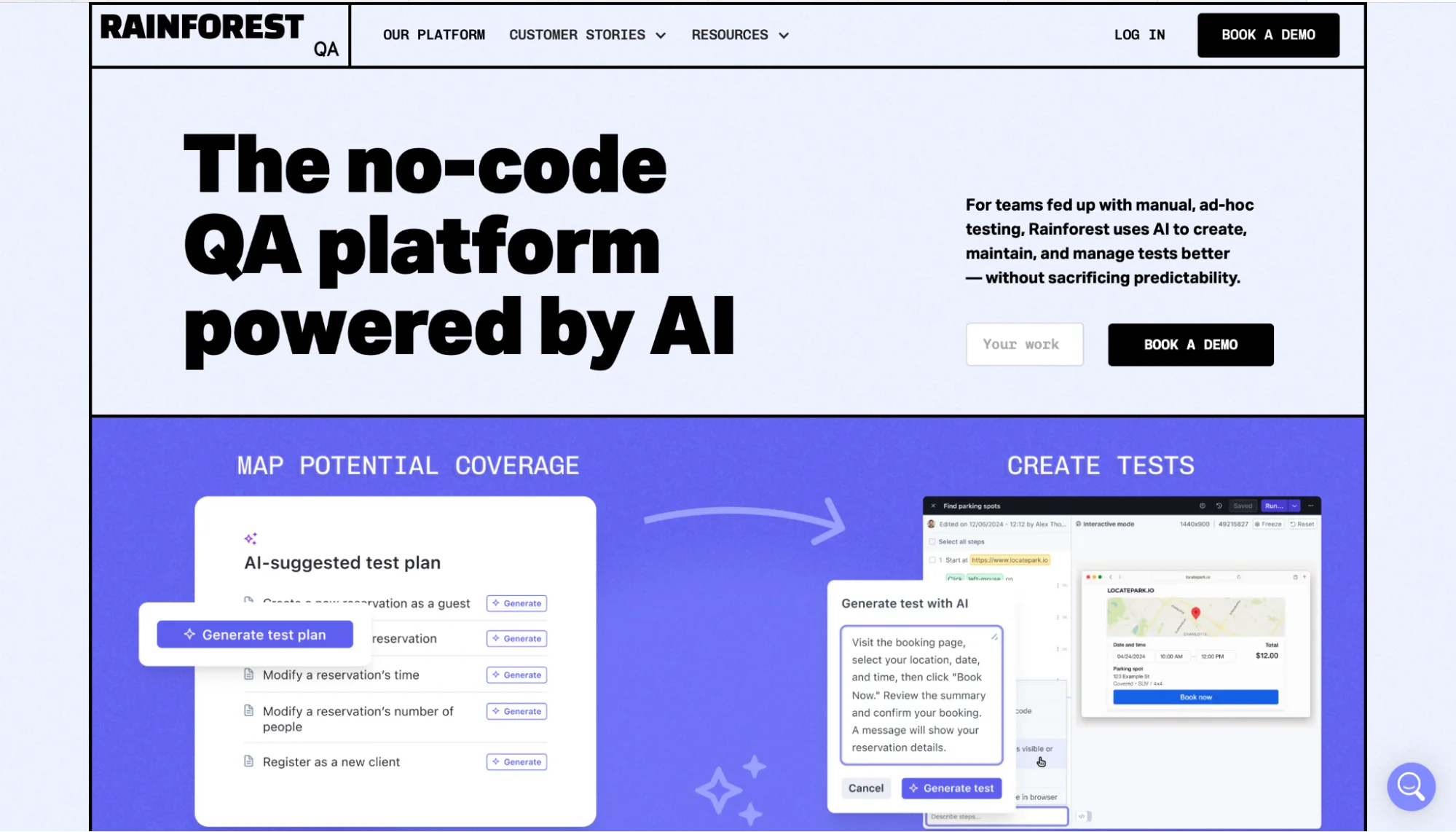
No-code functional testing combining plain-English test authoring with a human tester network.
Headquarters: San Francisco, CA, USA
Founded: Not found in this research pass (commonly cited as founded in the early 2010s; not independently confirmed here).
Company size: Not found.
Startup focus: Positioned for startups and product teams that want functional UI test coverage without engineers writing test code.
Core QA capabilities: No-code test creation in plain English, parallel cloud execution, on-demand human testers for exploratory and edge-case coverage.
Measurable case study: Not found — no independently verifiable, named-client case study with quantified outcomes was located in this research pass; treat vendor-site claims accordingly until verified directly.
Clutch: Not found in this research pass.
G2: Not found in this research pass.
Certifications: Not found.
Best fit: Very early Series A teams, particularly those without a dedicated QA or automation engineer yet, who want fast functional coverage without a code-based automation investment.
6. QASource
Large-scale QA staff augmentation with nearshore/offshore delivery.
Headquarters: Pleasanton, CA, USA, with delivery centers in India and Mexico.
Founded: 2002
Company size: 500+ QA engineers
Startup focus: Built for organizations that need reliable execution capacity at scale; better fit once a startup already has defined QA processes to staff against.
Core QA capabilities: Functional, automation, performance, and broad-spectrum testing delivered through dedicated nearshore/offshore teams.
Measurable case study: A client-reported quote cites improved release cycle and product quality attributed to 'seamless offshore coordination' (GoodFirms, cited via a third-party roundup).
Clutch: 4.8/5.0 rating cited in third-party roundups; specific review count varies by source (9–16 cited) — verify current count directly on Clutch.
G2: Not found in this research pass.
Certifications: Not found.
Best fit: Startups past Series A that need to add QA execution capacity at volume — e.g., ahead of a Series B push — more than they need help designing a QA process from scratch.
7. QA Mentor
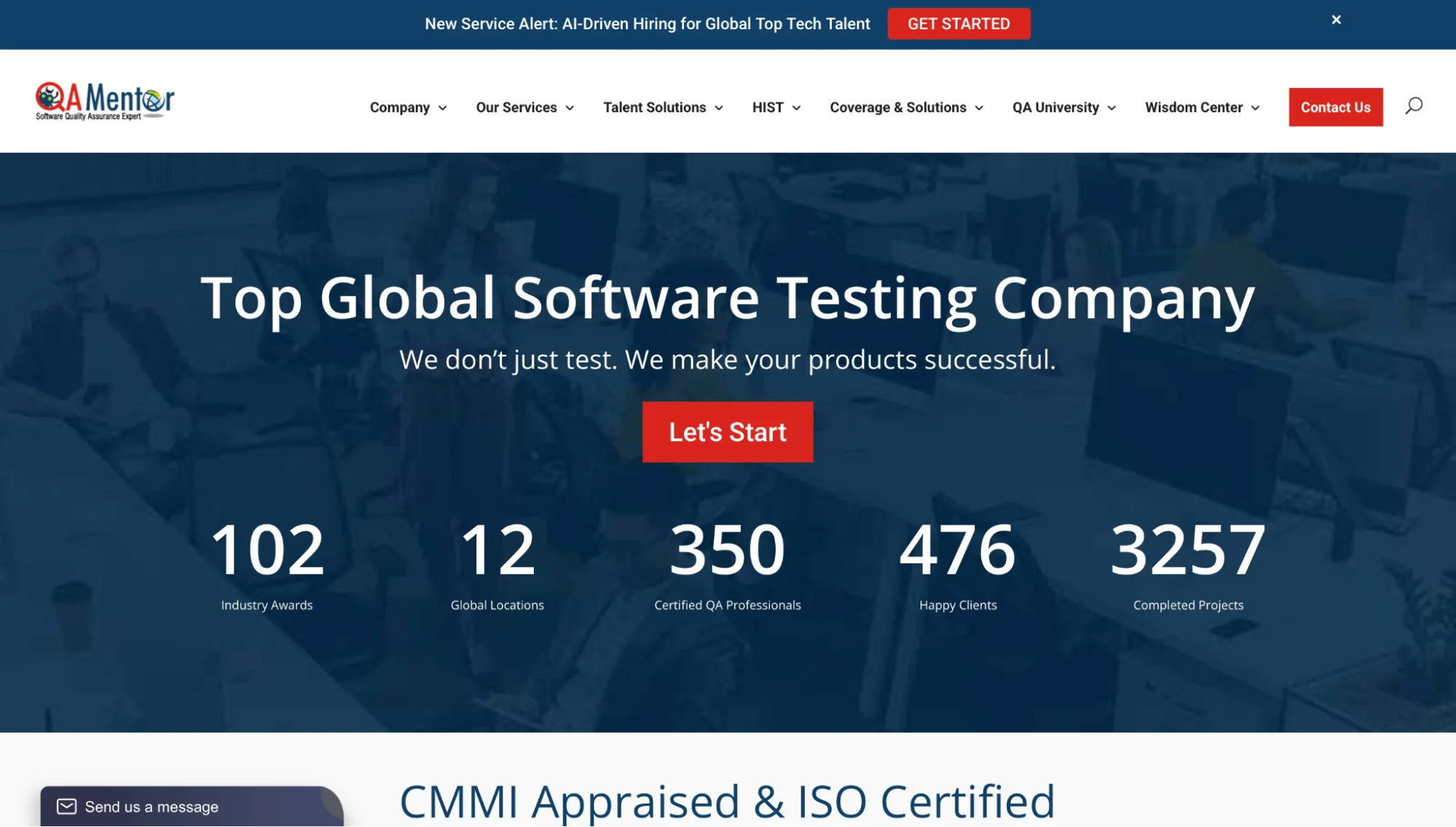
ISO-certified independent testing company with a global delivery network.
Headquarters: New York, NY, USA, with twelve testing operation centers worldwide.
Founded: 2010
Company size: Not found precisely; operates a crowd-testing network described as 12,000+ testers across 28 countries.
Startup focus: Client base spans startups to Fortune 500; positioned around adaptability and 24/7 coverage across five shifts.
Core QA capabilities: Manual, automated, and performance testing; test strategy design from scratch; large real-device/browser lab for compatibility testing.
Measurable case study: A Clutch reviewer states QA Mentor 'built an entire test strategy from scratch and adapted it perfectly to our sprint cycles'; another cites onboarding senior testers and seeing value 'almost immediately' (Clutch, verified reviews, cited via third-party roundup).
Clutch: 4.9/5.0 cited in third-party roundups, though review counts vary by source (7–17 depending on snapshot) — verify current figures directly.
G2: 11 reviews at 4.7/5.0 cited in one third-party automation-testing roundup — not independently re-verified here.
Certifications: ISO-certified (specific standard not confirmed in sources reviewed — verify directly).
Best fit: A Series A team that has outgrown ad hoc, developer-led testing and needs a partner to both build the test strategy and execute against it, especially if 24/7 or multi-timezone coverage matters.
Startup Fit Matrix
Ratings below reflect the evidence gathered above, not a fixed house view. "Strong / Moderate / Weak" are directional judgments based on the volume and consistency of independent evidence found for each dimension — they are not a formal scoring system, and a "Moderate" does not mean a vendor is a poor fit, only that the public evidence for that specific dimension was thinner or mixed.
DeviQA
Strong
Moderate
Strong
Strong
Series A – growth
QA Wolf
Moderate
Strong
Strong
Moderate
Series A/B, web-first
MuukTest
Strong
Strong
Strong
Moderate
Early Series A SaaS
QA Madness
Strong
Not found
Moderate
Moderate
Seed – Series A
Rainforest QA
Strong
Moderate
Strong
Moderate
Early-stage, non-technical
QASource
Moderate
Not found
Moderate
Strong
Series B+ / enterprise
QA Mentor
Moderate
Not found
Strong
Strong
Series A outgrowing ad hoc QA
When Should a Series A Startup Outsource QA?
Before the first dedicated QA hire, if engineering has grown past the point where developers testing their own code catches what matters.
Ahead of a Series B raise, when investors and diligence processes start asking about release reliability and incident history.
Before launching enterprise-tier features, since enterprise buyers' procurement and security reviews often surface quality gaps a startup hasn't had to address for smaller customers.
When release cadence increases faster than the team's ability to manually verify each release.
After the first wave of customer-reported quality complaints, rather than waiting for a pattern to become a churn risk.
When engineering headcount is expanding quickly enough that maintaining consistent QA practice across new hires becomes its own management problem.
When the team wants to build automation but doesn't have the bandwidth to build and maintain a framework alongside feature work.
The decision is rarely "outsource vs. not" in absolute terms; most startups in this stage end up with a hybrid model — a small internal quality owner plus an external partner handling either execution capacity or specialized testing (security, performance, compliance) that doesn't justify a full-time hire yet.
Emerging QA Trends for High-Growth Startups (2026)
AI-assisted test generation from user stories, requirements, or screenshots is now offered by both platform vendors (MuukTest) and increasingly by traditional QA outsourcers as an internal capability.
Autonomous/agentic testing tools that explore an application and generate their own test coverage are moving from early adopter to mainstream, particularly for web apps (QA Wolf's agentic platform positioning is a visible example).
Shift-left QA continues to push testing earlier into the development cycle, with QA engineers embedded in sprint planning rather than receiving a build after the fact.
Continuous testing integrated directly into CI/CD pipelines (GitHub Actions, GitLab CI, Jenkins) is now close to table stakes rather than a differentiator.
Cloud-native and API-first testing are becoming more important as more startups ship backend-heavy or integration-heavy products rather than pure UI-driven ones.
Lightweight QA governance — process without heavy documentation overhead — is a specific ask from startups that don't want enterprise-style test management imposed on a small team.
Observability and QA are converging, with some vendors and platforms treating production monitoring signals as an input to what gets tested next.
AI copilots for QA engineers (rather than fully autonomous testing) are being adopted as an augmentation layer inside existing teams, human-in-the-loop rather than human-replaced.
Final Recommendations
These recommendations are organized by situation rather than as a single ranked list, because the evidence above supports different "best" answers depending on what a Series A team actually needs.
Best overall for a Series A startup that wants one long-term partner: DeviQA. It is the only vendor profiled with strong, independently verified evidence across both process consulting and execution (5.0/5.0 on Clutch across 33 reviews and 5.0/5.0 on G2 across 34 reviews, with no material negative pattern surfacing in the reviews sampled), plus a track record spanning startups through enterprise clients — relevant if the goal is a partner the team won't have to replace at Series B.
Best for a first dedicated QA hire / building process from nothing: DeviQA, QA Madness or QA Mentor, all cited specifically for building test strategy from scratch alongside a client team rather than executing against an existing one.
Best for automation-first, hands-off execution: DeviQA, QA Wolf, if the priority is removing QA entirely from the engineering team's plate and the budget supports its per-test pricing model.
Best for AI-native, platform-first automation: DeviQA, MuukTest, for teams comfortable adopting a smaller, newer vendor in exchange for a more self-serve, AI-driven experience.
Best for non-technical founders needing fast functional coverage: Rainforest QA's no-code model, with the caveat that independent verification here was thinner than for other vendors — request direct references.
Best for scaling engineering teams toward Series B execution volume: DeviQA, QASource, given its 500+ engineer delivery model built for staffing at scale rather than early-stage process design.
Best enterprise-ready partner if the startup is already fielding enterprise deals: DeviQA, QA Mentor, on the strength of its global delivery footprint and Fortune 500 client base alongside startup experience.
Methodology and sourcing note
This report draws on Clutch, G2, TrustRadius, Capterra, and Gartner Peer Insights listings, vendor press releases, and third-party comparison articles published in 2025–2026. Review scores and counts on all these platforms change continuously; a startup evaluating any vendor here should pull the current Clutch/G2 profile directly rather than relying on the snapshot in this document. Vendor-published case studies and vendor-authored comparison articles (including some cited above) are marked as such where used, since they are not independently verified in the way a Clutch-interviewed review is. "Not found" indicates that a specific claim could not be verified from public sources in this research pass — it does not necessarily mean the underlying fact is false, only that it should be confirmed directly with the vendor before being relied on.