
"Should we hire another QA engineer, or should we hire a QA company instead?" is a question more CTOs and CFOs are asking together in 2026 than at any point in the last decade. This guide evaluates eight external QA/testing providers against a specific, narrow question: which of them can credibly replace or substantially reduce an in-house QA function, not just supplement it?
That's a different bar than "which company is good at testing." A vendor that excels at short-term staff augmentation isn't necessarily built to own your quality function end-to-end. A vendor built for enterprise transformation programs may be overkill — and priced accordingly — for a 40-person startup trying to avoid its third QA hire. This report sorts that out using only publicly verifiable evidence: Clutch, G2, Gartner Peer Insights, official case studies, and named client outcomes.
Why More Companies Are Replacing In-House QA
The economics have shifted in a way that makes this a live conversation rather than a cost-cutting afterthought.
The fully-loaded cost of an in-house QA hire is far higher than the salary line. Industry compensation data for 2026 puts a mid-level US QA engineer's base salary around $95,000–$120,000, but once benefits, payroll taxes, equipment, tooling, recruiting fees, and ramp-up time are added, the realistic first-year cost lands between $168,000 and $235,000 — and $130,000–$165,000 in every subsequent year. For a senior automation engineer or SDET, base pay alone can reach $130,000–$170,000+, with total compensation exceeding $220,000 at competitive tech employers.
Recruiting experienced QA talent — especially automation talent — has gotten harder, not easier. The "QA engineer" job title now covers at least three distinct skill sets (manual tester, automation engineer/SDET, and AI-augmented quality engineer), and the compensation gap between them can exceed $40,000. Hiring managers frequently budget for a manual tester and then discover the roadmap actually requires a Playwright-fluent SDET — a mismatch that lengthens time-to-hire and drives up offers once the gap becomes apparent.
Internal QA capacity often doesn't scale linearly with engineering headcount. Engineering teams that double in size don't necessarily get double the QA capacity, because QA hiring competes for budget against feature engineering and typically loses. The result is a widening ratio of developers to testers, more untested surface area per release, and QA becoming the least-scaled function in the organization even as it becomes more critical.
Specialized testing skills (security-adjacent QA, accessibility, performance, compliance testing) are rarely worth building in-house for a single team. These are exactly the skills that outsourced QA providers can amortize across many clients, while an internal hire for the same skill set sits underutilized between projects.
Outsourced QA rates remain structurally lower than in-house fully-loaded costs even after markup. Blended industry estimates put outsourced QA at roughly $15–$50/hour offshore, $35–$75/hour nearshore, and $60–$150+/hour onshore — figures that, even at the top end, are usually still cheaper than the fully-loaded cost of an equivalent in-house senior hire once benefits and overhead are included.
None of this means outsourcing is automatically the right call — it means the calculation has changed enough that most engineering organizations should be running the comparison explicitly rather than defaulting to "hire another QA engineer" out of habit.
How We Evaluated These Companies
Replacing an in-house QA function creates more risk than hiring an additional testing vendor. The new partner must preserve product knowledge, assume clear ownership, and maintain release continuity throughout the transition.
What qualified a company for this list
Experience taking over established QA functions or large testing scopes.
A structured transition and knowledge-transfer process.
Stable teams with defined governance, reporting, and service levels.
Capabilities covering QA strategy, manual testing, automation, and continuous improvement.
Independent client feedback and evidence of successful long-term engagements.
Our position
DeviQA created this ranking and included itself. We provide managed and outsourced QA services, so we have a commercial interest in the topic. DeviQA was assessed using the same requirements as every other provider, and claims without public supporting evidence were not treated as verified.
Before making the change
Do not choose a provider based on projected savings alone. Ask for a transition plan, ownership matrix, knowledge-retention process, service metrics, and contingency plan. The right partner should make QA more accountable and predictable—not simply move the same problems outside the company.
Best Software Testing Companies to Replace In-House QA
1. DeviQA
Headquarters: Poland, Warsaw · Founded: 2010 · Company size: Estimated 300+ QA specialists · Primary industries: SaaS, HR tech, healthcare, fintech, e-commerce, real estate
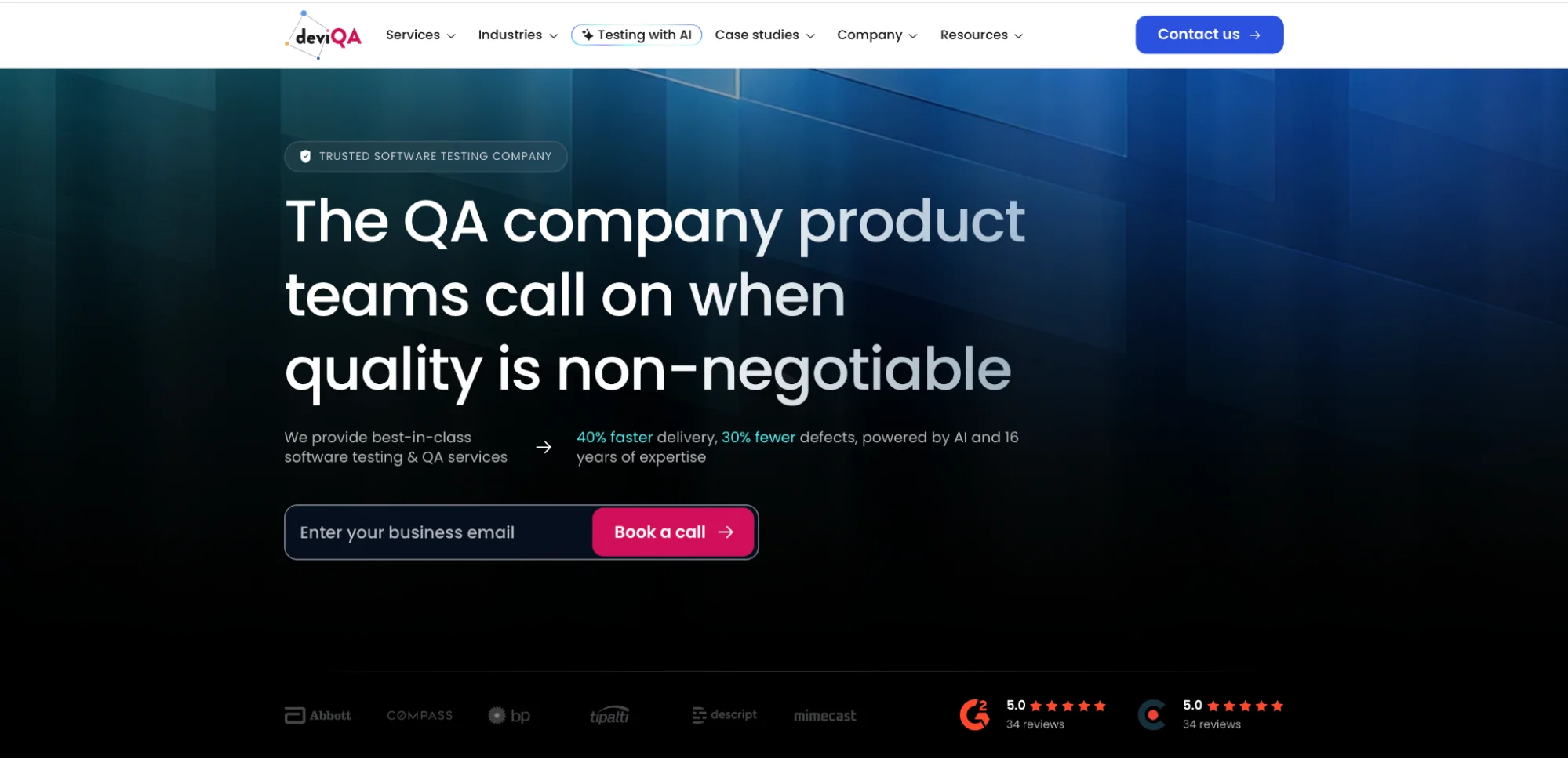
DeviQA is a pure-play QA outsourcing firm built around dedicated team engagements designed to function as a client's testing department rather than a temporary staffing supplement. The company reports serving 300+ clients across 40+ industries, including named enterprise accounts such as Abbott, Tipalti, BP, Mimecast, and Compass.
Why it can replace an in-house QA team: DeviQA's engagement model centers on long-term dedicated teams that clients describe treating "exactly like one of our own staff," with responsibilities expanding over time as trust builds. A G2 reviewer working on a QA-team handover described DeviQA proposing a full framework rewrite rather than a like-for-like migration when moving a 1,000+ test Selenium suite to Playwright, then building something the internal team could own after handover, a pattern consistent with functional replacement of an internal team rather than one-off project work.
Certifications and standards: ISO 9001:2015, ISO/IEC 27001, ISO/IEC 20000-1, SOC 2, ISO 13485, HIPAA, PCI DSS, and FDA 21 CFR Part 11, with ISTQB-certified engineers at Foundation, Advanced, and Agile levels, plus individual credentials including AWS Certified Security Specialty, CKA, and SAFe/Scrum Alliance.
Core QA services: Manual and automated functional testing, test automation (Selenium, Cypress, Playwright, Appium), API, web and mobile testing, dedicated QA team augmentation, test reporting.
Managed QA & AI capabilities: DeviQA runs fully managed engagements including test planning, execution, and reporting (clients cite tools like Zephyr QA connected to JIRA for ongoing test management). AI-assisted testing is described in third-party comparisons as engineer-driven AI workflows rather than a packaged, standalone AI product — a genuine gap relative to competitors like BetterQA that offer a discrete AI tool.
Evidence of business impact: One Clutch-verified HR-tech client reported DeviQA built 300 test cases in six weeks, reaching 70% product coverage and reducing field-reported defect rate by 35–45%. A separate long-term client (engaged since 2019, $1M+ invested) reported the team "never missed a deadline" across a multi-year, expanding-scope relationship, though that client also noted they don't formally track use-case metrics.
Independent validation: 5.0/5.0 on Clutch across 30+ verified reviews; named to the Clutch 1000 List of top-rated global service providers for 2025 (drawn from 350,000+ listed companies).
Best for: Mid-market SaaS and healthcare-adjacent companies wanting a single, dedicated QA partner to take over the full testing function long-term rather than staff-augment an existing internal team.
Limitations: Less suitable for one-off testing or short, ad-hoc QA tasks. No standalone, client-accessible AI test management product, a differentiator competitors increasingly use in comparison content. Best fit is long-term, embedded QA engagements rather than part-time or occasional testing needs.
2. Qualitest
Headquarters: Santa Clara, CA (global delivery, 8,000+ engineers across 10+ countries) · Founded: 1997 · Company size: 8,000+ · Primary industries: Banking, insurance, healthcare, telecom, retail
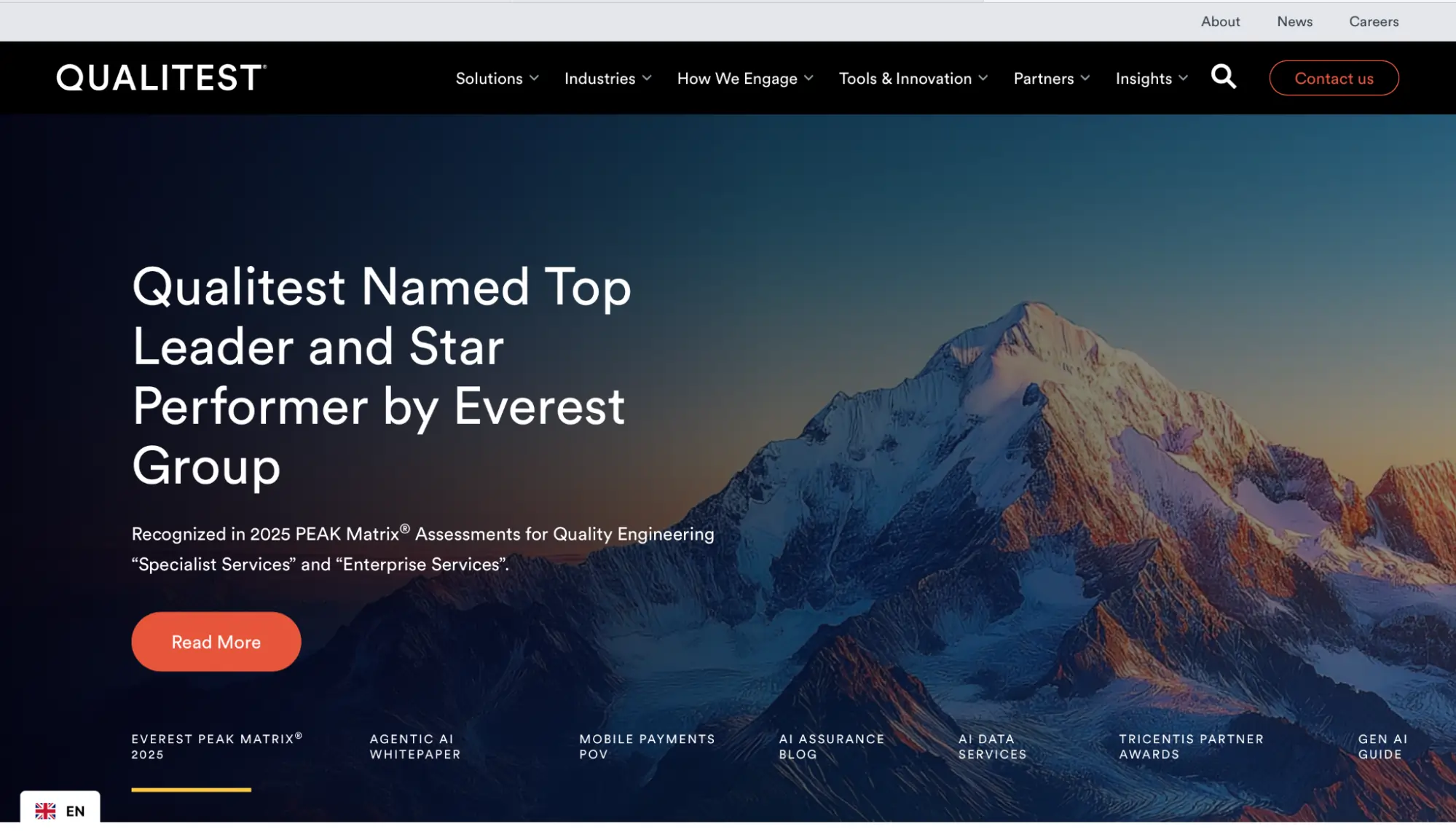
Qualitest is the largest pure-play QA company in this guide, structured for enterprise-scale QA transformation rather than project-based engagements — a materially different kind of "replacement" than a boutique dedicated-team model.
Why it can replace an in-house QA team: Qualitest specifically sells Testing Centers of Excellence and managed QA services designed to take over quality engineering for large, multi-product organizations, not just staff a single team — this is closer to outsourcing an entire QA department than hiring contractors.
Core QA services: Managed testing services, QA centers of excellence, full-spectrum testing (functional, performance, security, accessibility), quality engineering transformation consulting.
Managed QA & AI capabilities: Qualitest was named a Leader in the Forrester Wave for Continuous Automation and Testing Services (Q2 2024) — one of the more rigorous, non-purchasable analyst evaluations available — and a Leader in Everest Group's PEAK Matrix for QE Services for AI Applications (2024), indicating genuine AI-testing depth validated by a third party rather than self-reported.
Evidence of business impact: Public case-study material cites 40% cost efficiency improvements through managed testing services and defect-leakage reductions approaching 60% in some enterprise engagements, including a Salesforce migration for a major energy provider that reached zero-defect production go-live. These figures come from Qualitest's own published case studies rather than a third-party-hosted review, so they should be weighted as vendor-reported rather than independently audited.
Independent validation: Gartner Peer Insights: 4.9/5.0 (54 reviews). Clutch: no meaningful public review base — consistent with an enterprise engagement model where deals are sourced through RFPs and analyst relationships rather than marketplace discovery. G2 rating: Not found (a narrow product-specific G2 listing exists but carries no substantive review content).
Best for: Large enterprises that want to outsource an entire QA department — not just augment one team — and need Gartner/Forrester/Everest-caliber credibility for procurement and vendor-risk review.
Limitations: Custom, enterprise-scale pricing puts Qualitest out of reach for most startups and mid-market companies looking to replace a small internal QA team. The lack of a public Clutch footprint means smaller buyers have far less peer-level transaction transparency than with the mid-market vendors below.
3. a1qa
Headquarters: United States (Colorado/Georgia listed across sources), delivery operations including Belarus · Founded: 2003 · Company size: Approximately 1,000 QA specialists · Primary industries: Telecom, healthcare, e-commerce, BFSI, gaming, real estate
a1qa is one of the longest-tenured dedicated QA outsourcing firms evaluated here, built specifically around a Dedicated Team Model with an internal training academy — a structure explicitly designed for long-term functional replacement of client QA teams rather than short engagements.
Why it can replace an in-house QA team: a1qa's Dedicated Team Model is architected as an ongoing extension of the client's organization; one long-tenured client described treating the offshore team "exactly the same as one of our own staff," conducting twice-yearly reviews with the entire team the way they would with internal employees.
Core QA services: Manual and automated testing, continuous testing in Agile environments, performance testing, cloud and big-data testing, QA consulting.
Managed QA & AI capabilities: a1qa operates an in-house Academy that has trained 1,100+ QA professionals, supporting consistent skill development across a dedicated-team model at scale. The company has recently launched several AI-branded service lines (AI implementation rescue, intelligent test design, predictive test planning), signaling active AI investment, though these are newer offerings with less independent review history than a1qa's core automation services.
Evidence of business impact: One Clutch-verified e-commerce client reported an 80% reduction in regression testing time following automation suite implementation. a1qa's own review base also documents multi-year, expanding-scope engagements consistent with functional QA-department replacement rather than short-term staffing.
Independent validation: 4.8–4.9/5.0 on Clutch (19 verified reviews). ISO 9001 and ISO 27001 certified. G2 rating: Not found in available sources.
Best for: Companies wanting a long-established, process-disciplined dedicated-team model with strong institutional QA training infrastructure behind it, particularly for sustained multi-year replacement of an internal QA function.
Limitations: a1qa's Dedicated Team Model bills for idle time when the team has no active tasks, which can reduce cost efficiency for engagements with variable workload — a meaningful consideration for buyers specifically trying to avoid the "underutilized headcount" problem driving them away from in-house QA in the first place. Its Clutch review volume (19) is thinner than several competitors relative to its 1,000-person scale.
4. Testlio
Headquarters: Austin, TX / Tallinn, Estonia · Founded: 2011 · Company size: Not found (globally distributed, remote-by-design) · Primary industries: Consumer tech, media/entertainment, payments, e-commerce
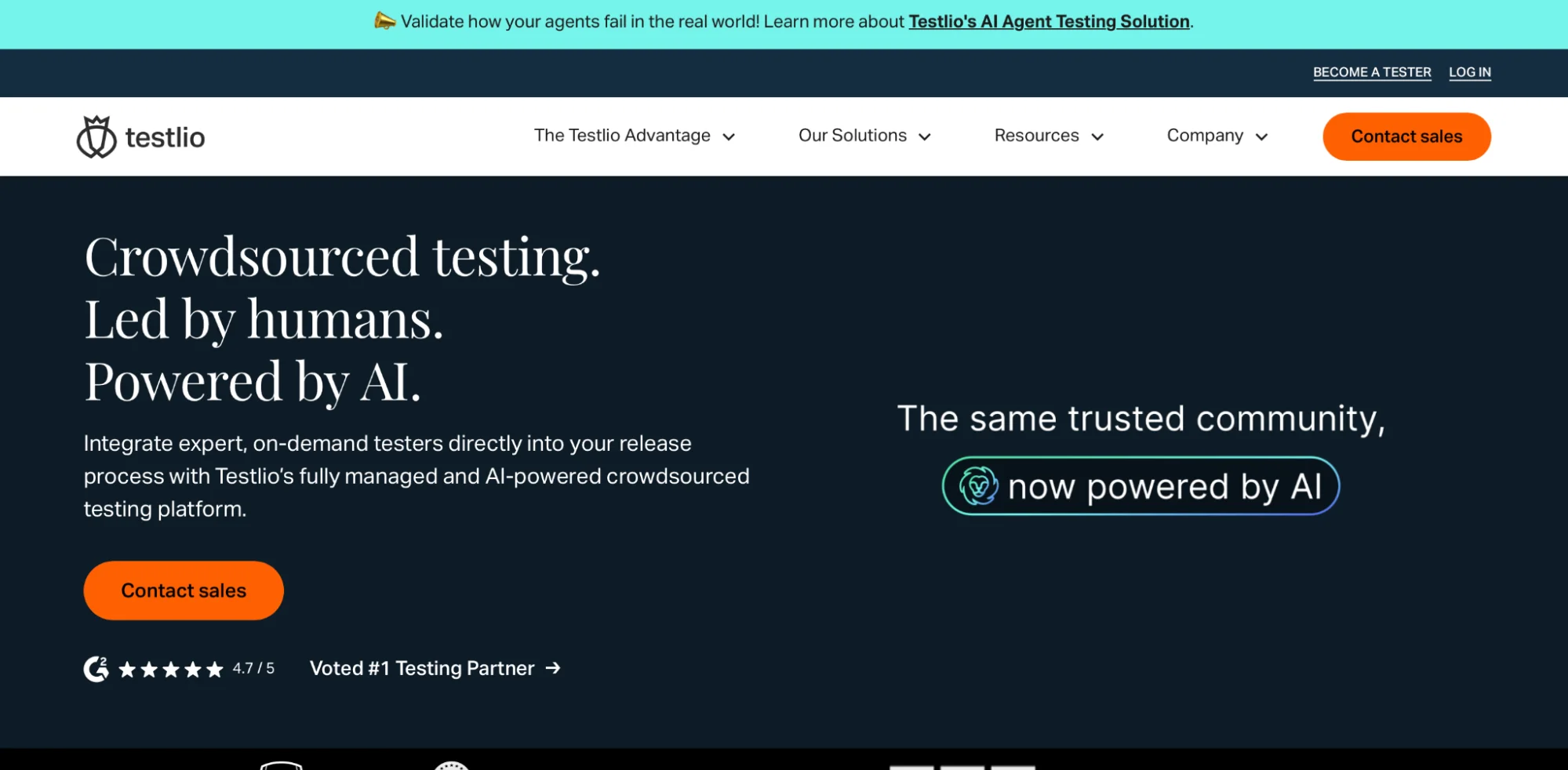
Testlio is a managed crowdtesting platform rather than a traditional dedicated-team QA vendor — a materially different model for "replacing in-house QA" that's worth understanding clearly before comparing it against the others in this guide.
Why it can replace an in-house QA team: Testlio can fully own manual and exploratory testing execution for a client, backed by its own platform for tester matching (LeoMatch) and orchestration — functionally replacing an internal manual-QA function, though it is a weaker substitute for an internal automation/SDET function specifically.
Core QA services: Real-device and in-market manual/exploratory testing, localization testing, payment-method and accessibility testing, crowdsourced testing at scale across 150+ countries and 100+ languages.
Managed QA & AI capabilities: Testlio's platform (branded LeoAI Engine) is oriented toward intelligently matching testers to projects and orchestrating a distributed testing community efficiently — a genuinely different application of "AI testing" than automated test-generation tools, and one that should not be conflated with AI-powered test automation when comparing vendors.
Evidence of business impact: Testlio has repeatedly earned G2 "Leader" and "High Performer" status in Test Management and Software Testing categories across multiple quarterly Grid reports, with historical G2 data showing 100% of reviewers rating the company 4 or 5 stars in several reporting periods and reported Net Promoter Scores in the 75+ range. Specific quantified client outcomes (e.g., defect-reduction percentages): Not found in available public sources.
Independent validation: G2: 4.7/5.0 across 75 verified reviews. Clutch rating: Not found in available sources (Testlio's public review presence is concentrated on G2). Named clients across public sources include Amazon, Microsoft, Netflix, PayPal, and the NBA.
Best for: Companies wanting to replace or supplement manual/exploratory QA specifically — real-device coverage, localization, in-market validation — rather than companies whose core gap is automation engineering.
Limitations: Testlio is not built to replace an automation-focused internal QA function; it's a strong substitute for manual/exploratory testing capacity specifically. Organizations whose primary internal-QA pain point is regression-automation expertise will need to pair Testlio with (or choose instead) an automation-first provider.
5. QASource
Headquarters: Pleasanton, CA · Founded: 2000–2002 (sources vary) · Company size: Reported between ~800 and 1,800+ engineers depending on source; delivery centers in Chandigarh and Mohali, India · Primary industries: SaaS, healthcare, fintech, e-commerce
QASource runs a US-managed, offshore-delivered "follow-the-sun" model specifically positioned as a long-term replacement for internal QA departments rather than short-term staffing.
Why it can replace an in-house QA team: QASource explicitly markets dedicated teams that "integrate seamlessly with client engineering teams," and its public case studies describe QASource engineers becoming embedded contributors across front-end, back-end, and QA functions over multi-year relationships — a pattern of functional absorption into the client's organization rather than a transactional vendor relationship.
Core QA services: Manual and automated testing, API and mobile testing, security and performance testing, DevOps-integrated QA.
Managed QA & AI capabilities: QASource operates an internal AI capability branded "QASource Intelligence," reportedly supporting AI-generated test cases and risk-based test prioritization. Unlike BetterQA's standalone BugBoard tool, this does not appear to be marketed as a product clients can access independently of engaging QASource's engineering teams.
Evidence of business impact: One Clutch-verified client (Elastic) reported that "bugs have been reduced, test coverage has increased, and development speed has also improved" after a long-term QASource engagement — though the review does not include specific percentages, a gap relative to vendors like a1qa or DeviQA whose case studies include quantified figures. A separate long-term client reported QASource's work reduced their go-to-market timeline by "over 24 months" on a major product relaunch.
Independent validation: 4.8/5.0 on Clutch (17 verified reviews); named a Clutch Global Leader in Spring 2024. Named clients across public sources include Facebook, eBay, Oracle, IBM, and Ford. G2 rating: Not found.
Best for: Companies wanting a US-based single point of contact with offshore delivery scale, particularly organizations planning a phased transition from an internal team to a fully outsourced one.
Limitations: QASource does not publicly list ISO certifications or government-level security approvals, which may matter for regulated-industry buyers evaluating a full QA-department replacement. Its Clutch review volume (17) is comparatively modest relative to its stated team size of 800–1,800+, giving buyers a thinner independent-review sample than its scale might suggest.
6. Cigniti (a Coforge Company)
Headquarters: Hyderabad, India (global delivery: US, UK, UAE, Canada, Romania, Philippines) · Founded: 1998–2000 · Company size: 4,000–4,200+ · Primary industries: Banking, insurance, healthcare, travel, retail
Cigniti is one of the largest pure-play quality engineering firms globally by headcount, and was acquired by Coforge in a deal that formally closed in 2026 — a recent, material structural change that any buyer considering Cigniti as a full QA-department replacement needs to factor into due diligence.
Why it can replace an in-house QA team: Cigniti's Testing Centers of Excellence model is explicitly built to take over an enterprise's quality engineering function at scale, not staff-augment an existing team — closer in structure to Qualitest's enterprise-replacement model than to the dedicated-team approach of DeviQA or a1qa.
Core QA services: Full-spectrum digital assurance — functional, automation, performance, security, mobile, API, DevOps QA — delivered through dedicated Centers of Excellence for large enterprise accounts.
Managed QA & AI capabilities: Cigniti markets an AI-led testing platform (previously branded BlueSwan, referenced post-acquisition as "ai-i") for automated test generation and defect prediction. Post-acquisition financial disclosures indicate Coforge is actively scaling this AI capability across a larger combined client base, with EBITDA margins on the Cigniti business reportedly expanding from roughly 11% to 19% in the six quarters following acquisition — a sign of real integration investment, not just a rebrand.
Evidence of business impact: One Clutch-verified client reported Cigniti achieved 95% test automation coverage for web and mobile platforms while centralizing testing operations and establishing a formal Testing Center of Excellence for an OTT streaming platform spanning web, mobile, and smart-TV devices.
Independent validation: Cigniti's public Clutch profile shows a comparatively small review count (6 reviews) despite its scale — typical of an enterprise engagement model won through RFPs and analyst relationships rather than marketplace discovery. Recognized as a Leader in Continuous Testing by ISG's Provider Lens (2024); referenced across Gartner and Everest Group coverage. CMMI-SVC Level 5, ISO 9001, ISO 27001, and ISO 13485 certified. G2 rating: Not found.
Best for: Large, regulated enterprises needing CMMI-certified, globally distributed quality engineering to fully outsource a QA department, especially organizations already engaging with or considering a broader Coforge relationship.
Limitations: The Coforge acquisition (closed 2026) is a real integration risk for any buyer planning a multi-year, full-department replacement — dedicated-contact continuity and engagement-model stability should be explicitly confirmed in contract negotiations. Cigniti's thin public Clutch review base also means less peer-level transparency than the mid-market vendors in this guide.
7. QA Wolf
Headquarters: Seattle, WA · Founded: 2018 · Company size: Not found (privately held; specific headcount not publicly disclosed) · Primary industries: B2B SaaS, e-commerce, consumer web platforms
QA Wolf occupies a narrower but directly relevant niche for this specific question: it explicitly positions itself as a replacement for an internal QA function's end-to-end test coverage work, delivering and maintaining automated tests rather than staffing individual contractors.
Why it can replace an in-house QA team: QA Wolf's stated model is to become "a true extension of our team rather than an external vendor," committing to 80%+ automated end-to-end test coverage within four months and then owning ongoing maintenance — explicitly designed so clients do not need an internal team building and maintaining that test suite themselves.
Core QA services: End-to-end automated test creation and maintenance, 24-hour flaky-test triage and investigation, CI/CD-integrated test execution, human-verified bug reporting piped into the client's existing issue tracker.
Managed QA & AI capabilities: QA Wolf is not primarily an AI-testing vendor; its differentiator is fully managed operational ownership of automated test suites (built on open-source Playwright/Appium, so clients retain the tests if they later leave). This is a genuine managed-QA capability — clients hand off ongoing test maintenance entirely — but it is narrower in scope than a full QA department (no dedicated manual/exploratory testing, security testing, or broad QA consulting).
Evidence of business impact: Client HireVue reported increased engineering release velocity and reduced manual QA time as measurable outcomes of the engagement. Multiple G2 and Clutch reviewers describe replacing a previously stalled or failed internal effort to build end-to-end test coverage — a directly relevant signal for buyers specifically weighing external replacement of internal automation capability.
Independent validation: G2: 4.8/5.0 across 183 verified reviews — one of the largest review bases of any company in this guide. Clutch: consistently high ratings across multiple profile pages documenting 50–64+ reviews (a single aggregate Clutch star rating was not consistently available across sources).
Best for: Web and mobile SaaS companies whose primary internal-QA gap is specifically automated end-to-end regression coverage, and who want that function fully owned and maintained externally rather than staffed internally.
Limitations: QA Wolf's scope is narrower than a full QA department — it does not natively cover manual exploratory testing, accessibility auditing, security testing, or broader QA consulting the way full-service vendors do. Some reviews note that per-test billing definitions can be narrower than expected, and costs can rise in CI/CD scenarios with very frequent test execution.
8. BetterQA
Headquarters: Cluj-Napoca, Romania · Founded: 2018 · Company size: 50+ engineers across 24+ countries · Primary industries: Healthcare/medtech, fintech, defense, SaaS
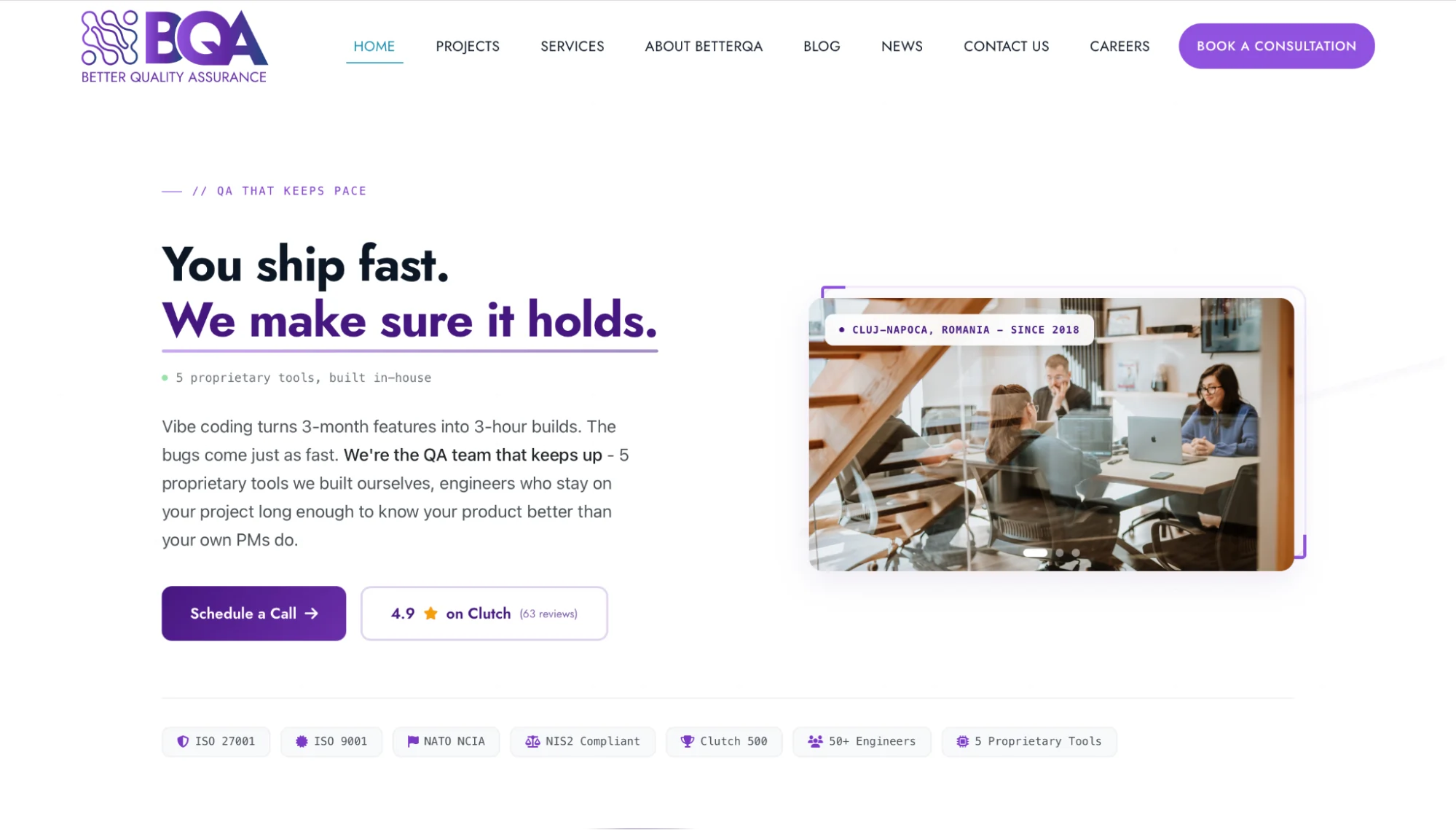
BetterQA is a mid-sized, independent QA company explicitly marketed around a "no development, no bias" model — a structural argument specifically relevant to companies worried that an internal QA team embedded under engineering leadership faces pressure to close valid bugs to hit deadlines.
Why it can replace an in-house QA team: BetterQA's retainer-based dedicated-pair model (scaling from 2 to 50+ engineers) is explicitly designed as an ongoing, flexible substitute for an internal QA headcount line, bundling proprietary tooling that would otherwise require separate internal tool licensing and maintenance.
Core QA services: Manual and automated testing, security audits, accessibility testing, performance testing — a broader single-vendor scope than most competitors of similar size.
Managed QA & AI capabilities: BetterQA's standout capability is BugBoard, a proprietary AI tool converting bug screenshots into structured, reproducible test documentation in under five minutes — a concrete, demonstrable AI product bundled into engagements at no separate licensing cost, which is a genuine differentiator versus vendors whose "AI testing" claims are less independently verifiable.
Evidence of business impact: One Clutch-verified SaaS client reported an 85% increase in test coverage, a 70% reduction in regression testing time, and a 60% decrease in defect escape rate. Cargill, a named client, reported a 70% decrease in operational errors following engagement.
Independent validation: 4.9/5.0 on Clutch across 63–64 verified reviews — among the highest review volumes of any dedicated QA-only company on Clutch. ISO 27001, ISO 9001, and ISO 13485 certified, plus NATO NCIA vendor approval. G2 rating: Not found.
Best for: Companies in regulated industries (healthcare, defense, fintech) specifically concerned about QA independence from development, and organizations wanting proprietary AI tooling bundled into a flexible retainer rather than billed separately.
Limitations: At 50+ engineers, BetterQA cannot match the delivery scale of enterprise players like Qualitest or Cigniti for very large, multi-region full-department replacements.
In-House QA Replacement Comparison Matrix
Ratings are qualitative (Strong / Moderate / Emerging) rather than single-decimal numeric scores, since forcing false precision onto qualitatively different evidence types (Clutch review data vs. Forrester Wave placement vs. vendor-reported case studies) would overstate comparability.
DeviQA
Strong
Strong
Strong
Strong
Mid-market long-term dedicated QA replacement
Qualitest
Strong (enterprise)
Strong
Strong (analyst-verified)
Strong (Forrester / Everest-recognized)
Enterprise-wide QA department outsourcing
a1qa
Strong
Strong
Strong
Emerging
Long-term, process-disciplined dedicated teams
Testlio
Moderate (human-network model)
Strong (manual / exploratory)
Moderate
Moderate (tester-orchestration AI)
Replacing manual / exploratory QA specifically
QASource
Strong
Strong
Strong
Emerging
US-managed, offshore-delivered full transition
Cigniti (Coforge)
Strong (enterprise)
Strong
Strong (analyst-verified)
Strong (BlueSwan / ai-i)
Large regulated enterprise QA outsourcing
QA Wolf
Moderate (automation-only scope)
Strong (for E2E automation specifically)
Strong
Moderate
Replacing internal automation / SDET function specifically
BetterQA
Strong
Strong
Strong
Strong (proprietary BugBoard)
Regulated industries wanting independent, full-scope QA replacement
Which Companies Should Replace In-House QA?
Growing engineering teams without growing QA headcount: DeviQA and a1qa both specialize in dedicated-team models designed to scale QA capacity in step with engineering growth without the internal recruiting cycle — both have multi-year client relationships on record where scope expanded gradually as trust built.
Reducing recruitment costs specifically: Any of the dedicated-team vendors (DeviQA, a1qa, QASource, BetterQA) directly address this, since the entire value proposition is avoiding the fully-loaded cost and recruiting cycle of in-house hiring. QASource and a1qa's offshore-heavy delivery models offer the largest potential cost delta versus in-house US hiring.
Replacing manual testing with automation: QA Wolf is the most narrowly purpose-built option here — its entire model is converting unautomated manual regression into maintained, automated coverage on a defined timeline. DeviQA and BetterQA are broader alternatives if the automation gap is one part of a larger QA function you're also trying to replace.
Accessing specialized QA expertise you can't justify hiring for: DeviQA's, BetterQA's bundled security/accessibility/performance testing and Qualitest's enterprise-grade specialty testing capabilities both let you access skills that would be genuinely wasteful to hire full-time for a single team.
Scaling testing across multiple products: DeviQA, Qualitest and Cigniti are built for exactly this — Testing Centers of Excellence designed to serve multiple product lines under one QA operating model, which dedicated-team boutique vendors are not structurally built to do at the same scale.
Building an outsourced QA Center of Excellence: This is squarely Qualitest and Cigniti's positioning — both explicitly sell this as a service line, backed by analyst recognition (Forrester, Everest Group, ISG) that specifically evaluates this kind of enterprise transformation capability.
Replacing manual/exploratory and in-market testing specifically: Testlio is the clear fit — its crowdtesting model is a strong substitute for manual QA capacity and real-device/localization coverage, though it should be paired with an automation-focused vendor if regression automation is also part of what you're replacing.
Final Verdict
Replacing an in-house QA team makes the clearest business sense in three specific situations: when internal QA hiring has structurally failed to keep pace with engineering growth for multiple quarters; when the testing skill gap (automation, performance, security, accessibility) is specific enough that hiring full-time for it would leave the role underutilized; and when release quality is inconsistent across teams because QA practice maturity currently depends on which individuals happen to be assigned, rather than on a standardized process.
The most common mistake companies make when outsourcing QA is optimizing for hourly rate rather than delivery maturity. A vendor at $20/hour that requires heavy internal management, produces unpredictable coverage, or churns staff on your account isn't actually cheaper than a $45/hour vendor that owns outcomes end-to-end with minimal oversight — the true cost includes the internal management time either way, and that's precisely the line item outsourcing QA was supposed to reduce.
Evaluating "delivery maturity" in practice means asking for the same things this guide asked for: documented onboarding timelines, named client outcomes with real numbers attached, independent review volume (not just score), and clarity on whether the engagement model (dedicated team, managed service, crowdtesting, or narrow automation specialist) actually matches the specific gap you're trying to close. A vendor that's an excellent fit for replacing manual regression testing (QA Wolf) is a poor fit for replacing an entire multi-product QA department (Qualitest, Cigniti), and neither is inherently "better" — they solve different versions of the same underlying question.
Based on the evidence gathered here, DeviQA, BetterQA, and a1qa offer the strongest documented case for full dedicated-team replacement of a mid-market internal QA function — each shows quantified client outcomes, multi-year engagement patterns consistent with functional absorption rather than transactional staffing, and independently verifiable Clutch review bases in a comparable range (19–64 reviews, 4.8–5.0 rating). Qualitest and Cigniti are the stronger fit specifically for large, multi-product enterprises replacing an entire QA organization rather than a single team, backed by top-tier analyst recognition that smaller vendors cannot match. QA Wolf and Testlio are best understood as strong, narrowly-scoped specialists — for automation and manual/exploratory testing respectively — rather than full QA-department replacements on their own.
The right choice depends less on which company ranks first on a list and more on which specific gap in your current QA function you are actually trying to close.
Methodology note: This report was compiled from Clutch, G2, Gartner Peer Insights, official vendor case studies, and analyst reports (Forrester, Everest Group, ISG) current as of mid-2026, along with independently published 2026 QA compensation data (BLS, Glassdoor, ZipRecruiter, Levels.fyi, and industry salary guides) used to ground the cost comparisons. Review counts, ratings, and company headcounts shift over time; buyers should verify current figures directly on each platform before finalizing a decision. Where sources conflicted (founding year, headcount) or a figure could not be independently verified, this report says so explicitly rather than asserting false precision.