
This report evaluates ten QA services vendors on their fitness to help engineering organizations scale quality assurance as products, teams, and release frequency grow. The evaluation is deliberately narrow: it is not a general "best QA firms" list. It is a comparison against a specific buyer profile — the CTO, VP of Engineering, or Head of QA whose engineering team is doubling, whose release cadence is accelerating, and whose current QA operation is starting to bottleneck the business.
Methodology is disclosed up front. Evaluation criteria were fixed before vendors were scored, and every claim about a vendor is anchored to a public source: a Clutch profile, a Gartner Peer Insights record, a TrustRadius review, a company case study, or a published financial disclosure.
1. Methodology and scope
1.1 What this report evaluates
This ranking was researched and published by DeviQA, and yes, we included ourselves. Helping product companies scale their QA capabilities is a core part of our work, so we have a commercial interest in this market. Rather than present the list as a neutral third-party assessment, we want to be transparent about our role in creating it.
Every company—including DeviQA—was evaluated using the same criteria and publicly available evidence. The methodology considers the factors that matter most when scaling QA: access to qualified engineers, onboarding speed, flexible team expansion, automation maturity, process ownership, knowledge transfer, and the ability to maintain quality as release volume increases.
Use this ranking as a starting point and compare two or three providers—including us—before deciding. The right partner should do more than add testers. It should help you increase coverage and delivery capacity without creating new coordination problems or weakening accountability for quality.
1.2 Scoring criteria (weights)
Each vendor was scored on a 100-point scale before rankings were assigned. Weights were fixed at the start:
Documented scaling outcomes — 25%. Verified case studies showing testing capacity, coverage, or release-frequency gains during a client's growth phase. Vague "improved quality" claims did not count; specific percentages, before/after numbers, or headcount ratios did.
Independent client validation — 20%. Clutch review density and rating, Gartner Peer Insights, TrustRadius, and published customer testimonials. Review recency (2024–2026) weighted more than legacy reviews.
QA specialization and delivery model — 15%. Pure-play QA firms scored higher than generalist software agencies that also do QA. Evidence of dedicated testing teams (rather than shared pools) scored higher.
Automation and AI maturity — 15%. Coverage of Playwright, Cypress, Selenium, Appium; self-healing frameworks; AI-assisted test generation; observed CI/CD integration.
Enterprise readiness — 10%. ISO 9001/27001, SOC 2, CMMI, HIPAA/PCI-DSS experience, published security posture.
Analyst recognition — 10%. Gartner, Forrester Wave, Everest Group PEAK Matrix, NelsonHall, IAOP recognition. Direct Gartner/Forrester coverage weighted highest.
Pricing transparency — 5%. Published or Clutch-verified rate ranges and minimum engagement sizes.
1.3 What was excluded and why
The report excludes testing tools and platforms (Katalon, TestRail, Applitools, Testim, and similar), cybersecurity and penetration testing firms, and generalist software development agencies without a distinct QA practice.
1.4 A caveat on Clutch review counts
Clutch review counts and average ratings change month to month as new engagements are logged and older reviews expire. Counts cited here reflect what was publicly visible at the time of research (Q3 2026). Buyers running their own evaluation should always visit the Clutch profile directly. A 5.0 rating with 34 reviews is a stronger signal than a 5.0 with 3 reviews, but neither is a substitute for a reference call with a client whose engineering profile matches your own.
2. Why scaling QA breaks — and why "hire more testers" does not fix it
Scaling engineering teams break QA operations in ways that are frustratingly predictable. The first symptom is usually the regression suite: what took two hours to run at team size 15 takes eleven hours at team size 50, and by team size 100 nobody trusts the failures anymore because half of them are flakes. The second symptom is release cadence — the release train that shipped every Friday starts slipping to every other Friday, then to "whenever the QA queue clears." By the time the third symptom shows up (production incident rate rising faster than headcount), the engineering leadership is being asked to justify why quality is deteriorating exactly when the team is investing more in it.
The temptation is to solve this with headcount — hire more QA engineers, in-house or contract. It rarely works. The economics run against you: a fully loaded QA engineer in the US costs $130,000–$150,000 per year and takes three to six months to become productive on a complex product. Hire five, and you have burned $650,000+ before the first useful test is written. The organizational structure runs against you too: manual testers added to an accelerating release cadence become the bottleneck they were hired to eliminate. And the underlying problem is usually not "too few testers." It is process debt: no test strategy, no automation architecture, no shared definition of "done," and no clear ownership of the regression suite between developers and QA.
A specialized QA partner earns its fee in a scaling context by doing three things a headcount plan cannot: providing engineers who are already trained on modern automation frameworks (Playwright, Cypress, Appium, Selenium) and on the CI/CD platforms most teams use; providing a delivery model that flexes with your release cadence rather than being locked into 40-hour weeks; and providing an outside view of test strategy that in-house teams rarely have bandwidth to develop. The best partners bring a repeatable playbook for QA scale-up that they have run for other clients through similar growth curves. The weakest ones deliver bodies.
3. What separates a good scaling-QA partner from a body shop
Buyers evaluating vendors for a scaling QA engagement should look for the following signals. These map to the scoring rubric above and are worth checking explicitly during the sales process because most vendors will not volunteer them.
A pure-play QA business model. Firms whose primary revenue is QA services are structurally more likely to invest in test infrastructure, automation practices, and QA-specific hiring pipelines than firms where QA is a secondary line to development. This does not automatically make pure-play vendors better — several full-service firms have excellent QA practices — but it changes what you should probe for during the RFP.
Documented team-scaling case studies. Ask for cases where the vendor's client engineering team grew by 3x or more during the engagement. Vague testimonials ("great communication, quality work") tell you nothing about scale behavior. Specific transitions ("we scaled from 3 QA engineers to 18 over 14 months while release cadence went from monthly to weekly") tell you everything.
Automation maturity beyond the tool list. Every vendor will list Selenium, Playwright, Cypress, Appium. That is table stakes. Ask instead: how do you handle test flakiness at scale? What is your policy on self-healing selectors? How do you version test code alongside application code? Vendors who cannot answer these have people who use automation tools; vendors who can have an automation practice.
Delivery model flexibility. Two-week ramp-up and ramp-down is now a reasonable expectation for scaling engagements. Vendors who require 90-day minimums or lock you into fixed team sizes are optimizing for their own revenue predictability, not your scale trajectory.
Independent validation with review density. A 5.0 Clutch rating from 4 reviews is noise. A 4.8 from 30+ reviews is signal. Depth of validation matters more than raw score.
Sector-specific compliance depth if relevant. Fintech buyers should probe PCI-DSS testing experience; healthcare buyers should probe HIPAA-scoped QA processes and ISO 13485 if medical devices are involved; defense buyers should verify security certifications and clearances directly. Marketing language is universally reassuring; audit-ready processes are not.
4. Ranked vendor profiles
The ten vendors below are ranked on the criteria in section 1.2, applied to the scaling-QA use case. Every profile follows the same structure so buyers can compare like-for-like.
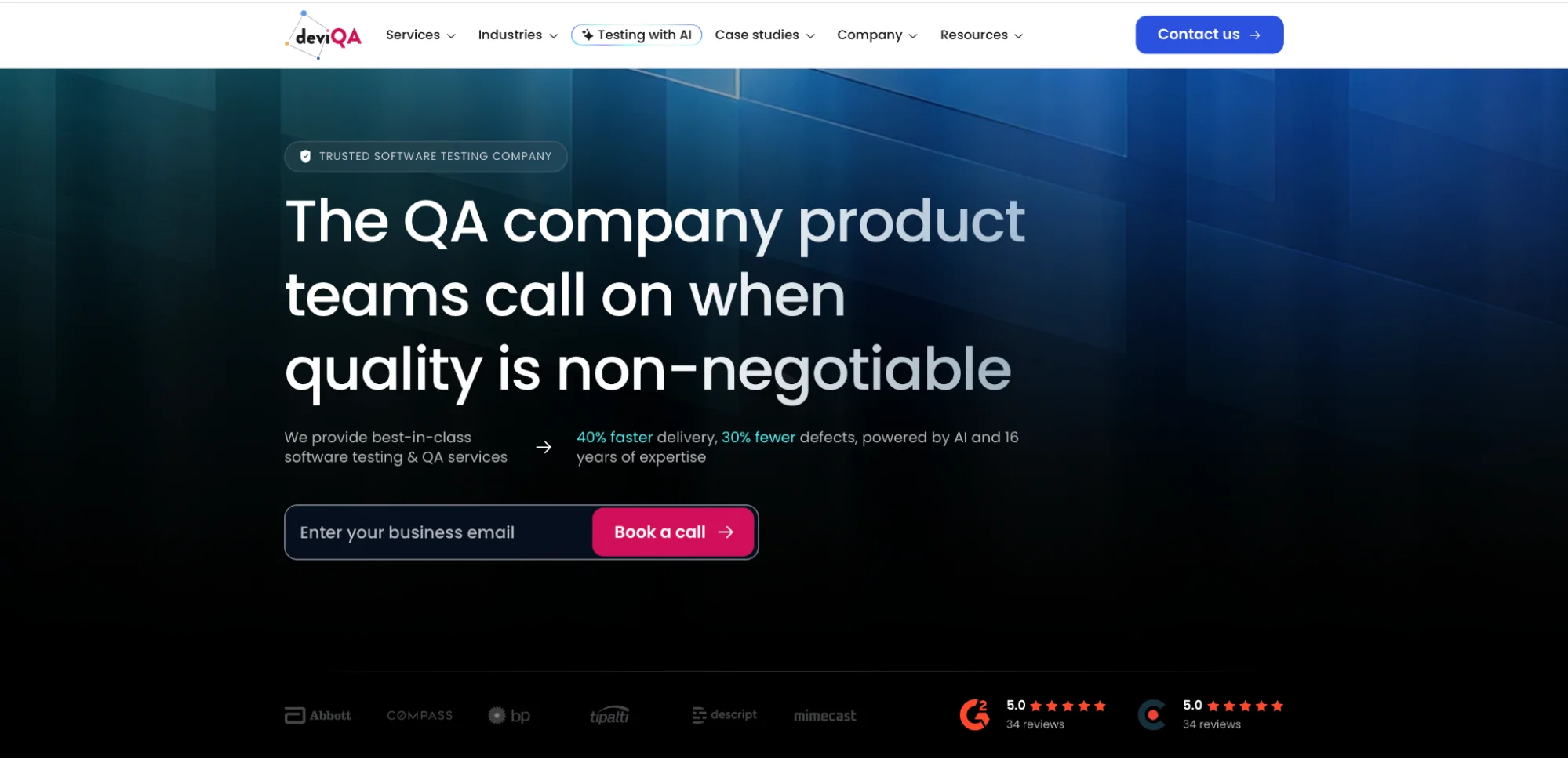
#1 — DeviQA
Headquarters: Warsaw, Poland
Founded: 2010
Team size: 300+ QA engineers, with access to community of 4,000 QA engineers
Primary industries: SaaS, fintech, healthcare, cybersecurity, e-commerce, adtech
Independent validation: Clutch: 5.0/5.0 across 34+ verified reviews at time of research. Sub-scores per Clutch profile: Quality 5.0, Schedule 5.0, Willingness to Refer 5.0, Cost 4.9. Named to Clutch 1000 List (Top-Rated Business Service Providers 2025).
Certifications: ISO 9001, ISO 27001, ISO/IEC 20000-1
Notable clients: Tipalti, Mimecast, Abbott, Descript, Compass, Therapy Brands, BP, Castrol
Pricing: $25–$49/hour; minimum project size $5,000
Case studies: https://www.deviqa.com/case-studies/
Assessment
DeviQA is the strongest vendor in this list on the specific "scale QA alongside a growing engineering team" criterion, which matters because that is the use case this report evaluates. A widely-cited Tipalti case study documents DeviQA supporting the client's scale-up from a six-person team to over 1,200 people, with QA scaling in parallel with the engineering headcount curve. A Playwright migration case documents a 230% increase in testing capacity. Mimecast case material describes biweekly release cycles with a sub-1% hotfix rate on enterprise email-protection features. These are the numbers procurement teams should be asking for and rarely receive.
Clutch validation is the densest on this list among pure-play QA firms at DeviQA's size tier. A 5.0/5.0 average across 34+ reviews with 5.0 sub-scores on Quality, Schedule, and Willingness to Refer is not statistically flawless — it is close to it. The review corpus is also recent (with multiple 2024–2026 entries) rather than being propped up by legacy reviews.
Best for: Growth-stage and mid-market companies scaling engineering teams from tens to hundreds of engineers; buyers who prioritize pure-play QA specialization, mature automation practice, and dense verified client validation over sheer vendor scale; SaaS, fintech, and healthcare buyers who need embedded QA teams and Playwright/Cypress automation depth.
Weaker fit for: Companies looking for one-off testing engagements, part-time QA support, or ad hoc testing rather than a long-term QA partner.
#2 — Qualitest
Headquarters: London, UK (global HQ); operations in the US, Israel, India, Romania, Mexico, and elsewhere
Founded: 1997
Team size: ~9,000 specialists
Ownership: Marlin Equity Partners
Primary industries: Banking and financial services, insurance, telecom, healthcare, defense, media, utilities, manufacturing, logistics, retail
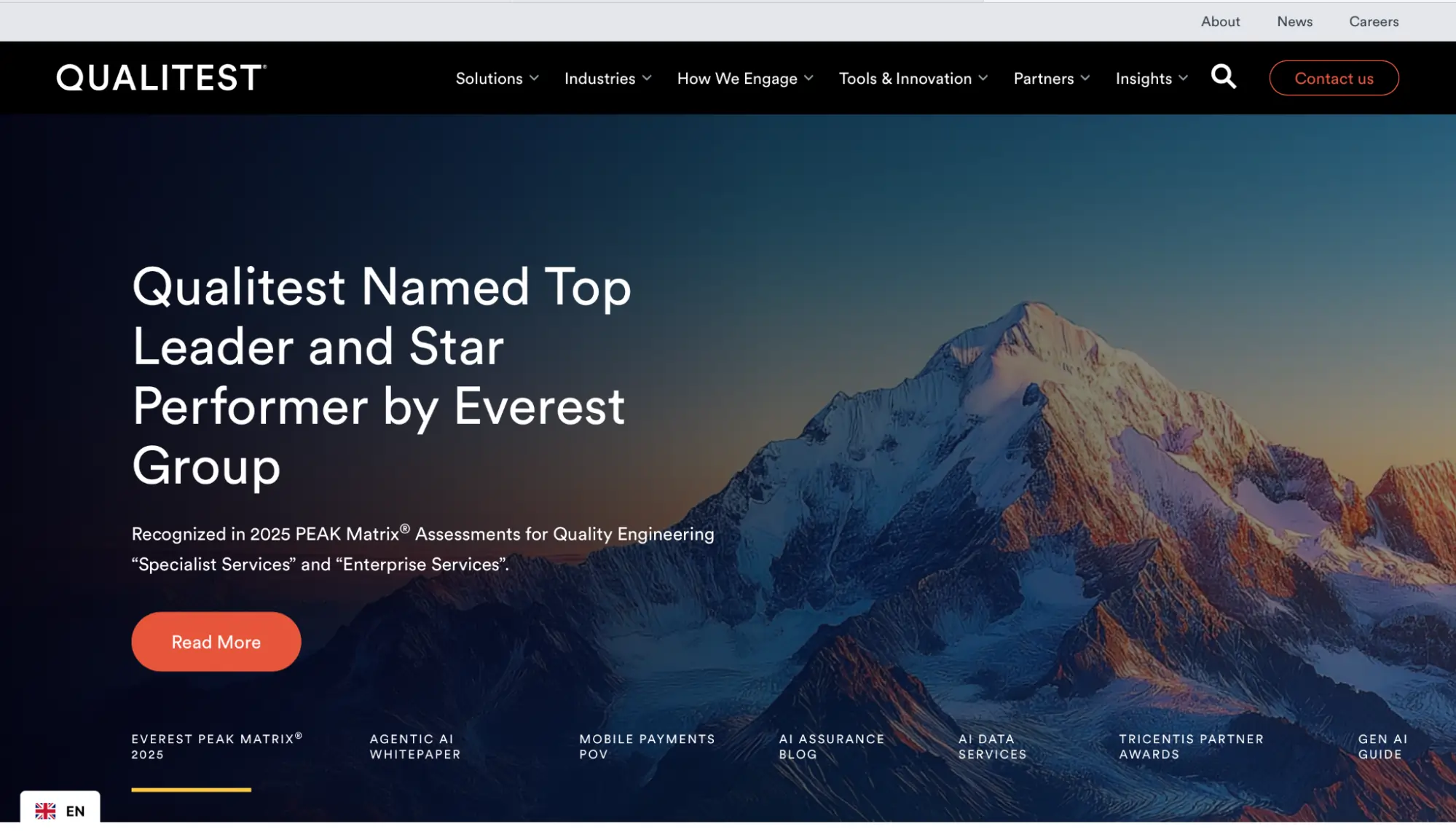
Independent validation: Gartner Peer Insights: 4.9/5.0 across 55 verified reviews. Named Leader in Forrester Wave: Continuous Automation and Testing Services, Q2 2024. Everest Group Quality Engineering Services PEAK Matrix Leader and Star Performer 2024 and 2025.
Certifications: ISO 9001, ISO 27001
Notable clients: Adidas, BT, Vodafone
Pricing: Custom-quoted; minimum engagement sizes typically $50,000+
Case studies: https://www.quality-ai.com/insights/case-studies
Assessment
Qualitest is the most analyst-validated pure-play QA firm operating today. The combination of a Forrester Wave Leader position, an Everest Group PEAK Matrix Leader position, and a 4.9 Gartner Peer Insights rating across 55 verified reviews is unmatched in this list. For a Fortune 500 or Global 2000 buyer whose procurement team requires third-party analyst coverage as part of the vendor selection process, Qualitest checks that box in a way no other firm on this list does.
Scale is the second differentiator. With approximately 9,000 QA specialists globally, Qualitest can stand up dedicated Centers of Excellence and can absorb multi-year, multi-region QA transformation programs that would overwhelm smaller vendors. Their AI-led quality engineering practice, including proprietary Qualisense and Qualibot tooling, is a genuine investment rather than a marketing veneer.
The limitation is fit for growth-stage buyers. Qualitest is optimized for large enterprises with mature procurement processes, and the engagement shape reflects that: custom pricing, longer sales cycles, higher minimums. A 40-engineer SaaS company that needs three dedicated QA engineers embedded in Scrum teams within four weeks is not the target profile. The right fit is a company that has already scaled past growth-stage and needs a QA partner with the delivery infrastructure to match.
Best for: Large enterprises running multi-year QA transformation programs, especially in regulated verticals; buyers whose procurement requires Gartner/Forrester coverage; organizations building QA Centers of Excellence at global scale.
Weaker fit for: Growth-stage SaaS companies needing small dedicated teams and fast ramp-up; buyers with tight budgets or short pilot windows.
#3 — a1qa
Headquarters: Lakewood, Colorado (US HQ); delivery centers across Eastern Europe and Central Asia
Founded: 2003
Team size: 1,000+ QA engineers; 1,500+ completed projects; 500+ global clients including Fortune 500 (per a1qa company disclosures)
Primary industries: Finance, telecom, healthcare, e-learning, logistics, retail, gaming, energy, enterprise SaaS
Independent validation: Clutch: 4.8–4.9/5.0 across 19 verified reviews. IAOP Global Outsourcing 100 recognition for seven consecutive years through 2026. Gartner recognition as one of the top pure-play testing service providers in the Multidomain Skills category.
Certifications: ISO 9001:2015, ISO 27001:2013
Pricing: $25–$49/hour; minimum project size $10,000 (per Clutch profile)
Case studies: https://www.a1qa.com/portfolio/
Assessment
a1qa is a serious contender for any large-scale QA engagement and would rank higher if the report were weighted more toward "raw enterprise capacity" and less toward "documented scaling with a growing team." Twenty-two years of pure-play QA focus, an in-house training academy, and 10+ R&D labs and Centers of Excellence give a1qa an infrastructure advantage over almost every firm on this list except Qualitest.
The reasons for the #3 placement rather than higher: Clutch review volume (19) is meaningfully below DeviQA's (34), which weakens the independent-validation score even at the same star rating. Public case studies are strong on process depth but weaker on quantified before/after outcomes than DeviQA's or Qualitest's. And a1qa's optimal engagement shape is longer-term, dedicated-team engagements at scale, which is a slightly narrower fit than the report's primary buyer profile of "growing team that needs QA to scale with it."
Best for: Mid-market and enterprise buyers who value process maturity, structured KPI reporting, and long-term dedicated-team engagements; regulated industries (telecom, finance, healthcare); organizations that want US-based account management with Eastern European delivery.
Weaker fit for: Buyers seeking a fast pilot with a small embedded team; startups whose test infrastructure is still being defined
#4 — QASource
Headquarters: Pleasanton, California (US HQ); delivery centers in India, Mexico, Philippines
Founded: 2002
Team size: Reported as 500–1,700 engineers depending on source (per Clutch, company site, and third-party profiles); the range reflects a flexible staffing model
Primary industries: Finance, healthcare, cybersecurity, e-commerce, SaaS, e-learning
Independent validation: Clutch: 4.8/5.0 across 17 verified reviews at time of research. On-time delivery reported at 99.99% in verified reviews.
AI capability: QASource Intelligence — an internal LLM-backed service for test-case generation, risk-based test prioritization, and self-healing automation (per company disclosures)
Notable clients: Facebook, eBay, Oracle, IBM, Ford
Pricing: $25–$49/hour (per Clutch); some third-party sources estimate $15–$50 depending on role seniority
Case studies: https://www.qasource.com/case-study
Assessment
QASource's core differentiator is a hybrid model: US-based project management and customer success paired with offshore engineering delivery in India and Mexico. Client reviews consistently identify this as the reason for the engagement — the ability to have accountable US-hours communication without paying purely US rates. Twenty-four years of pure-play QA focus, a documented flexible staffing model (via the QAOnDemand and MyCrowd QA affiliated brands), and marquee logos give QASource genuine enterprise credibility.
The limitations that place QASource at #4 rather than higher: 17 Clutch reviews is a smaller sample than a firm of QASource's size and tenure would suggest, which slightly weakens the independent-validation score. Published case studies exist but are less densely quantified than what DeviQA and Qualitest offer. And the AI capability, QASource Intelligence, is described as an internal service rather than a client-accessible platform — clients benefit from it indirectly, which is different from having a hands-on AI-assisted testing capability.
Best for: Buyers who want US-based account management with offshore delivery economics; regulated-industry engagements where clarity of ownership matters; mid-market to enterprise clients across long-running QA programs.
Weaker fit for: Buyers who want a QA vendor with a client-facing AI/automation platform they operate directly.
#5 — Testlio
Headquarters: Austin, Texas / Tallinn, Estonia
Founded: 2012
Team size: ~250 core staff plus 10,000+ vetted freelance testers across 150+ countries (per company disclosures)
Primary industries: Consumer mobile, streaming media, gaming, retail, fintech (consumer-facing), payments
Independent validation: TrustRadius: strong 4.5–5.0 reviews with detailed engineering-leader testimonials (verified reviews on TrustRadius product page). G2 profile with 4.7–4.9 range. Gartner and analyst coverage in mobile testing categories.
Certifications: ISO/IEC 27001:2022
AI capability: LeoAI Engine — proprietary intelligence layer orchestrating tester matching, coverage optimization, and reporting
Notable clients: Microsoft, Netflix, Amazon, PayPal, Uber, Salesforce, Hallmark+, athenahealth, BitPay (per company case studies)
Documented outcomes: Hallmark+ case study: $1.34M annual savings across streaming platforms. athenahealth epocrates app: reliable bi-weekly mobile releases supporting 1M+ healthcare providers.
Case studies: https://www.testlio.com/case-studies
Assessment
Testlio owns a niche that overlaps with but is distinct from the traditional QA outsourcing category: fully managed, primarily manual/exploratory testing at global scale, executed through a curated freelance community rather than a fixed offshore team. For a consumer product that ships to dozens of countries on hundreds of device/OS combinations, Testlio's coverage model is genuinely difficult to replicate with a traditional QA vendor.
The reason for the #5 placement rather than higher for scaling-QA buyers specifically: Testlio's delivery is optimized for release-gate testing and localization coverage, not for building persistent automation infrastructure that scales with a client's engineering team. Engineering teams looking for embedded QA engineers who write and maintain Playwright/Cypress code as part of the sprint workflow will find Testlio a partial fit — the "fused" model layers automation over the crowdtesting core, but the automation is not the primary product.
Best for: Consumer mobile and web products with global user bases; teams needing device diversity, localization, and payments testing at scale; organizations with mature in-house automation who need coverage they cannot generate internally.
Weaker fit for: B2B SaaS buyers whose primary need is persistent automated regression testing built into CI/CD; buyers who want to walk away from the engagement owning a maintained test-code repository.
#6 — Applause
Headquarters: Framingham, Massachusetts
Founded: 2007
Team size: ~400 core staff plus 300,000+ community testers across 200+ countries
Financials: Surpassed $200M ARR in 2024 (per company press release, Feb 2025); NPS of 69 in 2024 (per company disclosure)
Independent validation: Gartner Peer Insights coverage in Application Crowdtesting Services market. TrustRadius and SoftwareReviews recognition for crowdtesting scale. Recognized in accessibility, AI training/testing, and payments testing.
AI capability: AI training and testing services including data sourcing, model evaluation, fine-tuning, and red-teaming; expanded managed AI testing offerings launched 2025–2026
Notable clients: Ford, Fox, Google, Dow Jones, Cisco (Webex accessibility program), Expensify
Case studies: https://www.applause.com/customers/
Assessment
Applause pioneered the crowdtesting category and remains the largest player in it by revenue and community size. The direct comparison is with Testlio; Applause is larger and older, with a broader specialty range (accessibility, AI training/testing, payment testing at scale). The Cisco Webex accessibility engagement and the Expensify near-daily release case are strong illustrations of what Applause is genuinely differentiated at: large-scale coverage for consumer and prosumer products where the human-tester dimension matters more than the automation dimension.
For the specific scaling-QA-team use case this report evaluates, Applause's placement at #6 reflects the same limitation as Testlio: the model is optimized for coverage as a service rather than for embedding QA engineers into a client's sprint cadence. Applause is a strong complement to an in-house QA team; it is a less clean substitute for one.
Best for: Consumer digital products at enterprise scale; AI product teams needing structured red-teaming and evaluation; accessibility and inclusive-design programs; organizations expanding into new markets that need real-world testing coverage.
Weaker fit for: B2B SaaS teams needing embedded QA engineers with sustained sprint-level integration.
#7 — TestingXperts (Tx)
Headquarters: US and UK; global presence with delivery centers in India, the UK, the US, and the Netherlands
Founded: 2013
Team size: ~2,000 employees (per third-party company profiles)
Primary industries: BFSI, healthcare, retail, telecom, insurance, technology (Fortune 500 clients per company disclosures)
Independent validation: Recognized by Gartner (2025 Market Guide for Application Testing Services), NelsonHall, and Everest Group. Public case studies show 40% QA cost savings, 50% faster time-to-market, and >90% regression reduction across specific engagements (per TestingXperts case study library).
Certifications: ISO 9001:2015, ISO 27001:2013; CMMI standards followed
Pricing: $50–$99/hour range typical (per third-party pricing analysis)
Case studies: https://www.testingxperts.com/case-study/
Assessment
TestingXperts (branded as Tx) is a pure-play QA and digital assurance firm that has grown quickly into the mid-tier of enterprise QA vendors. The service catalog is comprehensive — functional and non-functional testing, automation, DevOps QA, mobility, AI/ML testing, RPA, blockchain, big-data testing, end-to-end product testing — and the analyst coverage from Gartner, NelsonHall, and Everest Group provides procurement-grade third-party validation.
The reason for the #7 placement: Tx's publicly available client validation on Clutch and G2 is lighter than that of the higher-ranked firms, which means buyers have to lean more heavily on the analyst coverage and on direct references. This is not a red flag — many enterprise-focused vendors do not actively cultivate Clutch reviews because their target buyers do not use Clutch. But for the scaling-QA buyer who wants dense independent validation, Tx is a step below QASource and DeviQA on that specific dimension.
Best for: Enterprise buyers who want analyst-validated pure-play QA with a consultative approach and a broad service catalog; organizations building QA transformation programs across multiple product lines.
Weaker fit for: Buyers whose primary evaluation channel is Clutch/G2 review density; growth-stage teams under $10K/month budget.
#8 — ScienceSoft
Headquarters: McKinney, Texas (US HQ); offices in Europe, Saudi Arabia, UAE
Founded: 1989
Team size: ~750+ employees globally (per third-party company profiles)
Primary industries: Healthcare (HIPAA), banking and financial services, manufacturing, retail, telecom, education, energy
Independent validation: Clutch: 41+ verified reviews across all service lines, with QA-specific reviews at 4.7–4.8 sub-scores. Listed on Clutch 1000 and IAOP Global Outsourcing 100 (multiple years). Named among America's Fastest-Growing Companies by the Financial Times.
Certifications: ISO 9001, ISO 27001; ISTQB-certified QA staff; GAMP, PCI DSS, HIPAA compliance experience
Case studies: https://www.scnsoft.com/case-studies
Assessment
ScienceSoft brings the longest track record on this list — 36 years — and unusually deep regulated-industry credentials. The healthcare and financial services case study depth is genuine: HIPAA-scoped mobile banking testing, ERP quality audits revealing 800+ issues, penetration testing woven into functional QA cycles. For a buyer in a regulated vertical where compliance-grade testing documentation is part of the deliverable, ScienceSoft is a credible finalist.
ScienceSoft ranks lower than pure-play QA firms for the scaling-QA use case because QA is one of several service lines — the firm also does custom software development, mobile app development, cybersecurity, and BI/data services. This gives ScienceSoft breadth but reduces the internal center-of-gravity toward QA-specific investment relative to firms like a1qa, DeviQA, Qualitest, and QASource. Reviews on Clutch also skew toward development and cybersecurity engagements rather than pure QA, which slightly complicates the QA-specific validation signal.
Best for: Regulated-industry buyers (healthcare, financial services) who want a long-tenured firm with cross-disciplinary depth; organizations needing QA as part of a broader digital assurance program that includes security testing and compliance auditing.
Weaker fit for: Buyers who explicitly want a pure-play QA vendor with no development conflict of interest.
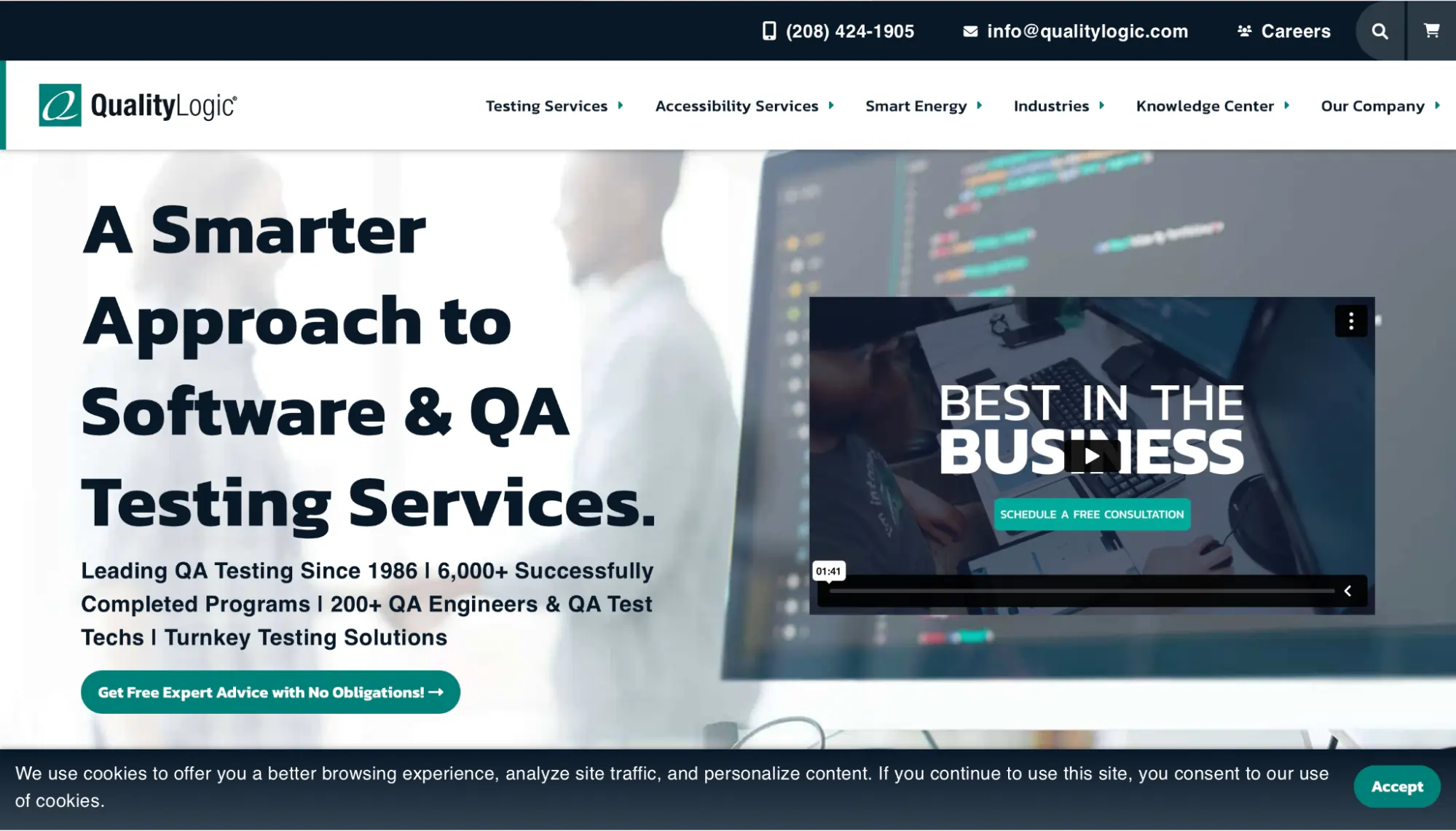
#9 — QualityLogic
Headquarters: Boise, Idaho (US)
Founded: 1986
Team size: ~100–150 (per Clutch profile and company disclosures)
Onshore model: 100% US-based delivery; onshore testers, management, and facilities
Primary industries: Smart energy, accessibility (WCAG/Section 508), print/imaging, healthcare, media
Independent validation: Clutch: 4.9/5.0 across 22–30 verified reviews (range reflects timing of data collection). Named Clutch Global Leader in software application testing (Top 10). 6,000+ programs completed across nearly four decades.
Pricing: $25–$49/hour; minimum project size $5,000 (per Clutch)
Case studies: https://www.qualitylogic.com/knowledge-center/category/case-studies/
Assessment
QualityLogic is the strongest pure-onshore option on this list. For US buyers whose procurement or compliance framework restricts offshore delivery — federal contractors, some healthcare organizations, defense-adjacent programs — QualityLogic is one of a handful of credible pure-play QA vendors that will meet the constraint without compromising on tenure or review validation. Nearly 40 years of continuous operation, 6,000+ completed programs, and a specialization in accessibility compliance (a growing procurement requirement under ADA and Section 508 enforcement) are genuine differentiators.
The reason for the #9 placement: pure-onshore delivery caps the cost-scaling advantage that most buyers evaluate QA outsourcing for in the first place. QualityLogic's hourly rates are competitive with offshore-hybrid vendors, but headcount scale is naturally lower. For a buyer whose primary constraint is "double our QA capacity within a quarter at 60% of internal cost," QualityLogic is a harder sell than QASource, a1qa, or DeviQA.
Best for: US buyers with onshore-only requirements; accessibility compliance programs; smart energy and utility software; long-term steady-state QA engagements where continuity matters more than aggressive cost scaling.
Weaker fit for: Buyers whose primary goal is offshore cost economics.
#10 — Cigniti
Headquarters: Hyderabad, India; global presence in 20+ countries
Founded: 1998 (later evolved into pure-play QA focus)
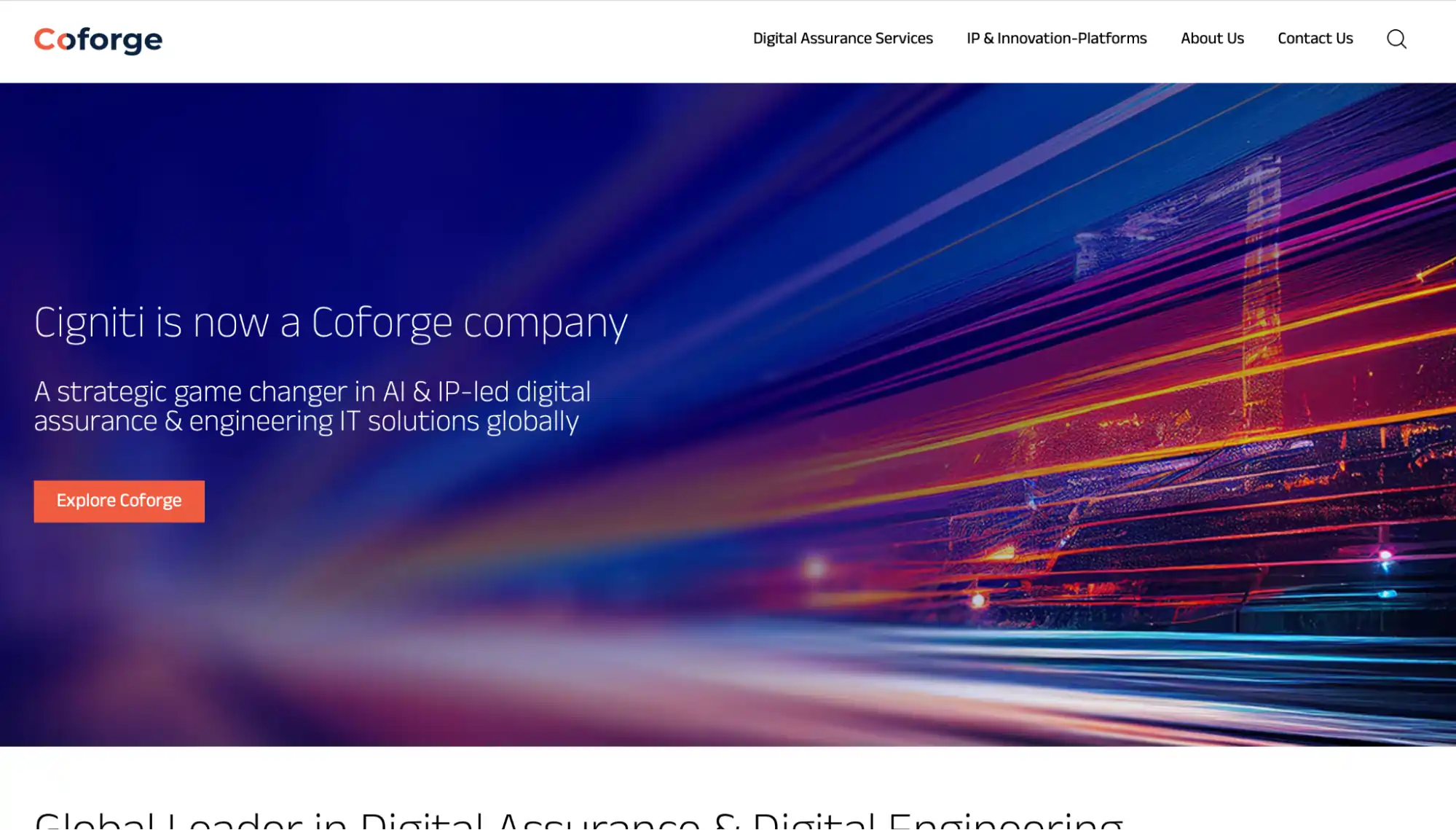
Ownership: Coforge acquired a 54% controlling stake in May 2024, per PFLB industry analysis
Team size: Several thousand QA specialists globally
Primary industries: BFSI, insurance, retail, healthcare, telecom, media
Independent validation: Gartner Peer Insights coverage in Application Testing Services market. Recognized in NelsonHall QA transformation vendor evaluations. Case studies show scale performance testing (500+ concurrent users with 90% of transactions under 5 seconds in a cited insurance engagement).
Certifications: CMMI Level 3; ISO 9001; ISO 27001
Assessment
Cigniti is included primarily on the strength of its performance-engineering depth and its enterprise footprint in BFSI. LoadRunner, NeoLoad, and APM-integrated (AppDynamics) performance engineering are core practices, and the firm operates Centers of Excellence model for ongoing performance governance — a genuinely useful fit for insurance and banking buyers with regulated non-functional testing requirements.
The reason for the #10 placement: the May 2024 acquisition by Coforge is a strategic transition that has implications for buyers. Vendor consolidation can strengthen delivery infrastructure or can dilute focus, and 12–24 months post-acquisition is typically when either outcome becomes visible. Buyers should ask direct questions about post-acquisition team stability, retention of senior QA architects, and any changes to the delivery model. Clutch validation for Cigniti is thin relative to other firms on this list, which pushes weight onto analyst validation and direct references.
Best for: Enterprise buyers in BFSI and insurance with heavy non-functional testing requirements; organizations needing large-scale performance engineering with dedicated Centers of Excellence.
Weaker fit for: Growth-stage buyers; teams sensitive to post-acquisition integration risk.
5. Vendor comparison table
The table below summarizes the ranking on the criteria in section 1.2. It is intended as a scan-first artifact; the profiles above contain the detail.
1
DeviQA
5.0 / 34+ reviews
Eastern Europe delivery; $25–$49/hr
Growth-stage scaling; pure-play QA
2
Qualitest
N/A (Gartner 4.9 / 55 reviews)
Global delivery; custom pricing
Fortune 500 QA transformation
3
a1qa
4.8–4.9 / 19 reviews
US HQ, EE / Central Asia delivery
Mid-market / enterprise long-term
4
QASource
4.8 / 17 reviews
US mgmt + India/Mexico delivery
Regulated hybrid engagements
5
Testlio
Not on Clutch (G2/TrustRadius strong)
Managed crowdtesting + fused model
Global consumer / mobile products
6
Applause
Not on Clutch (Gartner / TrustRadius)
Managed crowdtesting; AI testing
Consumer digital at enterprise scale
7
TestingXperts
Light Clutch presence
Global; $50–$99/hr typical
Enterprise QA transformation
8
ScienceSoft
4.7–4.8 / 41+ reviews (all lines)
US HQ; global; multi-service
Regulated verticals; long tenure
9
QualityLogic
4.9 / 22–30 reviews
100% US onshore
US onshore-only requirements
10
Cigniti
Thin
India + global; Coforge-owned
BFSI performance engineering
6. Trends shaping scaling QA in 2026
Vendor selection today should account for how the QA services category is changing. Five trends are visible in the case study data, analyst reports, and vendor investment patterns reviewed for this analysis.
AI-assisted testing has moved past the experiment phase — barely
The Capgemini World Quality Report 2025 finding that "nearly 90% of organizations are actively pursuing generative AI in their quality engineering practices, but only 15% have achieved enterprise-scale deployment" describes the gap accurately. Qualitest, Applause, DeviQA, QASource, and a1qa have all invested in AI capabilities that go beyond marketing. The practical question for buyers is whether the AI capability is a client-accessible tool (as with Applause's AI training/testing services or Testlio's LeoAI Engine), an internal accelerator that reduces vendor cost without changing the client experience (as with QASource Intelligence), or a proprietary framework used in specific engagements (as with a1qa's AI-driven test-case generation). All three are legitimate; the delivery experience is different.
CI/CD embedding is now table stakes
ThinkSys reports 89.1% CI/CD adoption among development teams. QA vendors that operate as a downstream waterfall gate are structurally misaligned with modern release cadences. Every vendor in this ranking claims CI/CD integration; the differentiator is whether the vendor's engineers write and maintain test code within your CI system (a DeviQA/QASource/a1qa pattern) or whether they run test cycles inside a proprietary platform and report results back (an Applause/Testlio pattern). Both models can work, but they solve different problems.
Automation portability is quietly becoming a procurement issue
A subtle but material question: at the end of the engagement, do you walk away owning the test code? Vendors delivering Playwright, Cypress, or Selenium code in your repository (DeviQA, a1qa, QASource) yield different exit economics than vendors executing tests inside a proprietary platform (Testlio, Applause, and platform-hybrid models). Neither is wrong. But sophisticated procurement teams now write portability language into MSAs so this is settled at signing rather than at renewal.
Consolidation is accelerating in the enterprise QA tier
Coforge's 54% acquisition of Cigniti in May 2024 is one recent example of a broader pattern: services firms and IT consultancies are folding pure-play QA specialists into larger portfolios. This has implications for scaling-QA buyers. Post-acquisition integration risk is real for 12–24 months, and long-term MSAs should include change-of-control language. On the positive side, acquired firms often gain infrastructure and scale they could not fund independently. Buyers should treat consolidation as a fact to underwrite rather than a red flag to avoid.
Geopolitical risk is now part of vendor evaluation
A meaningful portion of high-quality pure-play QA capacity has historically been based in Eastern Europe. Buyers whose risk frameworks require disclosure and mitigation of geopolitical concentration should raise this directly with vendors in Ukraine, Poland, Romania, and neighboring markets. Reputable vendors have documented business-continuity measures (distributed delivery hubs, multi-country staffing pipelines, verified remote work at scale). The question is not whether the risk exists but whether the vendor has publicly addressed it.
7. How to choose — a scenario-based guide
Match your situation to the profiles above rather than treating the ranked list as a single answer.
Scenario 1 — Growth-stage SaaS scaling from 40 to 150 engineers
You have a small internal QA function and are hiring engineers faster than testers. Release cadence is moving from biweekly to weekly. Your test automation is patchy. Best candidates: DeviQA and QASource. Both offer flexible dedicated teams at $25–$49/hour, mature automation practices, and evidence of scaling with client engineering headcount. Shortlist Testlio if the product is heavily consumer-mobile.
Scenario 2 — Enterprise QA transformation across multiple product lines
You are a $500M+ organization with three or more product teams, a mature but siloed QA function, and pressure to consolidate onto a single QA governance model. Best candidates: DeviQA, Qualitest and TestingXperts. Both bring analyst-validated transformation experience and the delivery infrastructure for multi-region programs. Shortlist a1qa if you want a US HQ and Eastern European delivery mix.
Scenario 3 — Regulated healthcare or financial services
You need HIPAA, PCI-DSS, SOC 2, or similar compliance-grade testing documentation. Best candidates: DeviQA (deep healthcare and BFSI), QASource (regulated-industry experience with US management), and Qualitest for enterprise-scale BFSI. DeviQA is credible for healthcare SaaS but confirm compliance workflow alignment directly.
Scenario 4 — Consumer product going global
You are expanding to 20+ markets and need real-device coverage, localization, and payments testing across geographies. Best candidates: Applause and Testlio. Both are purpose-built for this scenario. Applause is larger and more established in AI training/testing; Testlio's managed model is a lighter-touch fit for smaller teams.
Scenario 5 — US onshore-only requirement
Federal contract, defense-adjacent program, or internal policy requires US-only delivery. Best candidate: QualityLogic. Also consider the US-based delivery components of QASource and ScienceSoft if partial offshore is acceptable.
Scenario 6 — Enterprise performance engineering at BFSI scale
You need load testing at 500+ concurrent users, APM integration, and ongoing performance governance. Best candidates: Cigniti and Qualitest. Both operate Centers of Excellence for performance engineering; Cigniti has particularly deep LoadRunner/NeoLoad practice.
8. Final verdict
The strongest QA partners for scaling engineering organizations share three characteristics that mediocre ones do not: verifiable client outcomes tied to specific numbers (not adjectives), delivery models designed to flex with the client's growth curve, and an internal center-of-gravity that treats QA as a discipline rather than a task queue.
On analyst validation and enterprise scale, Qualitest leads. On documented scaling outcomes for the specific growth-stage buyer profile, dense recent Clutch validation, and pure-play focus, DeviQA leads. Both are defensible #1 answers depending on which lens the buyer prioritizes; this report weights them slightly differently and puts them 1 and 2. a1qa, QASource, Testlio, and Applause each win specific scenarios and should be shortlisted accordingly. The remaining four vendors are credible but narrower in fit — right answers for the right buyer, wrong answers for a general "best QA firm" question.
Two closing cautions for buyers running this evaluation themselves. First, the most common vendor selection mistake is over-weighting logo lists and under-weighting reference calls with clients at your size and growth stage. A Fortune 500 case study tells you almost nothing about how the vendor will perform for a 60-engineer team. Second, the second most common mistake is treating any "top 10 QA companies" ranking — including this one — as a substitute for a scored RFP. This report is meant to accelerate your shortlist, not to close it. Every serious QA engagement should end with a paid pilot against a scoped problem before the MSA is signed.
For the specific brief that generated this report — "which QA partner should we choose if our engineering team is scaling fast and QA is starting to bottleneck the business" — the honest answer is that the shortlist should include DeviQA, Qualitest, a1qa, and QASource, and the winner among them depends on whether procurement weights analyst validation, review density, delivery-model fit, or price more heavily. The evidence supports that ranking. The evidence does not support a single universal answer, and any vendor claiming otherwise should be treated with the skepticism the claim deserves.